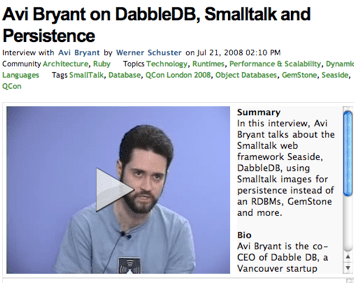

Randal Schwartz and Leo

Don’t miss this fun new video from Randal Schwartz and Leo about Squeak, EToys and OLPC.  Randal builds a very nice car demo.

Seaside Sign Small

From Michael Lucas-Smith:

Hi Everyone,

Just a heads up that Industry Misinterpretations, our Smalltalk podcast, has three podcasts specifically about Seaside coming out over the next week.

Podcast #1: Myself, James Robertson, Tamara Kogan, Martin Kobetic, Arden Thomas

Podcast #2: Myself, James Robertson, Michel Bany, Alan Knight, Arden Thomas

Podcast #3: Myself, James Robertson, The entire Gemstone GLASS team

The podcasts will be appearing here:
http://www.cincomsmalltalk.com/userblogs/cincom/blogView?content=podcasts
You can subscribe to the podcast in iTunes (just search for smalltalk) or with: http://www.cincomsmalltalk.com/rssBlog/blog_podcast.xml
They’ll also be announced on James’s blog:
http://www.cincomsmalltalk.com/blog/blogView

Cheers,
Michael

OLPC on TV

August 20, 2007

OLPC Size

From: Michael Haupt,

The German/Swiss/Austrian TV station 3sat has a weekly 30-minute show called “neues” (roughly translated “new things”) which deals with IT-related information. Yesterday’s show was focusing on bringing IT to isolated regions and emerging nations as well as developing countries. The show featured an article on mesh networks in Ecuador and the Linux4Africa project.

Linux4Africa is a German project collecting old but functional hardware. The components are cleaned, repaired (if necessary), bestowed with an Edubuntu Linux installation, and sent to Tanzania and Moçambique.

12 of the show’s 30 minutes were dedicated to an extensive coverage of the OLPC project. Etoys and Squeak were mentioned several times during the feature. The project itself was introduced, and Bert Freudenberg was interviewed about the technical features of the XO laptop, which was presented in detail.

There were also two interviews in the studio. Two members of GTZ (Deutsche Gesellschaft für Technische Zusammenarbeit; German Society for Technical Cooperation) responsible for XO distribution in Ethiopia talked about the project in general and about the impressive progress children made when working with the XO.

The other interview - which filled the first slot in the OLPC coverage - featured two students from Hasso Plattner Institute, Potsdam, who have developed strategic and skill-improving games for the XO in the Software Architecture Group’s course on software architectures.

All in all, the editorial staff at 3sat did a tremendous job in preparing this show. To the writer’s knowledge, this was the first time the OLPC project was presented at such a level of detail in German television. Germany being a country where the the project has no actual lobby, it is important to have such media coverage - it would be nice to see much, much more of it.

The entire show can be watched online (in German).

Castle

Previously we spoke with Michael Rueger and Steve Hunter. From Michael we found out about the perspective of writing and supporting open source software. From Steve we found out what it is like being a consumer of open source software. Today we talk with Bert Freudenberg. From Bert we hope to learn what it is like being a Smalltalk programmer contributing to open source.

Read the rest of this entry »

Smalltalk window

In our last article we spoke with Michael Rueger.

Today we talk with Steve Hunter. Steve started with OO languages way back in 1985 at General Electric. He used Eiffel, C++, and Objective-C which were the “hot” OO languages at the time. Steve says that he was strongly influenced by Bertrand Meyer’s OO Software Construction Book. His educational background in software/systems analysis and design techniques lead Steve to contribute to the work Object Modeling Technique by GE, and have continued to inspire Steve throughout his career.

Steve’s joined ParcPlace and was impressed by the ease of use and powerful development environment of Smalltalk. Particularly impressive was the VisualWorks debugger, and the cross platform nature of the VM and the dynamic prototyping nature which showed such great potential in market growth.

Steve believed strongly in the benefits of business modeling and saw the merger between Digitalk and ParcPlace as a mismatch of intention between R&D and commercial engineering. In 1995 Steve started Hunter Object Systems and then in 2000 created Agilense. He created EA WebModeler which is a metadata driven modeling solution for Enterprise Architecture and took it to market. Agilense has many very large customers including Sun Microsystems. The most notable component of EA WebModeler for our community is the Squeak based graphical modeler.

I spoke with Steve about EA WebModeler, what it is like depending on Open Source software like Squeak, and more. Read the rest of this entry »

Minding Your Business With Smalltalk
There has been a lot of talk about the future of Smalltalk. There are number of Object Oriented Languages that are candidates for replacing Smalltalk. Why has Smalltalk lasted so long? Why do business software suppliers still choose Smalltalk? Who are the people that still bet on the future of Smalltalk and how do they manage to succeed. Read the rest of this entry »

CIO Insight magazine has published an interview with Smalltalk’s and Squeak’s father, Alan Kay. The interview, titled “Alan Kay: The PC Must Be Revamped—Now”, covers many topics such as the past, present and future of computing, Squeak and Croquet, the OLPC project and the other initiatives of ViewPoints Research Institute, and the need to reinvent the PC in order for computing to leap forward.