

It’s that time again. For more information see this link: ESUG Conference 2015 in Italy.
It’s that time again. For more information see this link: ESUG Conference 2015 in Italy.
https://www.kickstarter.com/projects/1598272670/chip-the-worlds-first-9-computer
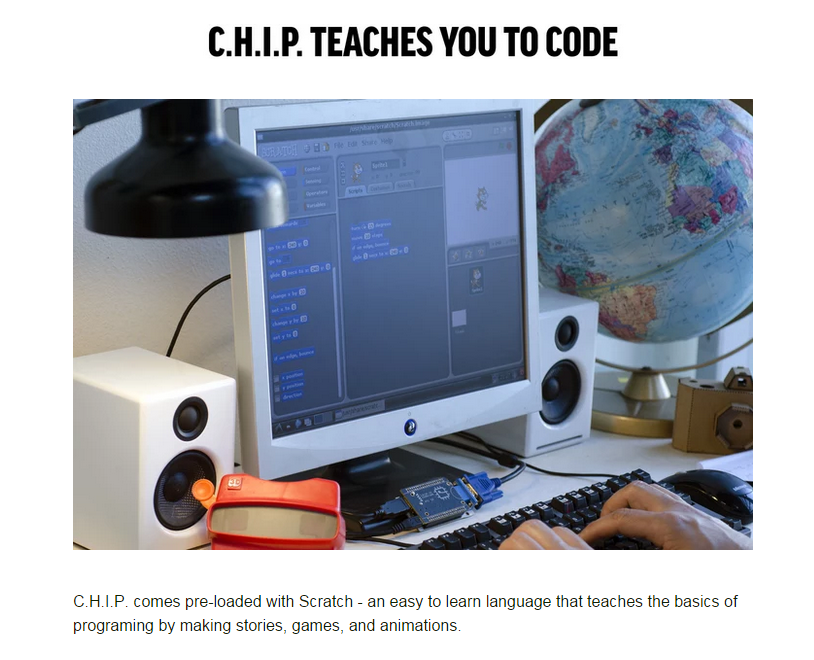
The wildly popular C.H.I.P. comes pre-loaded with Scratch!
Nice play C.H.I.P.!
Please distribute widely

23rd International Smalltalk Joint Conference – Call for Contributions
Brescia, Italy
from 13 to 17 July 2015
http://www.esug.org/Conferences/2015/
This call includes:
Developer Forum
Smalltalk Technology Award
International Workshop
http://www.esug.org/wiki/pier/Conferences/2015/International-Workshop-IWST_15
Student Volunteer
http://www.esug.org/wiki/pier/Conferences/2015/Student-volunteers
Camp Smalltalk 12 July 2015
———————————————————————-
You can support the ESUG conference in many different ways:
* Sponsor the conference. New sponsoring packages are described at
http://www.esug.org/wiki/pier/About/BecomeSponsor
* Submit a talk, a software or a paper to one of the events. See below.
* Attend the conference. We’d like to beat the previous record of
attendance (170 people at Amsterdam 2008)!
* Students can get free registration and hosting if they enrol
into the the Student Volunteers program. See below.
Developers Forum: International Smalltalk Developers Conference
————————————————————————
We are looking for YOUR experience on using Smalltalk. You will have
30 min for presentations and 45-60 min for hand-ons tutorial.
The list of topics for the normal talks and tutorials includes, but is not limited to the following:
* XP practices, Development tools, Experience reports
* Model driven development, Web development, Team management
* Meta-Modeling, Security, New libraries & frameworks
* Educational material, Embedded systems and robotics
* SOA and Web services, Interaction with other programming languages
Teaching Pearls and Show us Your Business
—————————————–
– Show your business 10 min session (Get prepared!!)
– Teaching pearls : we want some session on how to teach some design aspects. We want your tip and tricks to teach Smalltalk or OOP.
We expect to have several 10 to 15 min sessions aggregated.
!! How to submit?
————–
Submissions deadline is 15 of May 2015
Notification of acceptance will be on done on the fly.
More information at http://www.esug.org/conferences/2015
Pay attention: the places are limited so do not wait till the last minute to apply. Prospective presenters should submit a request to Stephane.Ducasse at inria.fr AND USE THE following header [ESUG 2015 Developers].
Please follow the template below the email will be automatically processed!
Subject: [ESUG 2015 Developers] + your name First Name:
Last Name:
Email where you can always be reached:
Title:
Type: Tutorial/Talk/Teaching Pearl
Abstract:
Bio:
Any presentation not respecting this form will be discarded automatically
International Workshop on Smalltalk Technologies
————————————————————————
Read the page: http://www.esug.org/wiki/pier/Conferences/2015/International-Workshop-IWST_15
Technology Award Competition
————————————————————————
The top 3 teams with the most innovative software will receive, respectively, 500 Euros, 300 Euros and 200 Euros during an awards ceremony at the conference. Developers of any Smalltalk-based software are welcome to compete.
More information at http://www.esug.org/conferences/2015/
Student Volunteer Program
————————————————————————
If you are a student wanting to attend ESUG, have you considered being a student volunteer? Student volunteers help keep the conference running smoothly; in return, they have free accommodations, while still having most of the time to enjoy the conference.
More information at
http://www.esug.org/wiki/pier/Conferences/2015/
http://www.esug.org/wiki/pier/Conferences/2015/Student-volunteers
We hope to see you there and have fun together.

From Eliot Miranda:
Hi All,
I’m pleased to say that today the simulator got as far as redrawing the
entire display and finishing the start-up sequence for a bootstrapped
64-bit Spur image. That means it correctly executed over 26 million
bytecodes. So at least a 64-bit Spur Stack VM is not too far off.
—
best,
Eliot
From Masashi-san:
Hi all,
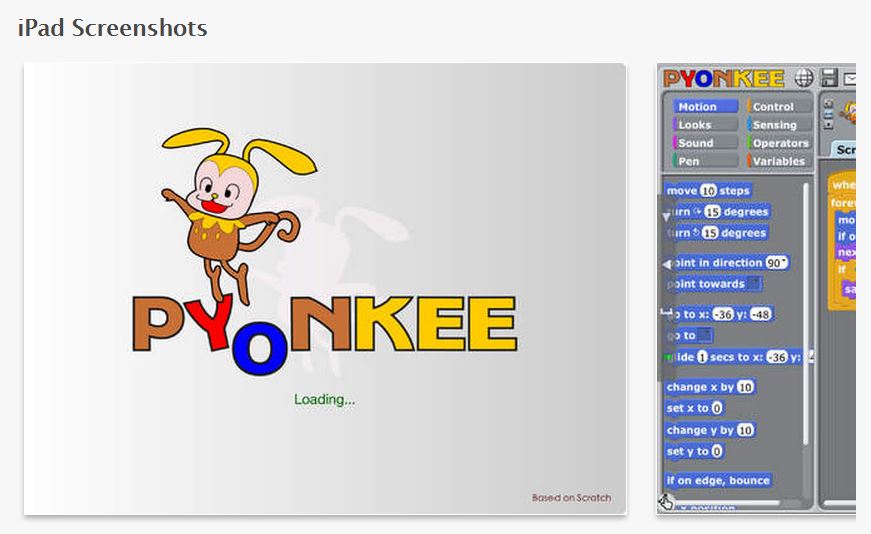
I have just released a Scratch clone running on iPad. It is based on Scratch 1.4 from the MIT Media Laboratory.
The app is now called “Pyonkee” – freely available on App Store.
https://itunes.apple.com/us/app/pyonkee/id905012686
Pyonkee was originally started as a fork of John M McIntosh’s Scratch Viewer.
https://github.com/johnmci/Scratch.app.for.iOS.
While Scratch Viewer just works as a viewer of the existing Scratch projects, Pyonkee supports creation/edit of projects.
Other features:
– User interfaces are optimized for iPad
– Native font support
– Embedded camera support
– IME support
– Auto-saving project
– Sending projects via e-mail
– Project import/export through iTunes (currently disabled)
Moreover, source code is open on github. Feel free to fork it.
https://github.com/SoftUmeYa/Pyonkee
Enjoy!
—
[:masashi | ^umezawa]
From Bert Freudenberg:
Hi all,
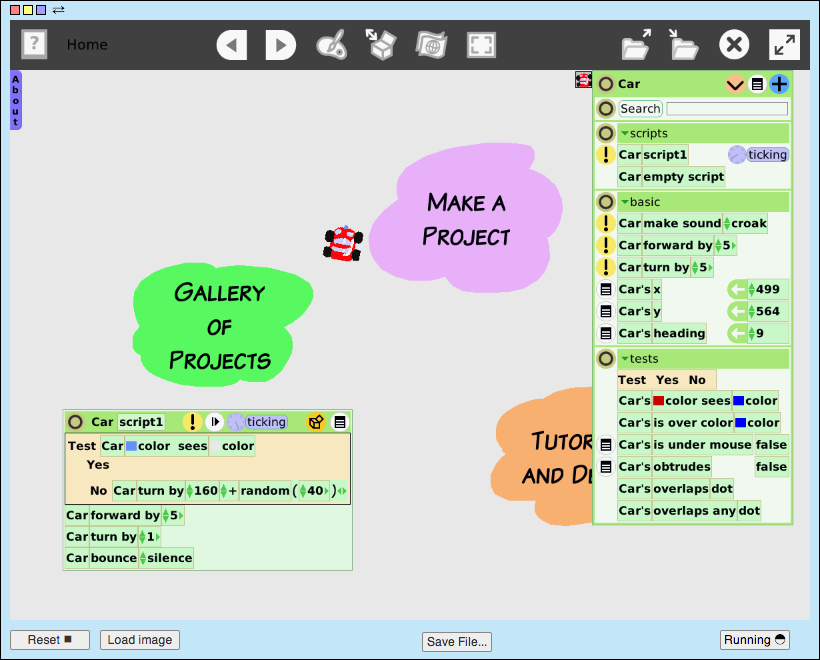
my SqueakJS VM has reached a major milestone. It is now sufficiently complete to run a full Etoys image (and possibly other non-closure images, too). It has support for most BitBlt modes, WarpBlt, even some Balloon2D rendering (for TTF fonts), a virtual file system, image saving etc.
Try it: http://bertfreudenberg.github.io/SqueakJS/etoys/
(Safari and IE are significantly faster than Firefox and Chrome, best is Safari Webkit nightly, works on iPad too, hopefully Android)
For more details, see my blogpost:
http://croquetweak.blogspot.de/2014/07/squeakjs-runs-etoys-now.html
Feedback and contributions welcome 🙂
– Bert –

(baby steps and giant leaps!)
From Eliot Miranda:
Hi All,
it gives me great pleasure to let you know that a spur-format trunk
Squeak image is finally available at
http://www.mirandabanda.org/files/Cog/SpurImages/. Spur VMs are available
at http://www.mirandabanda.org/files/Cog/VM/VM.r2987/.
Spur is a new object representation and garbage collector for
Squeak/Pharo/Croquet/Newspeak.
Features
The object representation is significantly simpler than the existing one,
and hence permits a lot of JIT optimizations, in particular allocating
objects in machine code. This speeds up new, new: et al, but also speeds
up blocks because contexts and closures are now allocated in machine code.
It also provides immediate characters, so for example accessing wide
strings is much faster in Spur, since characters do not have to be
instantiated to represent characters with codes greater than 255.
The garbage collector has a scavenger and a global scan-mark-compact
collector. The scavenger is significantly faster than the existing
pointer-reversal scan-mark-compact, hence GC performance is much improved.
The memory manager manages old space as a sequence of segments, as opposed
to the single contiguous space provided by the existing memory manager.
The memory manager grows the heap a segment at a time, and can and will
release empty segments back to the host OS after a full GC. Hence Spur is
able to grow the heap to the limit of available memory without one having
to specify the VM’s memory size at start-up.
The object representation uses “lazy forwarding” to implement become:,
creating copies of objects that are becommed, and forwarding the existing
objects to the copies. While Spur still scans the stack zone on become to
ensure no forwarding pointers to the receiver exist in stack frames (for
check-free push and store instance variable operations), it does not scan
the entire heap, catching sends to forwarded objects as part of the normal
message send class checks, hence following forwarding pointers lazily, and
eliminating forwarders during GC. The existing memory manager does a full
memory sweep and compact to implement become. Hence Spur provides the
performance advantages of direct pointers while providing a significantly
faster become.
While Spur uses moving GC (scavenging and compaction on full GC), just like
the existing memory manager, Spur supports pinning, the ability to stop an
object from moving. Old space objects will not be moved if pinned.
Attempting to pin a new space object causes a become, forwarding the new
space object to a pinned copy in old space. This allows simpler
interfacing with foreign code through the FFI, since one can hand out
references to pinned objects in the knowledge that they will not be moved
by the GC.
Finally Spur supports ephemerons in a simple and direct way, providing
pre-mortem per-instance finalization. Although the image-level support
needs to be written, it should soon be possible to improve the finalization
of entities such as buffered files (ensuring they are flushed before being
GCed), etc.
Future Work
Spur is as yet a work in progress. The 32-bit implementation is usable and
appears stable. The major missing component is an incremental scan-mark GC
that should eliminate long pauses due to the global scan-mark-compact GC
(which is still invoked at snapshot time). I hope to start on this soon.
But another key facet of Spur is that the object header format and the
sizes of objects are common between 32- and 64-bits. In 32-bit and 64-bit
Spur, object bodies are multiples of 8 bytes, so there may be an unused
slot at the end of a 32-bit object with an odd number of slots. Hence Spur
is close to providing a “true” 64-bit system, one with 61-bit
SmallIntegers, and 61-bit SmallFloats (objects with the same precision, but
less range that 64-bit Float, done by stealing bits from the exponent
field). I look forward to collaborating with Esteban Lorenzano on 64-bit
Spur and hope that it will be available early next year.
Experience
I am of course interested in reports of performance effects. Under
certain, hopefully rare circumstances, Spur may actually be slower (one is
when the number of processes involved in process switching exceeds the
number of stack pages in the stack zone). But my limited experience is
that Spur is significantly faster than the existing VM. Please post
experiences, both positive and negative.
Finally, caveat emptor! This is alpha code. Bugs may result in image
corruption. If you do use Spur, please try and back up your work just in
case. And if anything does go wrong please let me know, preferrably
providing a reproducible case.
Enjoy!
Eliot Miranda
Howdy!
If you want to know some cool history of Smalltalk, and perhaps this is a strong argument in actually *being* a Smalltalk and not trying to distance yourself from that rich and lovely heritage…. anyway, here goes:
On 04/28/2014 08:14 PM, Alain Busser wrote:
> Also, Ruby is famous for these methods:
>
> *select
> *reject
> *collect
>
> do these names not remind you something 😉 ?
There is a funny story about these verbs. Martin McClure told me at ESUG in Brest to ask Dan Ingalls about it, hinting that they are “inspired”
by a famous song.
And thus I did ask Dan in my interview with him I did a few years back over Skype (it is an interesting interview, for example – was there an inspiration from biology when Smalltalk was created?):
http://files.krampe.se/interview.mp3
…the song in question is by Arlo Guthrie:
http://en.wikipedia.org/wiki/Alice%27s_Restaurant_Massacree
…and here is a URL to the lyrics of it:
http://www.lyricsty.com/arlo-guthrie-alices-restaurant-lyrics.html
(search down to “injected”!) …or just let me quote:
“They got a building down New York City, it’s called Whitehall Street, Where you walk in, you get injected, inspected, detected, infected, Neglected and selected. I went down to get my physical examination one Day, and I walked in, I sat down, got good and drunk the night before, so I looked and felt my best when I went in that morning.”
…now… where do we stuff in #neglect:? 🙂
regards, Göran
From Chris Muller:
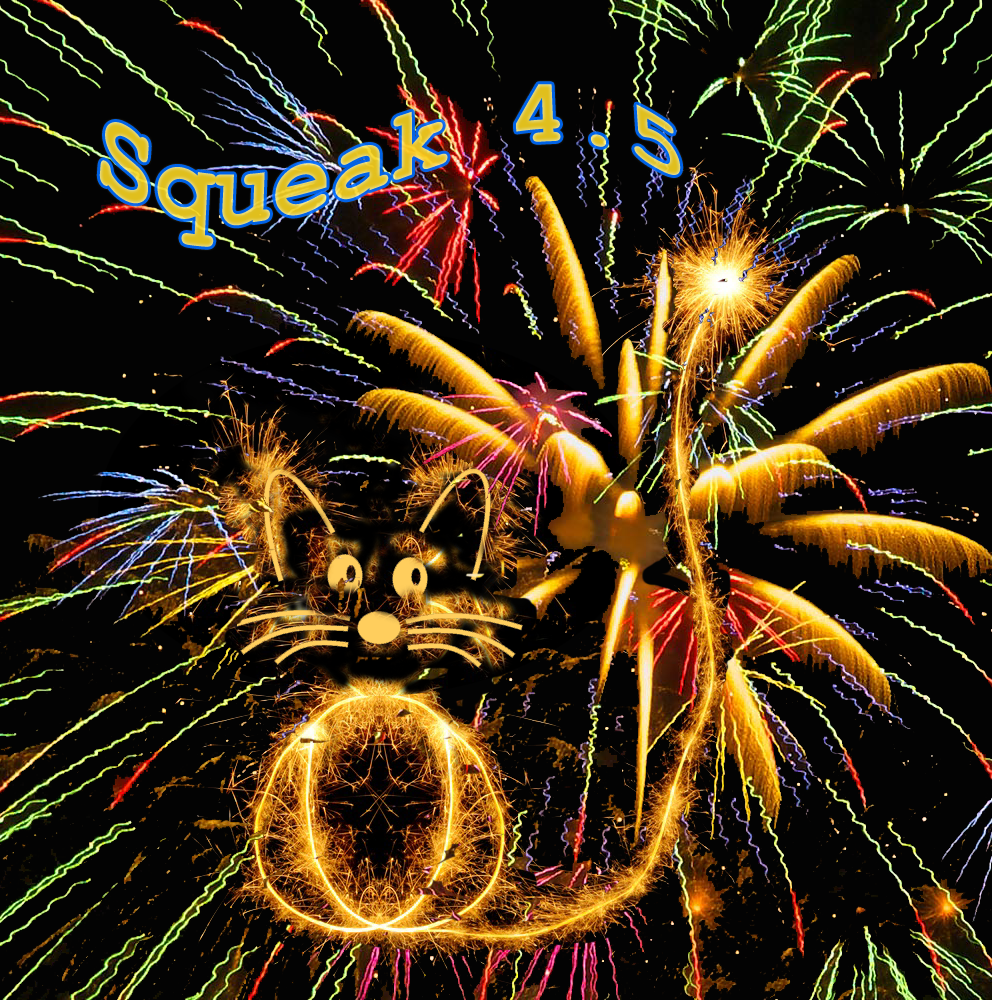
So! Let it be known! Squeak 4.5 is released!
Home page is here: http://www.squeak.org
4.5 release notes are here: http://wiki.squeak.org/squeak/6193
Excellent Job Everyone!! Can you tell we are excited!

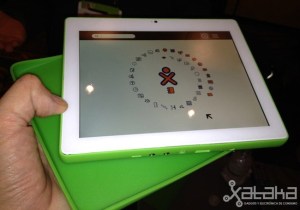
Check out OLPC XO-4.
I would hate to add to the speculation that OLPC is dead because it’s not. Wayan Wota has been calling OLPC dead for 5 years. This is not news. He has not been involved with the project in a long time. His article is about the XO-1, apparently he doesn’t even know the XO-4 was officially introduced at this year’s CES, alongside the tablet.
If you really want to know what’s going on with current OLPC community projects see Adam Holt’s http://www.unleashkids.org/
Full OLPC Statement (from: http://gizmodo.com/one-laptop-per-child-isnt-quite-dead-yet-1541430670):
OLPC’s mission to empower the world’s children through education is far from over. OLPC is thriving and making more inroads at bringing education to those who can’t easily access it. OLPC recently formed a strategic alliance with the Zamora Teran family through many of their enterprises and their philanthropic foundation, the “Fundación Zamora Teran to deliver XO laptops not only to Central and South America, but also to Africa.
Aside from distributing more laptops in several schools in Costa Rica, Uruguay is receiving its first 50k units of the XO-4 Touch (running Android) in a few weeks’ time. In addition, the XO Tablet is currently available directly through governments and NGOs, as well as in Europe and Canada and through all major retail outlets in the United States including Walmart, Amazon, Toys ‘R Us among the others.
OLPC also has outsourced many of the software and development units because the organization is becoming more hardware and OS agnostic, concentrating on its core values – education. As an example, we’ve partnered with the Smithsonian Museum to bring feature-rich, interactive and more targeted content to our young learners.
We have more exciting things planned in the horizon including the implementation of very large scale projects in several regions of the world, so be sure to stay tuned.
OLPC is a concept, it is a movement, it is a community and it is about helping children. Sure the grand vision may be delayed, but the benefits of education and technology, of improving the human condition is not dead. We all knew that it’s not profitable to teach third world children. Still, no one thought that companies would compete against OLPC. Countries opted for different technologies for hardware but never matched the promise or the vision of the software. Had the world united around this platform children would have benefited and the world today would be a better place as we develop together and stamp out ignorance. There is nothing like education to improve the world and that mission is not dead. OLPC is evolving, finding new ways to reach more children, making more with less, and finding ways to make a real difference in the world.
Support OLPC! Long Live the vision.
 The Weekly Squeak