Author: Ron Teitelbaum

  • 16th International Smalltalk Joint Conference *Call for Contributions*

    ESUGWelcome

    ———————————————————————
    16th International Smalltalk Joint Conference – Call for Contributions

    August 25-29, 2008 – Amsterdam, the Netherlands

    http://www.esug.org/conferences/2008/
    ———————————————————————-

    For the past 16 years, the European Smalltalk User Group (ESUG) has organised the International Smalltalk Conference, a lively forum on cutting edge software technologies that attract people from both academia and industry for a whole week. The attendees are both engineers using Smalltalk in business and students and teachers using Smalltalk both for research and didactic purposes.

    As every year, this year’s edition of the largest European Smalltalk event will include the regular Smalltalk developers conference with renowned invited speakers, a Smalltalk camp that proves fruitful for interactions and discussions. Besides, this year will be held the 4th edition of the Innovation Technology Awards where prizes will be awarded to authors of best pieces of Smalltalk-related projects.

    You can support the ESUG conference in many different ways:

    * Sponsor the conference. New sponsoring packages are described at http://www.esug.org/supportesug/becomeasponsor/
    * Submit a talk, a software or a paper to one of the events. See below.
    * Attend the conference. We’d like to beat the previous record of attendance (116 people at Köthen, Germany in 2004)!
    * Students can get free registration and hosting if they enroll into the the Student Volunteers program. See below.

    The conference features the following events:

    * Camp Smalltalk – There will be a Smalltalk camp the 23-24th of august
    * Developers Forum
    * Technology Forum

    Developers Forum : International Smalltalk Developers Conference
    ——————
    This year we are looking for YOUR experience on using Smalltalk. The list of topics includes, but is not limited to the following:

    * XP practices
    * Development tools
    * Experience reports
    * Model driven development
    * Web development
    * Team management
    * Meta-Modeling
    * Security
    * New libraries & frameworks
    * Educational material
    * Embedded systems and robotics
    * SOA and Web services
    * Interaction with other programming languages

    Submissions due on 1st June 2008
    Notification of acceptance on 15 of June 2008 More information at http://www.esug.org/conferences/2008

    How to sumbit?
    ——————
    Pay attention: the places are limited so do not wait till the last minute to apply. Prospective presenters should submit a request to esug-info@esug.org
    following the template below. Please use this template since the email will be automatically processed!

    Subject: [ESUG 2008 Developers] + your name

    First Name:

    Last Name:

    Email where you can always be reached:

    Title:

    Abstract:

    Bio:

    Any presentation not respecting this form will be discarded automatically

    Technology Forum
    ——————
    We are proud to announce the 4th Innovation Technology Awards. The top
    3 teams with the most innovative software will receive, respectively, 500 Euros, 300 Euros and 200 Euros during an awards ceremony at the conference. Developers of any Smalltalk-based software are welcome to compete.
    More information at http://www.esug.org/conferences/2008

    Student Volunteer Program
    ——————
    If you are a student wanting to attend ESUG, have you considered being a student volunteer? Student volunteers help keep the conference running smoothly; in return, they have free accommodations, while still having most of the time to enjoy the conference.
    More information at
    http://www.esug.org/conferences/2008

    Esug Student Volunteers Program

    We hope to see you there and have fun together.

  • The Golight: Tool Support for Test-Driven Development

    SqueakSVNAt the Hasso-Plattner-Institut (HPI) in Potsdam, all Bachelor students have to participate in a software development project in their final year. Said projects are usually issued by industry collaborators, and hence are “real” development tasks that often yield actual products. The different HPI research groups coach the student project groups.

    This year’s Bachelor project of the Software Architecture Group was issued by CollabNet, the company that spawned Subversion. The students are working on SqueakSVN to make SVN version control and tooling available in Squeak.

    Coaching in the Software Architecture Group includes training in agile methodologies, with a strong emphasis on Extreme Programming. Of course, this includes heavy testing.

    The students were facing the question of how to make the current project status perceivable in a motivating way. Ideally, the status should be immediately visible when entering the project room in the morning, without the need to start up a Squeak image and run all the tests first.

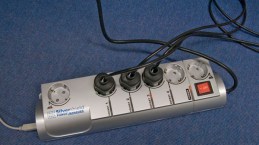
    ampel2They came up with a really nice idea: the “test stoplight”, or, rather, “golight” to make it sound more positive. It’s as simple as this. A wooden board, three red, yellow, and green light bulbs, sockets, power supply lines, and an USB-controlled multiway connector make up the hardware part of the golight.

    Realizing the software part was also easy. One computer plays the role of a dedicated test server, running a Squeak image. In this image, a process checks out the most recent version of the software from the repository every five minutes, runs all the tests, and switches on the light corresponding to the color of the TestRunner bar. At night, it switches the lights off entirely.

    leiste.jpgThe software does not even have to know anything about the protocol used to drive the multiway connector. The connector comes with a set of command-line tools that can be run from Squeak using OSProcess. These are currently limited to the Windows operating system, but since controlling the connector is basically about writing some data to a serial connection, it should not be too hard to come up with solutions for other platforms.

    This morning, when I first saw the golight, it was showing green.

    Feel free to contact us for detailed building instructions and information related to the software!

  • Immersive Education Summit Ad-Hoc Meeting

    Immersive Education Summit

    Well I couldn’t resist. Aaron E. Walsh sent out an invitation to the SqueakCroquet communities for an ad-hoc Immersive Education Meeting. The Boston Digital Summit held in January covered the Education Grid, this meeting was a chance to review this information for those that were not able to make it to the summit.

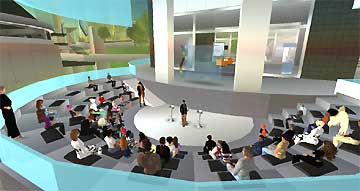
    Second Life was quite an experience. I had to sign up and go through some training, figure out how to get to Sun’s virtual auditorium and sit down. It was quite amusing to see some people show up on stage and not know how to sit down either, so I didn’t feel so bad. Maybe I should have spent more time in the training.

    Aaron, reviewed the details of the Education Grid. The Grid is an education content virtual repository focused on interoperability, standards, and quality educational content. The goal is to provide standards that allow content to be developed to operate in different virtual worlds. These standards must be open source to ensure that content can be made freely available.

    Content is just a piece of the puzzle in education. Educators also need tools to be able to evaluate the progress of students. There are a number of general tools that should be developed and made available in a consistent way for each offering. Aaron mentioned, “While it is possible to record everything that happens in a virtual world there is no way an educator could watch everything a student did in an activity that might take 2 hours.” Tools that allow educators to evaluate raw data, to assess progress and to track grades, and to create content are essential.

    Quality content will be assured by having a Peer Review of offerings before the become part of the grid. The peers will be selected from the community and people with special expertise will be sought to make sure that the education goals are met, the content is accurate, standards are followed, and licensing is compatible to be a part of the grid.

    Licensing and interoperability were the major concerns once Aaron opened the floor to questions. Ownership of the content was also discussed. Aaron mentioned that a not-for-profit organization would own the grid, but that the grid would be virtual and would be hosted by multiple organizations. I’m not sure there was a full answer about the ownership of the content. I would have suggested that copyright stay with the author or developing organization, and that the grid would receive unlimited rights to distribute the content, much in the same way were are trying to organize the Squeak community.

    Well I ran out of time but Aaron did a very nice job of wrapping it up just a few minutes over. Thank you! The concept is really a terrific idea. I hope that our communities will join together and support developing freely available virtual world educational materials. Aaron mentioned that other meetings will be held in Croquet, I look forward to that. I hope to see you there. Hopefully that meeting will be just as well attended as the SL meeting.

  • Learn Smalltalk And See the World!

    Smalltalk See The World 2

    Smalltalk positions around the world! Interested in a Smalltalk Job? Ready to see the world? Check out Noury Bouraqadi’s Smalltalk Jobs and Internship page.

    Dr. Bouraqadi just posted 3 new Jobs in Paris France, for French Speakers.

  • Dynamic Languages Symposium (DLS) 2008 – Call For Papers

    Cern

    Call For Papers

    *** Dynamic Languages Symposium (DLS) 2008 ***

    July 8, 2008 (Tuesday)

    Co-located with ECOOP 2008, Paphos, Cyprus

    Sponsored by ACM SIGPLAN

    http://www.swa.hpi.uni-potsdam.de/dls/dls08/

    ——————————-
    IMPORTANT DATES
    ——————————-
    Submission deadline: April 25, 2008 (hard deadline) Author notification: May 23, 2008 Camera-ready copy due: June 6, 2008 DLS 2008: July 8, 2008

    ——————————-
    ABOUT DLS
    ——————————-
    The Dynamic Languages Symposium (DLS) at ECOOP 2008 in Paphos, Cyprus, is a forum for discussion of dynamic languages, their implementation and application. While mature dynamic languages including Smalltalk, Lisp, Scheme, Self, Prolog, and APL continue to grow and inspire new converts, a new generation of dynamic scripting languages such as Python, Ruby, PHP, Tcl, and JavaScript are successful in a wide range of applications.

    DLS provides a place for researchers and practitioners to come together and share their knowledge, experience, and ideas for future research and development.

    DLS 2008 invites high quality papers reporting original research, innovative contributions or experience related to dynamic languages, their implementation and application. Accepted Papers will be published in the ACM Digital Library.

    ——————————-
    TOPICS OF INTEREST
    ——————————-
    Areas of interest include but are not limited to:

    – Innovative language features and implementation techniques
    – Development and platform support, tools
    – Interesting applications
    – Domain-oriented programming
    – Very late binding, dynamic composition, and runtime adaptation
    – Reflection and meta-programming
    – Software evolution
    – Language symbiosis and multi-paradigm languages
    – Dynamic optimization
    – Hardware support
    – Experience reports and case studies
    – Educational approaches and perspectives
    – Object-oriented, aspect-oriented, and context-oriented programming

    ——————————-
    SUBMISSION GUIDELINES
    ——————————-
    We invite original contributions that neither have been published previously nor are under review by other refereed events or publications. Research papers should describe work that advances the current state of the art. Experience papers should be of broad interest and should describe insights gained from substantive practical applications. The program committee will evaluate each contributed paper based on its relevance, significance, clarity, and originality.

    Papers are to be submitted electronically at http://www.swa.hpi.uni-potsdam.de/dls/dls08/ in PDF format. Submissions must not exceed 12 pages and need to use the ACM format, templates for which can be found at http://www.acm.org/sigs/pubs/proceed/template.html.

    ——————————-
    PROCEEDINGS
    ——————————-
    Accepted Papers will be published in the ACM Digital Library.

    ——————————-
    PROGRAM COMMITTEE
    ——————————-

    Chair: Johan Brichau (Université catholique de Louvain, Belgium)

    Joe Armstrong (Ericsson AB, Sweden) Pierre Cointe (École des Mines de Nantes, France)William R. Cook (University of Texas at Austin, USA) Pascal Costanza (Vrije Universiteit Brussel, Belgium) Wolfgang De Meuter (Vrije Universiteit Brussel, Belgium) Maja D’Hondt (IMEC, Belgium) Robert Hirschfeld (Hasso-Plattner Institüt, Germany) Roberto Ierusalimschy (PUC-Rio, Brazil) Andy Kellens (Vrije Universiteit Brussel, Belgium) Michele Lanza (University of Lugano, Switzerland) Michael Leuschel (University of Düsseldorf, Germany) Oscar Nierstrasz (University of Berne, Switzerland) Kent Pitman (PTC, USA) Lynne Shaw (CheckFree Investment Services, USA) David Ungar (Sun Microsystems, USA) Peter Van Roy (Université catholique de Louvain, Belgium) Martin von Löwis (Hasso-Plattner Institüt, Germany) Daniel Weinreb (ITA Software, USA)

  • Brought to you by ESUG!

    ESUGWelcome

    The European Smalltalk Users Group – ESUG has generously agreed to support international smalltalk presentations.

    From Prof. Stéphane DUCASSE :

    Hi all

    as announced at Lugano ESUG is putting in place new action to promote the use of smalltalk http://www.esug.org/promotionactions/publicationpromotion/

    PublicationPromotion
    ESUG offers 150 Euros for each international conference paper whose concepts involves an implementation in Smalltalk

    Rules
    • After notification of acceptance, one of the authors sends to the ESUG board the article, a CV, and a brief explanation of how Smalltalk was used
    • In case the ESUG board decides to support the promotion, the author has to send to ESUG after the camera-ready deadline a PDF of the article, where ESUG is referenced in the acknowledgment section, including a link to esug.org
    • During the presentation at the conference, the author must mention ESUG support
    • After the presentation at the conference the author sends to ESUG a PDF version of the slides, where there is a visible reference to ESUG (e.g. theESUG Logo). ESUG will put the slides on the ESUG website
    • The author can then trigger the payment by sending an e-Mail to the ESUG board
    • A maximum of 3 supported articles per year per institution is allowed

    Prof. Stéphane DUCASSE [ | ]
    http://stephane.ducasse.free.fr

    Open Source Smalltalks: http://www.squeak.org, http://www.gnu.org/software/smalltalk/smalltalk.html
    Free books for Universities at http://www.esug.org/sponsoring/promotionProgram.html
    Online Free Books at http://stephane.ducasse.free.fr/FreeBooks.html

  • Self-Sustaining Systems *Call for Papers*

    s3
    Workshop on Self-sustaining Systems (S3) 2008
    May 15-16, 2008
    Potsdam, Germany
    http://www.swa.hpi.uni-potsdam.de/s3/

    Call for papers:

    The Workshop on Self-sustaining Systems (S3) is a forum for discussion of topics relating to computer systems and languages that are able to bootstrap, implement, modify, and maintain themselves. One property of these systems is that their implementation is based on small but powerful abstractions; examples include (amongst others) Squeak/Smalltalk, COLA, Klein/Self, PyPy/Python, Rubinius/Ruby, and Lisp. Such systems are the engines of their own replacement, giving researchers and developers great power to experiment with, and explore future directions from within, their own small language kernels.

    S3 will be take place May 15-16, 2008 at the Hasso-Plattner-Institute in Potsdam, Germany. It is an exciting opportunity for researchers and practitioners interested in self-sustaining systems to meet and share their knowledge, experience, and ideas for future research and development.

    — Invited talk:

    Ian Piumarta: Late-bound Object Lambda Architectures (Viewpoints Research Institute, USA)

    — Submissions and proceedings:

    S3 invites submissions of high-quality papers reporting original research, or describing innovative contributions to, or experience with, self-sustaining systems, their implementation, and their application. Papers that depart significantly from established ideas and practices are particularly welcome.

    Submissions must not have been published previously and must not be under review for any another refereed event or publication. The program committee will evaluate each contributed paper based on its relevance, significance, clarity, and originality. Revised papers will be published as post-proceedings in the Springer LNCS series.

    Papers should be submitted electronically via EasyChair at
    http://www.easychair.org/conferences/?conf=s3 in PDF format.
    Submissions must be written in English (the official language of the
    workshop) and must not exceed 20 pages. They should use the LNCS format, templates for which are available at http://www.springer.de/comp/lncs/authors.html.

    — Venue:

    Hasso-Plattner-Institut (Potsdam, Germany)

    — Important dates:

    Submission of papers: February 15, 2008
    Author notification: April 11, 2008
    Revised papers due: April 25, 2008

    S3 workshop: May 15-16, 2008

    Final papers for LNCS post-proceedings due: June 6, 2008

    — Chairs:

    * Robert Hirschfeld (Hasso-Plattner-Institut Potsdam, Germany)
    * Kim Rose (Viewpoints Research Institute, USA)

    — Program committee:

    * Johan Brichau, Universite Catholique de Louvain, Belgium
    * Pascal Costanza, Vrije Universiteit Brussel, Belgium
    * Wolfgang De Meuter, Vrije Universiteit Brussel, Belgium
    * Stephane Ducasse, INRIA Lille, France
    * Michael Haupt, Hasso-Plattner-Institut, Germany
    * Robert Hirschfeld, Hasso-Plattner-Institut, Germany
    * Dan Ingalls, Sun Microsystems Laboratories, USA
    * Martin von Lšwis, Hasso-Plattner-Institut, Germany
    * Hidehiko Masuhara, University of Tokyo, Japan
    * Ian Piumarta, Viewpoints Research Institute, USA
    * David Ungar, IBM, USA

    — Registration fees:

    Early (until April 18, 2008)
    * Regular participants: EUR 160
    * Students: EUR 80

    Late (after April 18, 2008)
    * Regular participants: EUR 170
    * Students: EUR 90

  • Qwaq is Hiring!

    https://i0.wp.com/www.qwaq.com/images/Slide4_60pct.jpg

    We reported earlier that Qwaq received funding, well today Qwaq announced that it is hiring. They are looking for a Software Quality Engineer and a Senior Unix System Administrator. Qwaq builds secure 3d virtual worlds for business collaboration that is written in Squeak and Croquet. It is very exciting to watch this company grow. We will be watching.

  • Lively Kernel, a Self Supporting System on a Web Page

    Babe Ruth

    Don’t Miss Dan Ingalls’ Talk about the Lively Kernel! It’s Squeak on steroids! Ok not steroids (considering everything that going on with baseball), but it is Squeak on JavaScript!

    Details below:

    (more…)