Category: Beginners

  • “Squeak: Learn Programming with Robots” now free!

    Stéphane Ducasse writes that his book “Squeak: Learn Programming with Robots” is now free.

    The book was the result of a collaboration by Stéph with his wife who was a maths and physics teacher in a French school for students aged 11–15, meaning that the book addresses many of the issues that are raised by children when first introduced to programming concepts. It uses a simple environment written in Squeak Smalltalk to allow children to create and manipulate bots.

    The book (also known as the Bots Inc book) was published by Apress in June 2005, and received some very nice testimonials and reviews, with Huw Collingbourne saying that for “a beginning programmer or someone who wants an easy-to-understand entry to the world of ‘real’ object orientation, it would be a real treat.”

    Thanks to financial support from ESUG, Stéph has now been able to buy back the rights to the book in order to release it for free. He is now working to make the book available on his website, and translations are already under way.

    The original book is still available for purchase both as hard copy and for download onto Amazon’s Kindle.

  • New Video Tutorial – Squeak Bug/Fix Reporting

    Ken Causey has added a very useful video to the Squeak Smalltalk group at vimeo.com, in which he demonstrates the entire process of creating and submitting a bug/fix or enhancement for Squeak. Along the way he also explains how to track down simple bugs, how to manage changesets, and how to navigate your way around the Mantis bug tracking system.

  • Get recording your Squeak videos now!

    The Squeak mailing lists have recently seen a surge of interest in getting videos published to help explain Squeak and Smalltalk to developers coming to the language and environment for the first time.

    In response to this Randal L. Schwartz has set up a new Squeak Smalltalk group on vimeo.com to allow Squeakers to easily upload and share their videos.

    Videos can be a great way to help people quickly pick up a lot of complex information, which makes this an opportunity for Squeakers old and new to help promote Squeak. If there are any topics that you think would suit a short video, why not try recording one and publishing it? If you’re the developer of a powerful Squeak developer tool, and you’re amazed that no-one seems to use all of its functionality, this would be a great way to expose all of those features in a compelling way.

    If you’re a new developer struggling with Squeak, let us know what topics you’d like to see covered in video tutorials. If you’ve got any recommendations for recording and editing software for Windows, Mac or Linux, please leave a comment.

  • Squeak by Example now available in French

    Squeak by Example has been a hugely successful introduction to Squeak since its publication last year, and it has now been made available to a wider audience, following the publication of a French edition Squeak par l’exemple. As with the English edition, the book has been made available in print from print-on-demand specialists lulu.com for around €17/$20/£11, or can be downloaded from the site as a pdf.

    Squeak par l’exemple was produced thanks to the hard work of the team of translators: Martial Boniou, Mathieu Chappuis, Luc Fabresse, René Mages, Nicolas Petton, Alain Plantec, Benoît Tuduri and Serge Stinckwich.

  • “An Introduction to Seaside” now published

    Michael Perscheid announced in the Seaside mailing list the publication of a new Seaside book An Introduction to Seaside. He says that:

    “This book explains the major concepts of Seaside in a clear and intuitive style. A working example of a ToDo List application is developed to illustrate the framework’s important concepts that build upon each other in an orderly progression. Besides the notions of users, tasks, components, forms and deployment, additional topics such as persistence, Ajax and Magritte are also discussed.”

    The book is based on the online tutorial developed at the Hasso-Plattner Institut, and the content has been revised and expanded for this edition.

    The 212-page book can be previewed and ordered at online publisher lulu.com for about €20/£14/$25.

    Congratulations to all involved at the HPI Software Architecture Group for producing this great introduction to Seaside. They are: David Tibbe, Michael Perscheid, Martin Beck, Stefan Berger, Jeff Eastman, Michael Haupt, Robert Hirschfeld and Peter Osburg.

  • Waveplace in the US Virgin Islands

    WavePlace

    WavePlace 2

    Hi everyone,
    We’ve just posted two new videos from the St John Waveplace pilot, which concluded three weeks ago. The first shows mentoring during the pilot. The second shows students presenting their Etoys storybooks.
    1) Scenes from the St John pilot (4 minutes)
    2) The St John Storybook Awards (8 minutes)
    We will be posting the actual storybooks to our website soon so you can see them for yourself.
    In other news, the Haiti pilot will resume next week, since things have calmed down in Port-Au-Prince. The kids and teachers are well.
    As always, if you’d like to hear more from us, please subscribe to our newsletter or donate money on our website to help with our courseware and pilots.
    Take care,
    Tim
    Timothy Falconer
    Waveplace Foundation
    610-797-3100
  • Squeak by Example, 2.0!

    Squeak By Example

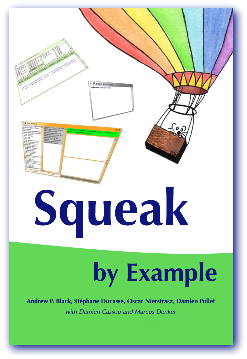
    Stéphane Ducasse has just announced that the second edition of Squeak By Example has just been published. It is available for download from the Squeak By Example website, or if you prefer paper to phosphors, you can order a hard copy from print-on-demand publishers lulu.com for only €16.18/$20.10/£11.07.

    Licensed under the creative commons by-sa licence, the first edition was a great success, with over 20,000 downloads in less than six months. For the second edition, the authors Oscar Nierstrasz, Stéphane Ducasse, Damien Pollet and Andrew P. Black, have reviewed and revised the contents based on feedback from readers.

    At over 300 pages, the book is an excellent introduction to developing in Squeak, and the overall organization and choice of topics makes it a great reference work.

  • Randal Schwartz Talks With Leo about Squeak, EToys and OLPC

    Randal Schwartz and Leo

    Don’t miss this fun new video from Randal Schwartz and Leo about Squeak, EToys and OLPC.  Randal builds a very nice car demo.

  • The Golight: Tool Support for Test-Driven Development

    SqueakSVNAt the Hasso-Plattner-Institut (HPI) in Potsdam, all Bachelor students have to participate in a software development project in their final year. Said projects are usually issued by industry collaborators, and hence are “real” development tasks that often yield actual products. The different HPI research groups coach the student project groups.

    This year’s Bachelor project of the Software Architecture Group was issued by CollabNet, the company that spawned Subversion. The students are working on SqueakSVN to make SVN version control and tooling available in Squeak.

    Coaching in the Software Architecture Group includes training in agile methodologies, with a strong emphasis on Extreme Programming. Of course, this includes heavy testing.

    The students were facing the question of how to make the current project status perceivable in a motivating way. Ideally, the status should be immediately visible when entering the project room in the morning, without the need to start up a Squeak image and run all the tests first.

    ampel2They came up with a really nice idea: the “test stoplight”, or, rather, “golight” to make it sound more positive. It’s as simple as this. A wooden board, three red, yellow, and green light bulbs, sockets, power supply lines, and an USB-controlled multiway connector make up the hardware part of the golight.

    Realizing the software part was also easy. One computer plays the role of a dedicated test server, running a Squeak image. In this image, a process checks out the most recent version of the software from the repository every five minutes, runs all the tests, and switches on the light corresponding to the color of the TestRunner bar. At night, it switches the lights off entirely.
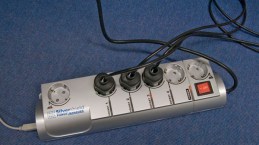
    leiste.jpgThe software does not even have to know anything about the protocol used to drive the multiway connector. The connector comes with a set of command-line tools that can be run from Squeak using OSProcess. These are currently limited to the Windows operating system, but since controlling the connector is basically about writing some data to a serial connection, it should not be too hard to come up with solutions for other platforms.

    This morning, when I first saw the golight, it was showing green.

    Feel free to contact us for detailed building instructions and information related to the software!