This month marks 29 years since the birth of Squeak Smalltalk. That is nearly three decades of exploration, invention, and collaboration – all made possible by the ambition and generosity of those who have shaped Squeak over the years.
On this occasion, it is fitting to pause and give thanks:
To those who, in the early years, had the vision and energy to create something enduring.
To those who continue to share insights and encouragement, answer questions, and work to resolve difficult issues on the mailing lists, sustaining collaboration and shared purpose.
To the programmers who work tirelessly on the system and the virtual machine, ensuring that Squeak remains robust, modern, and ready for the challenges ahead.
To the maintainers who incorporate patches and merges, smoothing the flow of progress and keeping the platform healthy.
To the unsung heroes who support the infrastructure, making sure our tools and resources are available and reliable.
To the academic community at large who continues to explore, teach, and contribute to Squeak.
To those who provide financial support, helping sustain the project and its infrastructure.
And to everyone else not mentioned in this brief list.
Each contribution, whether large or small, has helped Squeak remain vibrant and resilient – a system that is both a playground for ideas and a platform for serious development.
As we look forward to the next year, let this anniversary be a moment of encouragement. There is always more to explore, more to refine, and more to create together. Your help makes a difference and keeps Squeak a programming system that is a joy to use, where everything is available to see, understand, modify, and extend for any purpose. With 30 just around the corner, now is a good time to reflect that you make a difference, and that Squeak would not continue without the efforts of its community.
Here’s to another year of invention, collaboration, and joy with Smalltalk and Squeaking!
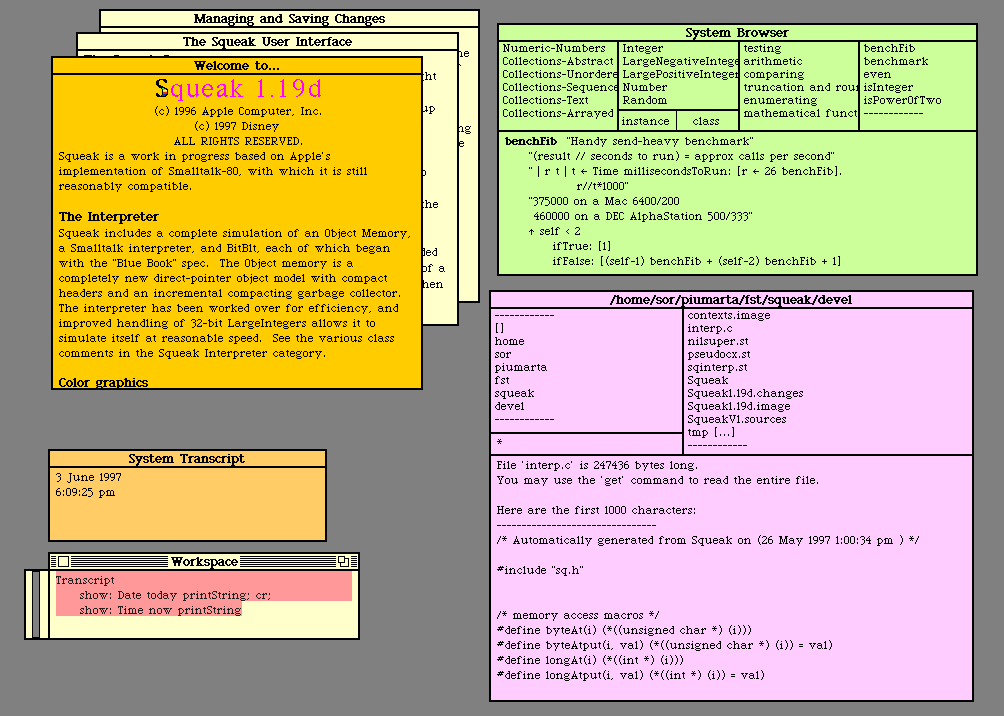
It was 28 years ago today when an email (Swiki copy here) was sent to comp.lang.smalltalk by Dan Ingalls with the subject “Squeak – A Usable Smalltalk Written in Itself,” marking the first announcement of Squeak to the world. In his email, Dan announced the release of Squeak with the intent to promote collaboration with academia and industry. Squeak began on a reconditioned Smalltalk-80 system from Apple’s ST-80. Notably, the implementation was written almost entirely in Smalltalk. Beginning with the Blue Book spec, a 32-bit direct pointer Object Memory and incremental garbage collection was added. Additionally it included a color BitBlt, a portable file system, and basic support for polyphonic music synthesis. Contributions were welcome, and the rest, well, is ongoing history.
We would like to acknowledge the invaluable contributions of all who have supported the project. In celebration of this milestone, we reached out to several current contributors, who then also shared this request with others to gather their thoughts on this occasion.
Alan Kay, for this celebration, emphasized several noteworthy contributions that the creation of Squeak and the achievements made for it brought to the community, which he believed deserved recognition. The highlighted contributions were:
Self-Bootstrapped – One of the most remarkable features was Squeak’s bootstrapping process, which allowed the environment to be constructed and run entirely on its own code. This self-hosting capability not only facilitated rapid development but also ensured flexibility and adaptability without reliance on external systems.
Freed from Xerox Ownership – The transition from Xerox ownership to independence was made possible by a special arrangement for the original developers of Smalltalk-80. This agreement enabled them to retain rights and forge a new path for the language, ultimately leading to the creation of Squeak. The developers were determined to continue the Smalltalk tradition while expanding its capabilities.
MIT Licensing – An important moment for Squeak came when design expert Don Norman helped secure a licensing deal that positioned Squeak under the MIT License. This permissive license encouraged a broad community of developers to contribute and collaborate, making Squeak accessible for educational and commercial purposes alike.
Rapid Multi-Platform Deployment – The combination of its innovative bootstrapping approach and strong community support allowed Squeak to achieve impressive cross-platform compatibility. Within just a few months of its initial release, Squeak was operational on all major operating systems, including macOS, Windows, and various Unix distributions. This rapid deployment not only expanded its user base but also solidified its status as a versatile tool for developers and educators.
We extend our heartfelt gratitude to Alan Kay for highlighting these significant achievements of Squeak and recognizing everyone who played a role in its development.
Göran Krampe – “I haven’t used Squeak or Smalltalk for many years. But I fondly remember the time I was heavily involved in the Squeak community, it was fun and warm and I got to know a lot of very sharp and interesting people. I got smitten by Smalltalk around 1993 when I studied Computer Science at KTH in Stockholm. I still consider Smalltalk to be my ‘home language’ which I feel the most at ease in. Eventually I got interested in other languages like Nim and Dart and I ended up trying to implement a simple Smalltalk-like language myself. Last time I really worked with Squeak I worked together with Ron Teitelbaum on the system called Teleplace (renamed many times!) originating from the Croquet project.
“Now, looking at the programming future and daring to make some observations or predictions, there are some obvious trends I think I see…there are so many different areas of software development where Smalltalk still can have an edge, for example in complicated simulation or interactive data exploration scenarios. I think that is where interesting options can be found…Squeak and Smalltalk with the image model and the highly flexible and malleable development environment has a great opportunity right now in tapping into AI…if I would be looking at improving the Squeak development environment – this is clearly where I would put the effort. The programming landscape is changing…I am very sure programming will not look the same in 5 years time. It is already happening.”
Chris Muller – “The rise of cloud app’s made our lives ‘easier,’ but also married us to their limitations. As dependence on them grows, so does the importance of having access to open Personal Computing. ‘Personal,’ meaning an unfettered interaction between an individual and their computer. No sign-ups. No subscriptions. No data-collections. Just a computer, executable, open canvas, and human imagination. Beautiful. Happy 28th!”
Marcel Taeumel – “Happy birthday to the Squeak project! As we celebrate this milestone, I want to express my appreciation for its commitment to backwards compatibility and modularity, which ensures extensibility and readability. Over the past decade of using Squeak for teaching and research in object-oriented design, I have come to value its powerful tools for exploration and debugging. Looking ahead, I envision meaningful improvements that respect and build upon the content we have created. Smalltalk is a beautiful language, and Squeak enables us to learn and grow in ways that truly enhance our productivity. Here is to many more years of success for Squeak and its community!”
Ron Teitelbaum – “I joined the community 19 years ago. It seems like only yesterday. In so many ways the community has changed but in many essential ways it has stayed the same. In that time we relicensed Squeak, went through a few major splits, with Eliot Miranda we helped to develop the new VM and support for ARM, helped push forward Cryptography, and with Ronie Salgado helped to contribute to 3d graphics. We have lost some amazing Squeak people. We also gained some very talented developers that have stepped up in amazing ways to help keep the community functioning. I’d like to say a big thank you to all of you that contribute in so many ways to keeping Squeak alive. It has been amazing. Feels like there is so much more we could do! Happy Birthday Squeak!”
Feel free to share your thoughts or wishes in the comments below!
José L. Redrejo Rodríguez has announced that the Squeak VM is now officially included in the Debian distribution. This reflects the acceptance of the Debian administrators of the completion of the migration of the VM code from the old Apple licence to the MIT licence, (meaning that this page now needs updating). The package should be appearing in the mirrors in short order, see the changelog notice for more details.
There’s still work to do in removing or re-licensing the remaining legacy code in the images, but this is an important step forward in the recognition of Squeak as Free software.




 The Weekly Squeak