Category: Video

  • New Screencasts on DrGeoII

    Hilaire Fernandes has announced that he has created over 50 screencasts illustrating the capabilities of DrGeoII. DrGeoII allows students at primary or secondary level to create and interactively manipulate geometric figures within definable constraints.

    It is written using Morphic in Squeak Smalltalk, and can be embedded and mixed with existing Morph elements of the Squeak environment on the OLPC XO to produce some very impressive-looking activities to help students learn about mathematics and physics. The DrGeo wiki has lots of useful advice on how to get the best from the application.

    Development of Dr. Geo II was partly sponsored by TOP, the Taiwan Open Source Project, with funding from the Taiwan Ministry of Economy, and by ESUG to promote the Smalltalk language.

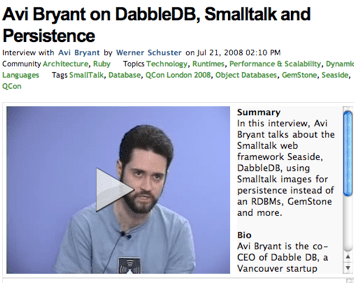
  • Avi Bryant Interview

    Werner Schuster from InfoQ.com spent some time talking to Avi Bryant at QCon London 2008, and InfoQ have posted a recording of their conversation. In the interview, Avi talks about the Smalltalk web framework Seaside, DabbleDB, using Smalltalk images for persistence instead of an RDBMs, GemStone and more.

  • Get recording your Squeak videos now!

    The Squeak mailing lists have recently seen a surge of interest in getting videos published to help explain Squeak and Smalltalk to developers coming to the language and environment for the first time.

    In response to this Randal L. Schwartz has set up a new Squeak Smalltalk group on vimeo.com to allow Squeakers to easily upload and share their videos.

    Videos can be a great way to help people quickly pick up a lot of complex information, which makes this an opportunity for Squeakers old and new to help promote Squeak. If there are any topics that you think would suit a short video, why not try recording one and publishing it? If you’re the developer of a powerful Squeak developer tool, and you’re amazed that no-one seems to use all of its functionality, this would be a great way to expose all of those features in a compelling way.

    If you’re a new developer struggling with Squeak, let us know what topics you’d like to see covered in video tutorials. If you’ve got any recommendations for recording and editing software for Windows, Mac or Linux, please leave a comment.

  • Seaside: your next web framework

    Randal L. Schwartz had a “standing-room only” audience at BarCampPortland for his presentation on why web developers should consider using the Seaside web application framework. BarCampPortland is described as an “unconference for the Portland [Oregon] tech community”, and aims to offer the attendees interesting topics, cool people and great networking opportunities.

    Randal was offered a 45-minute slot, and took the opportunity to explain what makes Seaside such a powerful framework for professional web developers. His material, which incorporated feedback from colleagues on the Seaside mailing list, was very well received, and will form the basis for future presentations by Randal to raise the awareness of Seaside in the web development community.

  • New Dabble DB Demo Debuts

    Avi Bryant writes at the Dabble DB blog that the team has produced a new 8-minute demo of their product in action. This new video replaces their 2006 video which was linked to so frequently that it still shows up as #4 in the google results for “the demo“.

    Dabble DB is a tool to help you create, manage, interpret and present data via your browser. Written in Squeak using the Seaside web application framework, it has received glowing reviews since its launch in 2005.

  • Dan Ingalls demos Lively at Google

    Dan Ingalls gave an interesting Tech Talk on the Lively kernel (best viewed in Safari 3 apparently) at Google a few weeks ago – what better way to (re)introduce our new board member?

  • Randal Schwartz Talks With Leo about Squeak, EToys and OLPC

    Randal Schwartz and Leo

    Don’t miss this fun new video from Randal Schwartz and Leo about Squeak, EToys and OLPC.  Randal builds a very nice car demo.

  • International Squeak Live Video Conference Between Nepal and Japan

    Nepal and Japan

    Hi Squeakers,
    Enclosed kindly find the information about International Squeak Live Video Conference in Nepal and Japan to be held Feb 28, 2008.  If you are interested to contribute or participate, you are most welcome.

    Best regards,
    Yogesh Shrestha

    International Squeak Live Video Conference (pdf)

  • Demand OLPC

    Non-Universal Learning

    As they roll off the production line demand for the little education laptop is growing. The OLPC project, created by Nicholas Negroponte, to help teach the worlds children is starting to gain real traction. It sure didn’t take long to run through the first production run! The Give 1 Get 1 program appears to have been a big success. The program was extended through the end of 2007. Don’t wait get yours now!

    Over the weekend Peru pushed the demand over the first run ordering 260,000 laptops. We are very happy that the huge potential is being recognized. The stories and pictures of the children around the world receiving their laptops are terrific.

    We like to speculate about the benefits that these computers will bring to a world with such limited resources. How will these tools help to enhance the ability of teachers, provide access to materials and resources that help children learn, and eventually eliminate poverty in our world?

    It is easy to get the wrong idea about what this computer is, just as it is easy to get the wrong idea of the benefit of the internet. There is so much of the internet that is not good for children. The explosion of new social media has many people asking if letting children on the internet at all is even a good idea. It is true that delivering access to basic software and the internet is of little value and could even be considered harmful. If the OLPC project was about delivering laptops there would really be no good reason to support it.

    OLPC is not laptops, it’s software. It’s Squeak and EToys. It’s communications and collaboration. It’s coordination of lesson plans between teachers and with students. This is no regular computer, it’s an education platform geared to enhance the abilities of teachers to teach. To extend the reach of real educators, to provide a common platform so that the worlds brightest minds can reach across the great north-south divide and help teach children that have so little resources. It is a way to share the greatest discoveries of the past with the children of the future. There is no better way to fight violence and poverty than with education.

    Children around the world will benefit from the extraordinary efforts of all the volunteers and participants in this very worthwhile project. Children that may even be in your own back yard. Like maybe Birmingham Alabama in the U.S.A. where the city just ordered 15,000 laptops for every child in grade 1 through 8.

    It appears the questions about success are beginning to fade. The real question is can production keep up with demand. Demand OLPC today. There is no substitute for the little education laptop.