Category: OLPC

  • If you can’t take the HEAT!

    Taking the heat

    You know what they say, “If you can’t take the heat, get out of the laptop for the worlds children business!” Pictured above is the OLPC computer running day and night (look closely and notice the Squeak E-Toys running) at scorching temperatures 52C (125F) during the day time and 22C (72F) at night. Just image running your computer laptop in an oven all day!

  • Sophie-Croquet?

    Sophie-Croquet

    By Daniel Lanovaz

    I’m ready! Sophie, Croquet, Seaside, Scratch, Plopp, OLPC … The Era of Squeak and Smalltalk is upon us!

  • Minding Your Business With Smalltalk (Part 3 of 4)

    Castle

    Previously we spoke with Michael Rueger and Steve Hunter. From Michael we found out about the perspective of writing and supporting open source software. From Steve we found out what it is like being a consumer of open source software. Today we talk with Bert Freudenberg. From Bert we hope to learn what it is like being a Smalltalk programmer contributing to open source.

    (more…)

  • Scratch Unleashes New Projects Web Site

    Scratch
    Creating from Scratch
    New Software from MIT Media Lab

    Unleashes Kids’ Creativity Online

    A new programming language developed at the MIT Media Lab turns kids from media consumers into media producers, enabling them to create their own interactive stories, games, music, and animation for the Web.

    With this new software, called Scratch, kids can program interactive creations by simply snapping together graphical blocks, much like LEGO® bricks, without any of the obscure punctuation and syntax of traditional programming languages. Kids can then share their interactive stories and games on the Web, the same way they share videos on YouTube, engaging with other kids in an online community that provides inspiration and feedback.
    Scratch To Web
    “Until now, only expert programmers could make interactive creations for the Web. Scratch opens the gates for everyone,” says Mitchel Resnick, Professor of Learning Research at the MIT Media Lab and head of the Scratch development team.

    Resnick’s Lifelong Kindergarten research group previously developed the “programmable bricks” that inspired the award-winning LEGO® MINDSTORMS® robotics kits. Just as MINDSTORMS allows kids to control LEGO creations in the physical world, Scratch allows them to control media-rich creations on the Web.

    “As kids work on Scratch projects, they learn to think creatively and solve problems systematically – skills that are critical to success in the 21st century,” says Resnick.
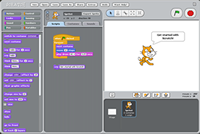
    ScratchScreen

    Designed for ages 8 and up, Scratch is available by free download from the Scratch website (http://scratch.mit.edu). The software runs on both PCs and Macs. The MIT Media Lab is now collaborating with other organizations – including Intel, Microsoft, Samsung, BT, the LEGO Group, Motorola, and One Laptop Per Child (OLPC) – to create other versions and applications of Scratch, including versions for mobile phones.

    The name Scratch comes from the technique used by hip-hop disc jockeys, who spin vinyl records to mix music clips together in creative ways. Similarly, Scratch lets kids mix together a wide variety of media: graphics, photos, music, and sounds.

    A glance at the Scratch website (http://scratch.mit.edu) reveals a kaleidoscope of projects created by kids: a story about a polar bear school, space attack games, and a break-dancing performance. Some creations are goofy and fun; some reveal serious social themes. Kids are constantly modifying and extending one another’s projects on the website – and learning from one another in the process. “It’s exciting to wake up each morning and see what’s new on the site,” said Resnick.


    Scratch was developed by Resnick’s Lifelong Kindergarten research group in collaboration with UCLA educational researchers, with financial support from the National Science Foundation and the Intel Foundation. Throughout the development process, the design team received feedback from children and teens at Intel Computer Clubhouses and school classrooms.

    “There is a buzz in the room when the kids get going on Scratch projects,” says Karen Randall, a teacher at the Expo Elementary School in St. Paul, Minnesota. “Students set design goals for their projects and problem-solve to fix program bugs. They collaborate, cooperate, co-teach. They appreciate the power that Scratch gives them to create their own versions of games and animations.”

    For more information, see http://scratch.mit.edu/about

    LifeLongKindergarten - Mit Media Lab

    The Lifelong Kindergarten group (http://llk.media.mit.edu) at the MIT Media Lab develops new technologies that, in the spirit of the blocks and finger paint of kindergarten, expand the range of what people can design, create, and learn.

    ©2007 MIT Media Laboratory

    LEGO and MINDSTORMS are trademarks of the LEGO Group.

    Used here with special permission. ©2007 The LEGO Group.

    National Science Foundation

    The development of Scratch was supported by the National Science Foundation under grant number 0325828. Any opinions, findings, conclusions, or recommendations expressed in this release are those of the authors and do not necessarily reflect the views of the National Science Foundation.

  • Don’t Miss Smalltalk Solutions – April 30th – May 2nd 2007

    Smalltalk Solutions is this weekend! There will be a number of talks on Seaside. Check out the presentation listing in DabbleDB (which is written using Seaside). Gemstone will be talking about their work porting Seaside and Monticello to Gemstone and are announcing a free version of Gemstone.

    Carl Gundel announced a Seaside Birds of Feather Session Wednesday May 2nd from 5 to 7pm.

    Don’t miss Boris Popov’s Seaside Experience Report. Boris and DeepCove Labs have done some really excellent work! Check it out.

    Don’t Miss Bert Freudenberg’s Keynote presentation about OLPC! The One Laptop Per Child initiative is a wonderful way for all smalltalkers to get involved and contribute to something that is really worthwhile!

  • Help improving the Smalltalk experience on the OLPC machine

    As you may now, the XO laptops produced by the One Laptop Per Child project include a Squeak/Etoys image in the base software. The OLPC developers decided to hide the Smalltalk development enviroment and highlight the Etoys subsystem, since that’s the part that matters in a kids machine such as the XO.

    But the power of a full-fledged Smalltalk system is still there, and you can help. As Bert Freudenberg writes to the Squeak Beginners mailing list:

    So everybody interested in making the “Smalltalk experience” on the OLPC machine an enjoyable one, please help. The VPRI group focuses on etoys and system integration, but you are invited to contribute. And, in case this has not been clear, you do *not* need an OLPC prototype to run this. It’s Squeak, after all.

    More info on how to run the OLPC version of Squeak and Etoys on your system may be found here.

    Update: changed a misleading statement.

  • OLPC for ME?

    OLPC

    Don’t say you didn’t see this coming. The question now: Is there a world wide market for OLPC? Quanta announced plans to market the OLPC computer worldwide for $200. It doesn’t take long to realize that the argument for less is more has legs. I found myself nodding in agreement listening to Nicholas Negroponte talk about feature creep; having overly bloated software that takes forever to load, uses up a huge amount of resources but only provides marginal improvement from the same software that was available years ago. I’m not sure I’ve gained much from this insight, because now I feel the pain even more acutely when I open a pdf file!

    I remember my first LARGE hard drive. It was big in physical size and capacity. It was 40 megs! (it had to be partitioned to 2 20meg drives because the computer couldn’t address more then 20megs). I saw a 4 gig card the other day that was the size of a postage stamp. The amount of memory available today is astounding, a bit more then 640k. With all this new capacity imagine what we could have done with a simple software model.

    Does this mean that OLPC will take over the world? I would say no. I believe the focus that Mr. Negroponte has is correct in its original vision. Having a solid, durable, networked computer that has low power consumption and a way to generate power in places that don’t have available electricity will mean a lot in developing countries.

    Will these features be welcomed in developed countries. Yes possibly, but more likely the release of OLPC will spur competition and drive down the prices of other computers. What I believe will be the biggest change that could come out of this development is the demand for Open Source software out of the box. Imagine how much a computer today would cost if all the software installed was free. The problem of course is manufacture profits.

    Having a single OLPC model, which includes hardware and software, will help since it significantly reduces the manufacturing costs. How low can profits go before companies will not be able to afford to produce these computers. Having OLPC’s high standards for longevity will help also because one way to reduce the need for profits is to decrease longevity and depend on frequent replacement orders or replacement parts.

    These features of OLPC will hopefully make their way into consumers demands for inexpensive computers. I believe though that the limits placed on OLPC to achieve some of the availability, longevity, and networking goals will be too great for developed countries, and by simply offering Open Source version companies may be able to compete in price. OLPC achieves networking by selling at least a million units in an area to achieve the mesh network connections necessary to make it usable. The system really needs backup and the ability to download new software which is currently provided by local servers in schools or where ever possible. This architecture is truly inspired, and a huge benefit for countries where access to technology is extremely limited.

    By the way I hope I’m wrong and OLPC is a huge success in developed countries. There is one possible scenario that will make OLPC a huge success in developed countries. If OLPC is marketed as a toy for children, it is within the price range of toys today and much more powerful, it could be very popular. In any case I’m sure that it will change things for the better. Within a year I’m sure there will be many $200 laptop choices available to you. Maybe all of the new models will include Squeak and EToys!

    Ron Teitelbaum

    Ron is the Squeak News Team Leader. He is also President and Principal Software Engineer at US Medical Record Specialists.

  • SqueakFest ’07 at Columbia College Chicago

    SqueakFest ‘07

    We have lift off. Columbia College Chicago and Viewpoints Research Institute today announced the dates and location for SqueakFest ’07.

    SqueakFest ’07 will be held at

    Columbia College Chicago

    August 1, 2 & 3

    Please mark your calendars and help spread the word about this exciting event for educators, parents, community and technical leaders, and developers. There will be hands on workshops, key note presentations, panel discussions and more. Come learn, share you experiences, and show off your Squeak Etoys projects. There are also plans for a special OLPC track where you can learn more about this worthwhile initiative.

    Check back for more information as this exciting event takes shape www.squeakland.org. Please save the date!

  • Minding Your Business With Smalltalk (part 2 of 4)

    Smalltalk window

    In our last article we spoke with Michael Rueger.

    Today we talk with Steve Hunter. Steve started with OO languages way back in 1985 at General Electric. He used Eiffel, C++, and Objective-C which were the “hot” OO languages at the time. Steve says that he was strongly influenced by Bertrand Meyer’s OO Software Construction Book. His educational background in software/systems analysis and design techniques lead Steve to contribute to the work Object Modeling Technique by GE, and have continued to inspire Steve throughout his career.

    Steve’s joined ParcPlace and was impressed by the ease of use and powerful development environment of Smalltalk. Particularly impressive was the VisualWorks debugger, and the cross platform nature of the VM and the dynamic prototyping nature which showed such great potential in market growth.

    Steve believed strongly in the benefits of business modeling and saw the merger between Digitalk and ParcPlace as a mismatch of intention between R&D and commercial engineering. In 1995 Steve started Hunter Object Systems and then in 2000 created Agilense. He created EA WebModeler which is a metadata driven modeling solution for Enterprise Architecture and took it to market. Agilense has many very large customers including Sun Microsystems. The most notable component of EA WebModeler for our community is the Squeak based graphical modeler.

    I spoke with Steve about EA WebModeler, what it is like depending on Open Source software like Squeak, and more. (more…)

  • Minding Your Business With Smalltalk (Part 1 of 4)

    Minding Your Business With Smalltalk
    There has been a lot of talk about the future of Smalltalk. There are number of Object Oriented Languages that are candidates for replacing Smalltalk. Why has Smalltalk lasted so long? Why do business software suppliers still choose Smalltalk? Who are the people that still bet on the future of Smalltalk and how do they manage to succeed. (more…)