Category: Tools

  • Yabba Dabble Do!

    Dynamic Languages 2

    Smallthought Systems, the authors of the Seaside-based online spreadsheet app Dabble dB, have a brand new application for the Facebook crowd: Dabble Do (no relation to Fred Flintstone, but “Yabba Dabble Do!” could be their tagline!)

    ToDo Lists are aplenty, but this one has a couple of neat features. Instead of a calendar popping up, the user can simply write: “tomorrow” or “next Wednesday” (although I did find a bug when entering “next wednesday”. The icon displayed “this week” instead of “next week”.) Another interesting feature is assigning events for your friends. You simply type your friend’s name, assign a task to him and press “Do it!”. I don’t know how this will pan out, but it will be interesting to track how friends bang on each other. It could prove to be a fun way for friends to communicate with one another.

    If you’re a Facebook user, it’s worth checking out!

    More about Dabble Do:

  • New Seaside website

    Phlippe Marshall wrote to the Seaside mailing list:

    After too many delays the new Seaside homepage has finally gone online. Since we switched hosts it might take a moment until the DNS update propagates to you. The first thing you’ll notice is the updated look for which we no longer have to excuse. We cleaned up the content and added a lot of new stuff. Among others you’ll find interactive examples, feed aggregation Monticello commit logs and the answers to often asked questions like ‘What is the best Swiss cheese?’. Under the hood we made a lot of technology upgrades. We finally run on Seaside (2.8) and the Pier CMS with several plug-ins, we are also hosted at Seaside-Hosting. The only way to eat more dog food would be running on SqueakNOS.

    The page is not yet fully finished (and probably never will be) but we feel we’re at the point where it’s significantly better than the old one. So if you have suggestions for improvements or want to help get in contact with us.

  • Supporting Seaside, OR Mapping vs. OODBMS

    Seaside

    Cincom recently reiterated their support for Seaside. Not long ago Gemstone announced something similar. What will these two commercial companies lend to Seaside?

    It is certainly true that Seaside will benefit from additional resources. Resources devoted to documentation, compatibility, and testing will help the community. Working on new solutions for persistence is a great idea, and having different options to solve your persistence requirements can only help developers. (more…)

  • Sophie-Croquet?

    Sophie-Croquet

    By Daniel Lanovaz

    I’m ready! Sophie, Croquet, Seaside, Scratch, Plopp, OLPC … The Era of Squeak and Smalltalk is upon us!

  • Minding Your Business With Smalltalk (Part 3 of 4)

    Castle

    Previously we spoke with Michael Rueger and Steve Hunter. From Michael we found out about the perspective of writing and supporting open source software. From Steve we found out what it is like being a consumer of open source software. Today we talk with Bert Freudenberg. From Bert we hope to learn what it is like being a Smalltalk programmer contributing to open source.

    (more…)

  • Scratch Unleashes New Projects Web Site

    Scratch
    Creating from Scratch
    New Software from MIT Media Lab

    Unleashes Kids’ Creativity Online

    A new programming language developed at the MIT Media Lab turns kids from media consumers into media producers, enabling them to create their own interactive stories, games, music, and animation for the Web.

    With this new software, called Scratch, kids can program interactive creations by simply snapping together graphical blocks, much like LEGO® bricks, without any of the obscure punctuation and syntax of traditional programming languages. Kids can then share their interactive stories and games on the Web, the same way they share videos on YouTube, engaging with other kids in an online community that provides inspiration and feedback.
    Scratch To Web
    “Until now, only expert programmers could make interactive creations for the Web. Scratch opens the gates for everyone,” says Mitchel Resnick, Professor of Learning Research at the MIT Media Lab and head of the Scratch development team.

    Resnick’s Lifelong Kindergarten research group previously developed the “programmable bricks” that inspired the award-winning LEGO® MINDSTORMS® robotics kits. Just as MINDSTORMS allows kids to control LEGO creations in the physical world, Scratch allows them to control media-rich creations on the Web.

    “As kids work on Scratch projects, they learn to think creatively and solve problems systematically – skills that are critical to success in the 21st century,” says Resnick.
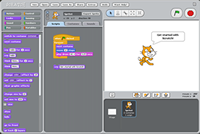
    ScratchScreen

    Designed for ages 8 and up, Scratch is available by free download from the Scratch website (http://scratch.mit.edu). The software runs on both PCs and Macs. The MIT Media Lab is now collaborating with other organizations – including Intel, Microsoft, Samsung, BT, the LEGO Group, Motorola, and One Laptop Per Child (OLPC) – to create other versions and applications of Scratch, including versions for mobile phones.

    The name Scratch comes from the technique used by hip-hop disc jockeys, who spin vinyl records to mix music clips together in creative ways. Similarly, Scratch lets kids mix together a wide variety of media: graphics, photos, music, and sounds.

    A glance at the Scratch website (http://scratch.mit.edu) reveals a kaleidoscope of projects created by kids: a story about a polar bear school, space attack games, and a break-dancing performance. Some creations are goofy and fun; some reveal serious social themes. Kids are constantly modifying and extending one another’s projects on the website – and learning from one another in the process. “It’s exciting to wake up each morning and see what’s new on the site,” said Resnick.


    Scratch was developed by Resnick’s Lifelong Kindergarten research group in collaboration with UCLA educational researchers, with financial support from the National Science Foundation and the Intel Foundation. Throughout the development process, the design team received feedback from children and teens at Intel Computer Clubhouses and school classrooms.

    “There is a buzz in the room when the kids get going on Scratch projects,” says Karen Randall, a teacher at the Expo Elementary School in St. Paul, Minnesota. “Students set design goals for their projects and problem-solve to fix program bugs. They collaborate, cooperate, co-teach. They appreciate the power that Scratch gives them to create their own versions of games and animations.”

    For more information, see http://scratch.mit.edu/about

    LifeLongKindergarten - Mit Media Lab

    The Lifelong Kindergarten group (http://llk.media.mit.edu) at the MIT Media Lab develops new technologies that, in the spirit of the blocks and finger paint of kindergarten, expand the range of what people can design, create, and learn.

    ©2007 MIT Media Laboratory

    LEGO and MINDSTORMS are trademarks of the LEGO Group.

    Used here with special permission. ©2007 The LEGO Group.

    National Science Foundation

    The development of Scratch was supported by the National Science Foundation under grant number 0325828. Any opinions, findings, conclusions, or recommendations expressed in this release are those of the authors and do not necessarily reflect the views of the National Science Foundation.

  • Don’t Miss Smalltalk Solutions – April 30th – May 2nd 2007

    Smalltalk Solutions is this weekend! There will be a number of talks on Seaside. Check out the presentation listing in DabbleDB (which is written using Seaside). Gemstone will be talking about their work porting Seaside and Monticello to Gemstone and are announcing a free version of Gemstone.

    Carl Gundel announced a Seaside Birds of Feather Session Wednesday May 2nd from 5 to 7pm.

    Don’t miss Boris Popov’s Seaside Experience Report. Boris and DeepCove Labs have done some really excellent work! Check it out.

    Don’t Miss Bert Freudenberg’s Keynote presentation about OLPC! The One Laptop Per Child initiative is a wonderful way for all smalltalkers to get involved and contribute to something that is really worthwhile!

  • CMSBox built on Squeak and Seaside

    CMSBox

    CMSbox is a Squeak3.9/Seaside2.8 powered CMS which has been made available by netstyle.ch for the Swiss marketplace, it has excellent features and already an impressive list of references.

    The site is not currently available in English but here is a Google translation. It’s great to see more and more businesses based on Squeak and Seaside.

  • Can your book do this?

    Books

    As the sun rose somewhere over the Atlantic Ocean, the dark fading away, and the cold of over a month starting to thaw, on the west coast of North America it is still dark and John M. McIntosh has only a deep and tired yawn as thanks and a simple form of celebration marking the release of Sophie RC3*.

    It is fitting that midnight should toll during this new release. The clock chimes to mark the occasion of new timeline commands; the ability to play movies connected and controlled by time itself, when time itself rests to zero for a new day. A new day indeed: the future of electronic books.

    Sophie is free and open source software built on Squeak. You can get your own copy of Sophie and start creating your own electronic books now. Check out this new video of what Sophie can do.

    Could you use Sophie to write really cool new electronic books? Sure. How about develop a new interactive brochure for your company? Yeah! How about delivering real engaging content to your potential voter base? Hmmm…

    How would you use Sophie?

    (*available soon watch for RC3)

  • Getting Lost in a Virtual World

    escher

    It’s much harder to get lost in a virtual world. Qwaq poked its head out of hiding today and released its first product: A virtual forum that enables collaborators to interact in real time. It’s not hard to imagine what an impact this new technology will have on business collaboration. (more…)