Tag: Smalltalk

  • UKSTUG Meeting on Wed 27: Christoph Thiede on SemanticText and Guille Amaral on Webside

    UKSTUG Meeting on Wed 27: Christoph Thiede on SemanticText and Guille Amaral on Webside

    Join us next Wednesday for an engaging double presentation on innovative advancements in Smalltalk programming:

    1. SemanticText: Improving Exploratory Programming in Squeak with Generative AI

    Presenter: Christoph Thiede

    From autocomplete to conversational agents, AI is transforming how we interact with code. Christoph will introduce SemanticText, a framework that integrates large language models (LLMs) into Squeak/Smalltalk, enabling conversational agents, semantic search tools, and retrieval-augmented generation workflows. He will showcase experimental integrations with Squeak’s tools and present the concept of a semantic exploratory programming system for debugging and exploring systems using natural language.

    Bio: Christoph Thiede is a member of HPI’s Software Architecture Group and a core developer of Squeak/Smalltalk, with a focus on enhancing developer productivity and tools.

    An extended abstract is available here.

    2. Webside: A Unified HTTP API for Smalltalk

    Presenter: Guillermo Amaral

    Guillermo will discuss Webside, an API that standardizes communication with Smalltalk systems via HTTP and introduces its application as a fully operational IDE. He will highlight recent improvements in its extensibility and functionality.

    Bio: Guillermo Amaral is the creator of Webside and has been a passionate Smalltalk user and advocate for over 20 years, leveraging it throughout his academic and professional journey.


    The meeting will be an online meeting from home and take place on 2024-11-27 at 7pm GMT/19:00 UTC/20:00 CET/11:00 PST. The event is hosted on Meetup and will be hold via Zoom.

    If you are curious about some of the latest ideas for Squeak and Pharo, tune in on Wednesday and bring all your questions and ideas!

  • Sandblocks: A Projectional Block-Based Editor for Squeak

    Sandblocks: A Projectional Block-Based Editor for Squeak

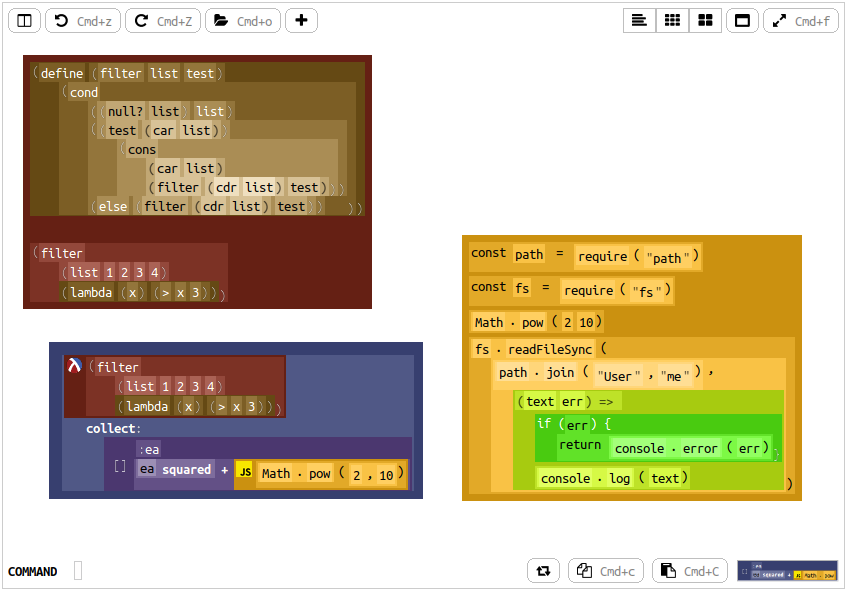
    Sandblocks is a projectional, block-based programming environment written in Squeak/Smalltalk.

    Projectional editors are promising for tasks like language composition and domain-specific projections. Effective user interaction requires clear communication of program structure and supported editing operations. While making the abstract syntax tree visible can enhance clarity, it often leads to increased space usage and potential usability issues. Sandblocks is an early prototype of a tree-oriented projectional editor for Squeak/Smalltalk, which aims to minimize space while clearly visualizing the tree structure.

    For more information on projectional editing, you can start by reading Martin Fowler’s explanation (here), in which he describes it as an alternative to source editing.

    Give it a Try!

    You can find the simple installation instructions on the project page here. The page specifically mentions Squeak 5.3, but it seems to work similarly well with Squeak 6.0. Sandblocks is a research prototype, so be sure to save often while working with it.

    Have a great time with Smalltalk and keep on Squeaking!

  • ESUG 2024 at Lille France

    ESUG 2024 at Lille France

    The 30th ESUG conference/summer-school will be held in Lille, France from 8 to 11 of July 2024.

    Conference calls

    Conference registration

    Early registration deadline: 15/04/2024

    Conference prices ESUG 2024 in Euros:

    • Early Registration Fee: 600€ (all days) / 200€ (per day)
    • Late Registration Fee: 1000€ (all days) / 300€ (per day)
    • Extra person to social dinner: 70€
    • Payment by bank transfer: free of charge
    • Payment by credit card: +6% fees
    • For late registrations we cannot ensure the availability of T-Shirts nor Social Event extra participants
    • : If the refund is requested during the early bird period all the fee (without charges) will be refunded. If it is requested after the early bird period is finished, the refund will be 50%

    Stay tuned.

  • Girls for Rasberry Pi

    Using Smalltalk Scratch to teach young kids engineering. See girls encouraging girls to get into engineering. See a scratch demo, a Lego Doggie, a blinking pillow, hair lights, a door alarm, backpack break lights and turn signals, then spread the word and follow GirlsForRaspberryPi

    Technology for everyone.


  • New Release of Physical Etoys

    New Release of Physical Etoys

    Hi everybody (and sorry if you receive multiple copies),

    It’s been a while since our last version but we’re proud to announce a new release of Physical Etoys.
    You can download it from here: http://tecnodacta.com.ar/gira/projects/physical-etoys/

    This new version includes:
    * Full support for the DuinoBot kit (http://www.kickstarter.com/projects/1689254125/multiplo-create-your-own-robot).
    * New objects such as the Timer and the IR receiver.
    * More example projects to help you get started.
    * And of course, lots of bug fixes and minor UI enhancements.

    All in all, this version is much better than the previous and we hope you would enjoy it as much as we do :).

    Thanks!
    Richo

  • What does the future hold for Pi


    raspberrypi

    From BetaNews: (see full article here: What does the future hold for Pi)

    BetaNews: What does the future hold for the Pi — new versions?

    Liz Upton: The Foundation’s committed to making sure that we don’t suddenly up-sticks and change the platform under people’s feet: the open community has been very good to us, and the last thing we want to do is to make the work they’ve done on the available software redundant. We want to continue selling the Raspberry Pi Model B for a good long time yet; we do have a final hardware revision to make, but the platform will be set in stone after that. We don’t have plans to make a new Pi at the moment; what we are putting a lot of effort into is improving the software stack. We reckon there are orders of magnitude of performance increases we can shake out of Scratch, for example; and this isn’t stuff you can expect the community to do, because it’s a very long and fiddly job. So Scratch, Wayland, Smalltalk: you should see some big improvements coming over this year. We’re also switching a lot of our concentration to our educational mission this year, after a year spent scrambling to get on top of manufacture.

  • Design Principles Behind Smalltalk

    Lambda the Ultimate is celebrating 10 years of its own existence, 30 (nominal) years of Smalltalk-80 and PARC turning 40, by revisiting a classic article Design Principles Behind Smalltalk by Dan Ingalls. From the post: “Ingalls’s piece should be filed under Visionary Languages. Alas, no such category exists on LtU.” Does this mean that Smalltalk-80 was the last visionary language?

  • Smalltalk: the past, the present, and the future?

    Anyone with an interest in the continuing role and development of Smalltalk has had lots to chew on over the past few days.

    As part of  a series of investigations into the most widely-used programming languages, Computerworld Australia has published a conversation with Alan Kay about his role in the development of the “foundation of much of modern programming today: Smalltalk-80”, Object-Oriented Programming, and modern software development.

    InfoQ is running a series of interviews recorded at QCon London. One of these is a session with Ralph Johnson and Joe Armstrong discussing the Future of OOP, including their take on what Smalltalk got wrong and right.

    Finally, Gilad Bracha continues to lay out his vision for what he sees as Smalltalk’s successor, Newspeak. His latest post contains encouragement and advice for those interested in porting existing libraries and applications to Newspeak.