
http://icn.sap.com/news/codeweek.html
https://www.facebook.com/SAPInnovationCenter
https://www.facebook.com/SAPInnovationCenter/posts/1120332404660697
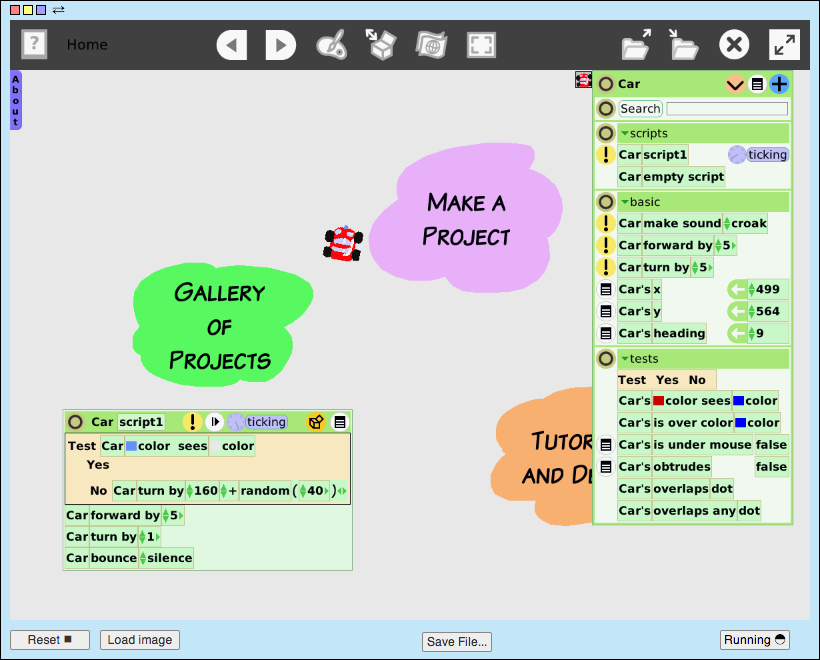
From Bert Freudenberg:
Hi all,
my SqueakJS VM has reached a major milestone. It is now sufficiently complete to run a full Etoys image (and possibly other non-closure images, too). It has support for most BitBlt modes, WarpBlt, even some Balloon2D rendering (for TTF fonts), a virtual file system, image saving etc.
Try it: http://bertfreudenberg.github.io/SqueakJS/etoys/
(Safari and IE are significantly faster than Firefox and Chrome, best is Safari Webkit nightly, works on iPad too, hopefully Android)
For more details, see my blogpost:
http://croquetweak.blogspot.de/2014/07/squeakjs-runs-etoys-now.html
Feedback and contributions welcome 🙂
– Bert –

Check out OLPC XO-4.
I would hate to add to the speculation that OLPC is dead because it’s not. Wayan Wota has been calling OLPC dead for 5 years. This is not news. He has not been involved with the project in a long time. His article is about the XO-1, apparently he doesn’t even know the XO-4 was officially introduced at this year’s CES, alongside the tablet.
If you really want to know what’s going on with current OLPC community projects see Adam Holt’s http://www.unleashkids.org/
Full OLPC Statement (from: http://gizmodo.com/one-laptop-per-child-isnt-quite-dead-yet-1541430670):
OLPC’s mission to empower the world’s children through education is far from over. OLPC is thriving and making more inroads at bringing education to those who can’t easily access it. OLPC recently formed a strategic alliance with the Zamora Teran family through many of their enterprises and their philanthropic foundation, the “Fundación Zamora Teran to deliver XO laptops not only to Central and South America, but also to Africa.
Aside from distributing more laptops in several schools in Costa Rica, Uruguay is receiving its first 50k units of the XO-4 Touch (running Android) in a few weeks’ time. In addition, the XO Tablet is currently available directly through governments and NGOs, as well as in Europe and Canada and through all major retail outlets in the United States including Walmart, Amazon, Toys ‘R Us among the others.
OLPC also has outsourced many of the software and development units because the organization is becoming more hardware and OS agnostic, concentrating on its core values – education. As an example, we’ve partnered with the Smithsonian Museum to bring feature-rich, interactive and more targeted content to our young learners.
We have more exciting things planned in the horizon including the implementation of very large scale projects in several regions of the world, so be sure to stay tuned.
OLPC is a concept, it is a movement, it is a community and it is about helping children. Sure the grand vision may be delayed, but the benefits of education and technology, of improving the human condition is not dead. We all knew that it’s not profitable to teach third world children. Still, no one thought that companies would compete against OLPC. Countries opted for different technologies for hardware but never matched the promise or the vision of the software. Had the world united around this platform children would have benefited and the world today would be a better place as we develop together and stamp out ignorance. There is nothing like education to improve the world and that mission is not dead. OLPC is evolving, finding new ways to reach more children, making more with less, and finding ways to make a real difference in the world.
Support OLPC! Long Live the vision.

Etoys, children, a funny hat and a handmade Smalltalk balloon. What more could you ask for! Looks like a great day for everyone.
Read more about it here: http://squeaklandnews.blogspot.de/
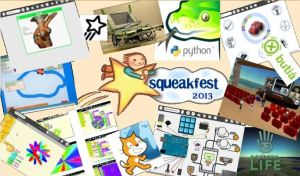
It’s that time again. Time to pack up the kids and join us at SqueakFest 2013. Don’t forget to bring your XO computer!
If you can’t make it please consider a donation to help cover travel costs: Donate
For more information see: Squeakfest 2013
From Rita:
There will be a Squeakfest again in Uruguay at June, 7th – 9th, this time in Atlantida. Etoys will cover the major part of the event, but there will also be workshops in Python, turtle art and robotics. After all, Uruguay is the country with XO-laptops in every elementary school and teachers are using the software which comes with Sugar.
http://squeakfest2013.weebly.com/
From our education team, Randall Caton and myself are going to present Etoys workshops. This year, I’ll introduce Kedama. I’m looking forward to an inspiring event!
If you want to help or know someone who would like to, I created a crowdfunding page to collect money to help to cover our travel cost. Please share as you like!
http://crowdfundedu.com/fundraiser/educators-to-squeakfest
Greetings,
Rita

Don’t miss the new Etoys book: http://wiki.squeakland.org/index.php/LearningWithEtoysI3.
Etoys is:
All school children should have the opportunity to engage with computers in the most meaningful way. Learning to think and using the computer to discover and work with powerful ideas is the knowledge of true value. The community of Etoys users is working toward the dream of having all students become computer literate. This book only covers a small portion of those items. As you and your students learn some of the basic techniques, you will find more and more uses for them. The process of learning Etoys is just that, a process; the learning is on-going even though projects are begun and finished. Students will enjoy becoming experts and sharing their knowledge with others in the classroom.
Imagine this: A group of learners want to visualize what they Imagine so they go to Etoys to Invent their dreams and Inspire each other by building on their various Etoys projects. Today’s learners need this kind of experience to be prepared for the future.
For more information about Etoys visit www.squeakland.org
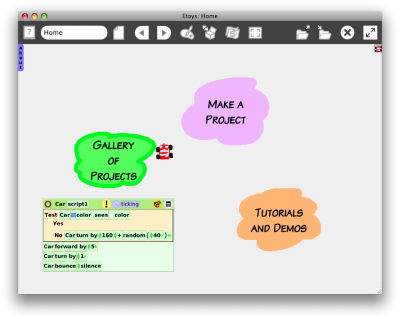
Bert Freudenberg announced on the squeak-dev mailing list that Etoys 4.1 is now available. Etoys is a media-rich authoring environment and visual programming system with a simple, powerful scripted object model, ideal for teaching children powerful ideas in compelling ways. Based on Squeak, Etoys is available for free, with an open-source licence. You can run it on Mac OS X, Windows, and Linux (using the Etoys To Go version), or even use a plugin to run it directly in your browser. Etoys is also available on the XO OLPC laptop.
This release includes new features such as DrGeo for exploring geometry, speech bubbles for objects, new tiles and Quick Guides in a number of languages. It also includes a large number of bug-fixes and cleanups. A number of new projects have been created to showcase the new features. Some of the new features were developed as part of Smalltalk’s participation in this year’s Google Summer of Code, which was co-ordinated by ESUG.
You can find out more about Etoys 4.1 by reading the release notes, or by downloading the new version.
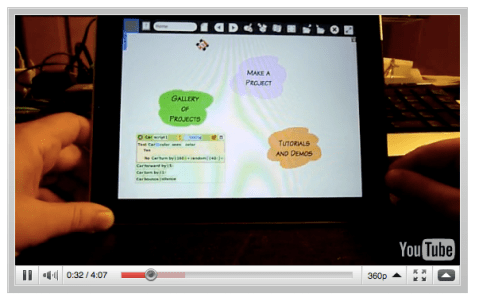
Bert Freudenberg has recently got Squeak working on the iPad, and has the video to prove it!
Bert’s work is based on John McIntosh‘s original port of the Squeak Virtual Machine to Apple’s touch-based OS, modified slightly to enable multi-touch and keyboard input. Bert also added multi-touch handling to Morphic. Interestingly, he notes that “Morphic was designed to handle multiple ‘hands’ (pointing devices) from the beginning”, so Squeak has always been multi-touch capable, and just let down by operating systems until now!
Bert’s work will help the Etoys team prepare their application for the next machine from OLPC, the XO-3, which will also be a touch device. The new version of the Sugar OS for the new device is still being developed, so it looks as though Etoys is well ahead of the curve.
Given the recent changes to Apple’s licence terms for iOS developers, it’s looking increasingly likely that we will see Squeak-based applications appearing for the iPad in the future. After a forty year wait, the Dynabook is nearly here!

Rita Freudenberg has announced that “The official Squeakfest website is now live and ready for you to propose a presentation, workshop, or panel.”
Squeakfest is an annual conference where developers and users of the Etoys media-rich authoring and experimentation environment (based on Squeak) get together to share ideas, experiences, and their enthusiasms with colleagues from around the world.
This year’s conference will be held at University of North Carolina in Wilmington, North Carolina, in the USA from 26th—28th July, and the theme for will be “Etoys in the STEM classroom.”
The conference will offer an opportunity to reflect on the achievements of the NSF-funded project “Using Squeak to Infuse Technology (USeIT)” which is now reaching its 3rd year.
The team are keen to hear from individuals and groups with experience teaching with Etoys, as well as non-classroom Etoys use, particularly as it relates to OLPC pilots or homeschooling. More information will be added to the website as it becomes available, but the organisers ask presenters to get presentation information to them by completing and submitting the online form no later than 11th June, 2010.
To get a flavour of what to expect at the conference, have a look at our report from last year’s Squeakfest.
Following his announcement of the release candidate last month, Timothy Falconer of Squeakland has now announced the full release of Etoys 4, which you can now download from their website.
The Squeakland Fall newsletter has the Etoys 4 release notes which detail the changes you’ll find, in English and Spanish. The newsletter also has some thoughts by Scott Wallace on this release which completes the hand-over of Squeak Etoys from Viewpoints Research to the newly formed Squeakland Foundation.
To publicise some of the work being done using Etoys, the Squeakland site has a new feature: the Squeakland Showcase. Everyone can now share their projects directly from Etoys to the website, where the Etoys community can then benefit from the many surprising and useful Etoys examples that are available.
Timothy invites anyone using Squeak or Etoys, to consider adding their name to their Squeakers list. More than 175 people from 35 countries have signed, which really shows the enthusiasm and reach of Etoys throughout the world.
Timothy adds “Special thanks to the Squeakland software team, particularly Bert Freudenberg, Yoshiki Ohshima, and Scott Wallace for their tremendous efforts in the last month. Your hard work really shows!”
 The Weekly Squeak