Author: Michael Davies

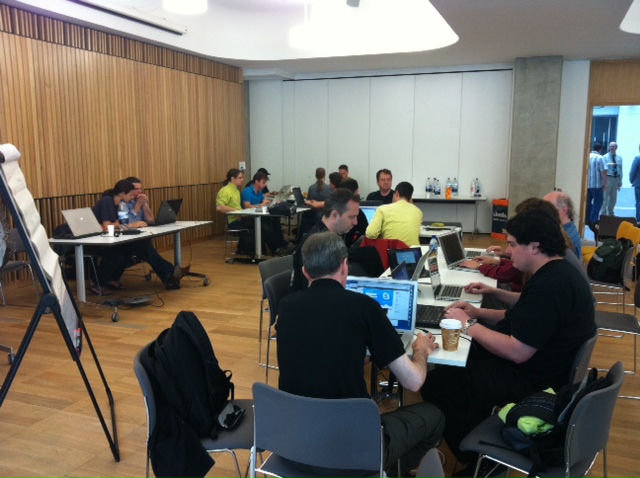
  • Hard at work at Camp Smalltalk

    Camp Smalltalk is well under way in the bright and modern School of Informatics building at the University of Edinburgh.

    Stéphane Ducasse got proceedings off to a flying start yesterday with an intensive introduction to Smalltalk for newcomers. Today, work continues on a number of projects including SUnit, Seaside, Pier, Gofer, SLAPS (an LDAP server implementation) and Spoon.

    And, of course, everyone is taking the opportunity to begin catching up with old friends, making new ones, and preparing their presentations for next week’s ESUG Conference.

  • A Seaside for every size

    There have been a couple of interesting pieces of news about Seaside in the last few days.

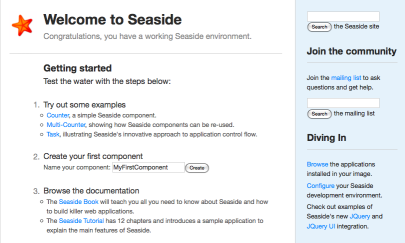
    Sebastiane Sastre and colleagues at flowingconcept.com have brought their new airflowing.com application out of private beta, and are now accepting new commercial subscriptions. Airflowing is an online tool for managing your creative business, including contacts, tasks and finances. It’s designed to be a quick-start tool aimed at people “who need to get things done and get paid” and is already in use in 35 companies. Under the skin it’s based on Smalltalk and Seaside so scaling the application up to meet new customer demand should be no challenge for the team! Find out more about this release and the hard work behind it at the flowingconcept blog, and try a trial subscription at airflowing.com.

    At the other end of the scale, Lukas Renggli highlighted a post by Pavel Krivanek to the Seaside mailing list. Pavel has managed to build a working Seaside image weighing in at under 5MB. The image includes the Zinc web server, and is based on a stripped-down Pharo-kernel image. As well as build instructions, Pavel has made a pre-built image available, so check it out!

  • Smalltalks 2011

    Worried that you won’t be able to come to Edinburgh for ESUG 2011? Well how about joining your fellow Smalltalkers in Argentina in November for Smalltalks 2011?

    The Smalltalks conference brings together more than 200 people from both academia and industry to discuss Smalltalk-based software over three days. Smalltalks conferences have included many high-quality presentations from industry and research, showing interesting applications of Smalltalk, advances in the Smalltalk language, didactic uses of Smalltalk and much more.

    This year’s conference runs from 3rd—5th November at the Universidad Nacional de Quilmes (English site) in Bernal, Argentina (just 15km from Buenos Aires).

    As in previous years, there will be a dedicated research track for original scientific contributions to, or using, Smalltalk in general. If you’re interested in submitting a paper for the conference, the hard deadline is 22nd August 2011, with notification of acceptance by 23rd September.

    See the call for papers for more details of submission guidelines and criteria.

  • 19th International Smalltalk Joint Conference – Edinburgh

    The 19th International Smalltalk Joint Conference is being held in Edinburgh, Scotland this year on 20-26 August 2011; with Camp Smalltalk running on 20-21 August and the main conference continuing on 22-26 August.

    As usual, it will also play host to the International Workshop on Smalltalk Technologies, a forum to trigger discussion and exchanges ideas around advances or experience in Smalltalk, which will be held on 23 August.

    This year will also see the 8th competition for the Innovation Technology Awards for excellent Smalltalk projects.

    But, as always, the main attraction will be the chance to meet, discuss and socialise with old and new Smalltalkers from around the world.

    There is an open call for papers; registrations are now open; and bookings are being taken for accommodation during the conference (which is being held at the same time as the world famous Edinburgh Festival, so early booking is essential).

    To encourage newer Smalltalkers, there is a student volunteer programme, and also the opportunity to apply for one of ten free places by emailing the ESUG board with subject: [ESUG 2011 Free entrance] + your name, and your case for receiving a free place.

    You can support the ESUG conference in many different ways:

    • Sponsor the conference. New sponsoring packages are described at http://www.esug.org/supportesug/becomeasponsor/
    • Submit a talk, a software or a paper to one of the events.
    • Attend the conference! The board would like to beat the previous records of attendance (156 participants at Brest, 170 people at Amsterdam, 150 at Barcelona)!

    See you all there!

  • SqueakSource 3 beta available

    Soon to be replaced?

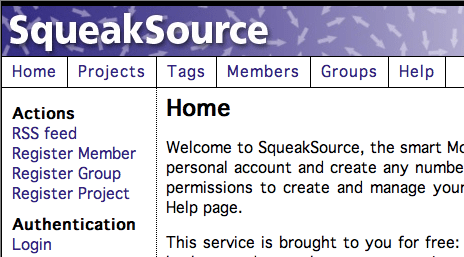
    Although we all work with SqueakSource every day, it has been in need of some care and attention for some time now. Fortunately, Tobias Pape and colleagues have been working on a total re-work of the SqueakSource code, and have now announced the availability of their first beta of SqueakSource3, named “Easter Fire”.

    SqueakSource3 is a port of the original SqueakSource to Seaside 3 and Magritte 2. It is based on the original SqueakSource by Lukas Renggli, Adrian Lienhard, and Avi Bryant.

    The developers’ plan for SqueakSource3 is:
    • Have it running on GemStone, esp. GemStone 3 beta
    • Provide a cleaner external API (may be REST or XMLRPC)
    • Provide a more clear modularization and extension api
    • Stability
    • You name it! Suggestions are welcome.

    SqueakSource3 is expected to run on GemStone/GLASS as well as on squeakish Smalltalks, ie, Pharo and Squeak. This beta has been tested on GemStone 2.4.4.x/GLASS 1.0-beta.8 and Squeak4.2 both with Seaside 3.0.4. Pharo tests are pending.

    SqueakSource3 incorporates work done in several SqueakSource forks such as access to diffs in a browser as done by Bert Freudenberg for source.squeak.org and a basic issue tracker contributed by Dale Henrichs. Other key contributors to the project include Philippe Marschal, Dale Henrichs, and Gerhard Obermann have contributed much to SqueakSource3.

    See the release announcement for more information, and for instructions on how to install the new code

  • Magma 1.2 released

    Chris Muller wrote to the squeak-dev mailing list announcing that Magma 1.2 is now released for Squeak 4.2, Pharo 1.1 and Pharo 1.2.

    Magma is a high-performance, fault-tolerant, multi-user object database that provides transparent access to a large-scale shared persistent object model, supports multiple users concurrently via optimistic locking, and uses a simple transaction protocol.

    This new release offers bug fixes, new features and improved performance thanks to minimising problems associated with finalisation. In addition, Chris has reviewed and updated the Magma documentation. More information and support is always available from the Magma mailing list.

    Chris writes that “this release is, exactly, one year since Magma 1.1, thank you for your patience”. Surely it’s us who should be saying thank you to Chris, for his continued work on this valuable project!

  • Voting is under way for the Squeak Oversight Board

    Voting is now under way in this year’s elections for the Squeak Oversight Board.

    After some prompting from their colleagues, the following people have thrown their hats into the ring:

    If you are one of the 460 registered members of the Squeak community you should have received an email “Poll: Squeak Oversight Board Election 2011” sent by Göran Krampe, who is running the election. If you’ve not got an email and you should have, email voters@squeak.org and Göran will see what he can do.

    Find out more at the election wiki page.

    Voting closes on 10th April at 18.00 UTC.

  • Google Summer of Code – Student Smalltalkers wanted!

    Janko Mivšek wrote to the squeak-dev mailing list that “we are preparing an application to this year’s Smalltalk Google Summer of Code under the ESUG umbrella, as last year”.

    Google Summer of Code is a global program sponsored by Google that offers student developers stipends to write code for various open source software projects. The Smalltalk community has a successful record of participation in the scheme, under the aegis of ESUG in recent years, and our organisers are looking for students and ideas, (and even better, students with ideas) for our entry in this year’s programme.

    Janko asks Smalltalkers to “please start thinking about ideas what projects would be nice to have. Also start looking around for students. How to approach the universitites near by you, do you know who to contact there, etc”.

    To see last year’s ideas and projects, visit the site for last year’s students. You can find out more at the new Smalltalk GSoC 2011 website: http://gsoc2011.esug.org, and don’t forget to ensure you’re aware of the GSOC timeline.

  • Call for papers for IWST in Edinburgh

    Alain Plaintec has published the call for papers for the International Workshop on Smalltalk Technologies which will be held on 23rd August during the ESUG 2011 conference in Edinburgh. The goal of the workshop is to “create a forum around advances or experience in Smalltalk and to trigger discussions and exchanges of ideas”.

    Participants are invited to submit short and not-so short research articles, of two kinds

    • Short position papers describing emerging ideas.
    • Long research papers with deeper description of experiments and of research results.

    Contributions can be on a wide range of topics, including meta-programming and meta-modeling, new dialects or languages implemented in Smalltalk and experience reports.

    Key dates:

    • Submission: 17th June
    • Feedback: 15th July
    • Workshop: 23rd August
  • Squeak 4.2 final now out!

    Squeak4.2-10966.zip is now available at http://ftp.squeak.org/4.2. This is intended to be the actual-released 4.2 image, unless, as Chris Muller says, “we find some problem, which we won’t!”.

    Some of the new features in this release are:

    • Preparation for adoption of Cog VM
    • Significant class-library and IDE improvements, with many speed improvements
    • High-precision Clock (microsecond precision)
    • Cleaned-up code base, with better support for unloading optional packages and fonts.
    • The last of the underscore assignments have been replaced with ANSI assignments.
    • Refactoring and unification of Smalltalk and SmalltalkImage globals.
    • API for stdio access (requires recent VM)
    • Improved command-line interface
    • Better Documentation (see Help > Help Browser)
    • SUnit now supports timeouts
    • More UI work including a tweaked look and feel, and support for translucent fonts
    • Support for classic MVC has been restored to Squeak for better support of slower devices
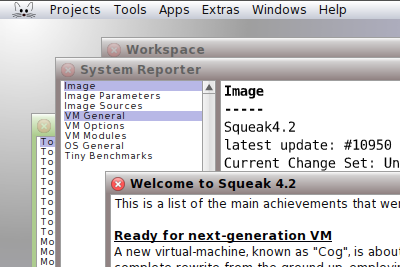
    • System Reporter (found under Help > About this system) – a tool to simplify and standardise the reporting of your image’s set-up.

    See Help > Welcome Workspaces > Welcome to Squeak 4.2 for more details of the changes in this image.

    Note that users on Macs may find that the mouse buttons work in an unexpected order in this image. This is expected behaviour to allow for the grand reunification of mouse button handling in the upcoming version of the VM, which will restore the standard behaviour. In the meantime, use the Swap Mouse Buttons preference to keep things sane.
    Congratulations to Chris Muller who has been leading the effort to get this release out the door, as well as the many contributors who provided updates, error checking, bug fixes and moral support for the process.