
Author: Michael Davies

  • Smalltalk Solutions 2008 – slides now available

    Most of the slides from the presentations at this year’s Smalltalk Solutions conference are now on line.

    The material available includes Gilad Bracha’s talk on Newspeak, James Foster’s guide to building a Seaside application using GemStone/S, Michael Rueger’s introduction to Sophie, Arden Thomas demonstrating WebVelocity in action, and Randal Schwartz’s double-header keynote: Seaside – Your Next Web Framework and an introduction to persistency solutions for use with Seaside.  

    There are also slides from a couple of sessions looking at the reasons for the recent resurgence of interest in Smalltalk: Arden Thomas looks at the features of Smalltalk that other languages lack, and Rob Rothwell explains how Smalltalk helps with the development of healthcare applications.

    There are many more slide-packs available, and still more to be added, so please check out the conference page for more information. James Robertson is adding video and audio as it becomes available.

  • One stop shop for Smalltalk jobs

    Randal Schwartz is very keen that there should be one community-supported site for collating and finding Smalltalk-related job postings. He says:

    It’s been very helpful to the Perl community to get one place for all serious Perl jobs: jobs.perl.org. Because then all the smart people look there, and all the clueful employers post there, and it’s also free. And the stats at http://jobs.perl.org/about/stats show that Perl is far from dead.

    I’m trying to do the same thing for Smalltalk. Please support me in that. Don’t point at other places.  Get them to post at http://smalltalkjobs.dabbledb.com.  It will be good for all of us overall. Truly.

    The DabbleDB interface has many RSS feeds for particular areas, and can be pulled out and searched in detail.  It’s also all in Smalltalk, which is a good demo.

    Ken Causey has already set up jobs.squeak.org to redirect to http://smalltalkjobs.dabbledb.com, so it look like Randal’s hopes will be fulfilled.

  • Conference News – Libre Software Meeting, 1-5 July, France


    Hilaire Fernandes wrote to tell the Squeak-dev mailing list that the 9th Libre Software Meeting will be held at Mont de Marsan, Landes, in SW France, on 1 – 5 July. LSM is an international free software event taking place in July each year, in a French town; the first event took place in 2000 at Bordeaux. This year, Squeak/Smalltalk will be well represented with conferences and workshops on Squeak, Seaside and Sophie. There will also be a coding sprint for Pharo, a new implementation of Smalltalk based on Squeak.

    For more information, see the post about the conference on Hilaire’s blog.
    http://blog.ofset.org/hilaire/index.php?post/Squeak-Smalltalk-LSM-2008

  • JSqueak – Smalltalk interpreter written in Java

    Dan Ingalls has released JSqueak, a Squeak interpreter written in Java. 

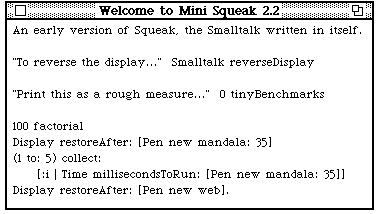
    JSqueak (formerly known as Potato) is less than 5000 lines of code, available under the MIT licence. It runs the Mini2.1 image, which is included for convenience. This image contains a complete Smalltalk development environment, including:

    • Rich text and Text editor
    • File browser (no file access in VM yet)
    • Code browser
    • Decompiler (plus temp-name hints)
    • Compiler
    • Source Code Debugger

    Dan wrote JSqueak to teach himself NetBeans and Java in the fall of 2006. Although he developed it as a throw-away project, he notes that

    it has features that recommend it for further useful service:

    • It is simple
      • Uses Java objects and storage management
      • Uses Java Integers for SmallIntegers
    • It is general
      • A weak(*) object table enables enumeration and mutation
    • It is efficient
      • Includes a method cache and an at-cache (**)
      • Also a cache of common SmallIntegers
    • (*) – This does not mean wimpy — it’s a good sturdy object table — it just doesn’t hold onto garbage.
      (**) – This is not an automated teller machine, but a device that speeds up array and stream access.

    These properties make it a reasonable base for teaching about VM design.

    Dan adds that a number of things should be finished or improved if this VM is to see further use – it currently runs between 10 and 30 times slower than the C-based VM! If you wish to track or contribute to such projects, he invites you to add yourself to the (brand new!) JSqueak Interest mailing list.

    You can find out more, and run the application as a WebStart Java Application at the JSqueak home page.

  • ESUG Awards for innovative software

    Noury Bouraqadi wants to  remind all Smalltalkers that the deadline for entries in the ESUG Innovation Technology Awards is in two weeks time. The Innovation Technology Awards, to be awarded at the 16th International Smalltalk Joint Conference in Amsterdam, are intended to make public part of the innovative software built using Smalltalk. The top 3 teams with the most innovative software will receive, respectively, €500, €300 and €200 during an awards ceremony at the conference.

    The winners will be selected based on criteria of creativity, stability, performance, successful use, and impact for the community. No constraints are put on the software except that it should be Smalltalk-based or Smalltalk-related;  all flavours of Smalltalk are accepted.

     The awards were founded by Nouri in 2004, and details of past winners can be found on his web-site.


  • Conference news: C5-09 in Kyoto

    Bert Freudenberg posted the following conference announcement to the squeak-dev mailing list.

    Conference on Creating, Connecting and Collaborating through Computing
    January 19 – 22, 2009
    Kyoto, Japan
    http://www.cm.is.ritsumei.ac.jp/c5-09/

    Join us at the 7th annual gathering to learn and share about recent work in the areas of collaborative systems, connecting people around the world through computing, and creating new media for business, social development, learning and play!

    The C5 conference is for researchers, software developers, educators, designers, and technology users who are concerned about developing and enabling human-oriented creation, connection, and collaboration processes. C5 is an international forum for presenting ongoing work as well as new work currently under development and for discussing future needs and directions in creative computing and multimedia authoring environments.

    Conference sessions will include invited talks, including one from Dr. Alan Kay, Viewpoints Research Institute, formal paper presentations, hands-on workshops, informal “un-conference” and “lightning” sessions as well social and sightseeing events.

    Please save the date and plan to join us in lovely Kyoto, Japan!

    — The C5-Organizing Committee

    There’s also a call for papers in three areas:

    • Theoretical papers
    • Case studies and experiment reports
    • Papers that ‘bring theory into practice or practice into theory’ bridging between practice and theory in creating, connecting and collaborating through computing.


  • Conference News: Smalltalks 2008 in Buenos Aires

    Following the success of last year’s Smalltalks 2007, the organisers are now planning to hold the Smalltalks 2008 conference on 13-15 November at the Universidad Abierta Interamericana in Buenos Aires.

    As with last year’s event, registration and refreshments will be completely free.

    The conference will be divided into two modules, Scientific Research and Software Industry, as well as hosting a coding contest. See the website for details of deadlines and speakers.

    You can get a flavour of last year’s conference by viewing some of the videos posted by Andres Valloud.

  • Squeak on the iPhone!

    John M McIntosh announced on the squeak-dev mailing list that “I’m pleased to say that I’m one of the 1.5% of the iPhone developer population that has been accepted to officially build applications for distribution via Apple’s iPhone Application Store.”

    He’s prepared a 93-day plan to build a new fully documented Objective C based source tree to host the Squeak VM on the iPhone and in addition as a 64bit VM on OS-X. He’s already collaborating with Impara who are looking at adapting the Squeak UI to the iPhone’s multi-touch paradigm and platform widgets, and is looking for further support (and funding) for this work.

    John is also looking to offer support for Squeak developers hoping to make their applications available through the iPhone Store, although he notes that Apple has a number of restrictions limiting the types of applications that can be made available in this way.

    The screenshot above shows a “visually exciting” 3.4 image running on an iPod Touch, the result of 15 days’ work. John does sound a note of caution: the VM is currently running at a speed equivalent to a 233Mhz 603e PowerBook, and 64MB of memory use is pushing the Apple’s imposed safety limits right to the max, so developers may have to relearn all those optimisation techniques they may have forgotten in recent years!

  • Randal Schwartz to join Smalltalk podcast (warning, some recursion involved)


    Randal Schwartz notes on his blog that: 

    James Robertson of the weekly Smalltalk Industry Misinterpretations podcast has graciously offered me the opportunity to add a short weekly Squeak News segment to his podcast.  I’ll be selecting the most recent posts from news.squeak.org, and reading them at varying speeds, depending on the amount of news.  Hear the result at the current podcast, andsubscribe to get future (weekly) releases.

    It would be really cool if my appearance reading the Squeak News gets picked up for Squeak News, so I’ll be reading an article from Squeak News for the podcast about reading the articles from Squeak News for the podcast.  Turtles all the way down!
    Heh, let’s see if this breaks the intar-web.


  • Qwaq developing new fast Smalltalk VM

    Eliot Miranda has posted some exciting news – he is working at Qwaq to develop Cog, a fast Smalltalk VM for Croquet. The VM will dynamically compile Smalltalk bytecodes to machine code transparently to the programmer, and execute this machine code instead of interpreting bytecode. He expects to have an initial release within a year which should execute pure Smalltalk code some 10 to 20 times faster than the current Squeak VM. The new VM will be released under the Qwaq open source licence (MIT-compatible).

    Eliot will be posting notes on his progress and design decisions on his blog, and notes that the VM is to be released under the Qwaq open source licence. He’s looking to maintain compatability with the existing Croquet VM, Hydra, and Slang plugins. His first post gives lots of interesting details of work done so far, and his future plans.

    Eliot is a long-time Smalltalker, having worked on VisualWorks for many years with a focus on VM development, and has recently been working with Gilad Bracha at Cadence.