Author: Michael Davies

  • Smalltalk Solutions 2008 – two weeks to go!

    The Smalltalk Industry Council’s annual Smalltalk Solutions conference is coming up on 18-21 June 2008 in Reno, Nevada. Smalltalk Solutions brings together Smalltalk users, developers, and enthusiasts as well as those interested in the latest Smalltalk technology.

    This year’s agenda has a host of fascinating topics and speakers lined up, with keynote presentations from Gilad Bracha comparing Newspeak with Smalltalk, Randal Schwartz reviewing persistence solutions for Seaside, and David Simmons from Microsoft on dynamic languages and secure cloud systems.

    Other topics include Sophie, uses of Smalltalk in industry, running Seaside on Gemstone/S, an introduction to Aida/Scribo CMS, as well as overviews of many new tools and packages.

    It looks like a packed agenda, but no doubt there also will be ample time to get to meet other Smalltalkers, put faces to names, and catch up on the newest developments in the Smalltalk world.

  • Gemstone’s MagLev presented at RubyConf

    Avi Bryant joined Gemstone’s Bob Walker at RailsConf last week for a presentation (summarised here) describing MagLev, a Ruby VM built on the same technology as Gemstone/S, offering transparent persistence, and so the possibility of massive scalability, to Ruby applications. Despite only being under development for three months, with the initial focus being on scalability rather than speed, MagLev is already able to run Ruby code at speeds comparable or better than established Ruby implementations, with orders of magnitude improvements in some cases.

    The presentation caused lots of excitement at the conference, and has sparked lots of heated debate within the Ruby development community with some very different views of MagLev from Charles NutterGiles Bowkett,  Obie Fernandez, and Antonio Cangiano, as well as an article at Slashdot and posts all over Reddit.  Avi has a blog-post addressing some of the discussion, as does Patrick Collison.

    For Smalltalkers, one particularly interesting feature of MagLev, from an interview with Bob Walker by InfoQ, is that it retains the ability to execute Smalltalk code as well as Ruby, and should support image-based development.

    [Edit: Chad Fowler had access to MagLev well before the presentation, and so offers a more considered assessment of it]

  • Dan Ingalls Interview on FLOSS Weekly

    Randal L. Schwartz writes that:

    “Dan Ingalls graciously granted me a 90-minute interview for my FLOSS “Weekly”
    show.  We talked about the early days at Xerox PARC, the birth of Squeak,
    and the Lively Kernel.”  

    Dan Ingalls has been the principal architect of five generations of Smalltalk environments. He designed the byte-coded virtual machine that made Smalltalk practical in 1976. He also invented BitBlt, the general-purpose graphical operation that underlies most bitmap graphics systems today, as well as pop-up menus. He has received the ACM Grace Hopper Award for Outstanding Young Scientist, and the ACM Software Systems Award.

    Dan’s major contributions to the Squeak system include the original concept of a Smalltalk written in itself and made portable and efficient by a Smalltalk-to-C translator. He also designed the generalizations of BitBlt to arbitrary color depth, with built-in scaling, rotation, and anti-aliasing. He worked with John Maloney to produce much of Squeak’s Morphic and MVC frameworks, as well as its audio support. Dan is currently a member of the Squeak Board.

    Dan is a Distinguished Engineer at Sun Microsystems where he is working on the Lively kernel project, a new kernel for JavaScript that will offer the reflective capabilities needed for proper development support, as well as in-browser support for other high-level languages.

    You can listen to the interview online or download it at http://twit.tv/floss29.

    [Pop-Quiz: In which language is Dan more comfortable: C++ or Visual Basic?]

  • New Yorkers’ chance to see Squeak-based education tools

    The Mid-Hudson Valley Linux User Group will get the opportunity on 4th June to hear about a range of educational tools running on Squeak, including: SeasideScratchCroquet and Etoys. Joe Apuzzo will discuss his experience teaching 60 kids from 3th grade to 5th math and science (all within 15 minutes per group).

    Find out more at the website.

  • S3 Highlights: Lively, COLA, Huemul, Squeak on Python and more


    On 15/16 May, the workshop on Self-Sustaining Systems (S3) took place at the Hasso-Plattner-Institut in Potsdam. An exciting event at a beautiful place, it featured invited talks by Ian Piumarta, Dan Ingalls, and Richard P. Gabriel, and five presentations of reviewed papers that approached self-sustainment from different angles.

    (more…)

  • Driving WifiBots with Squeak

    Noury Bouraqadi has some very exciting news for anyone interested in using Squeak for robotics. He writes on the mailing list that Squeak is now running on yet another platform: WifiBot robots. This work is a step towards both a smart software architecture that drives individual robots and  system that manages robots interactions and cooperation.

    If you’re interested in being watched by crowds of robots as you work, Noury and his colleagues are now seeking a PhD student to contribute to this project. See the project website for more details.

  • 16th International Smalltalk Joint Conference – Call for Contributions

    ESUG, the organisers of the 16th International Smalltalk Joint Conference, to be held 25-29 August 2008 in Amsterdam, have issued a call for contributions. Submissions are to be made by 1st June 2008, with notification of acceptance on 15th June 2008.

    About the Conference

    For the past 16 years, the European Smalltalk User Group (ESUG) has organised the International Smalltalk Conference, a lively forum on cutting edge software technologies that attract people from both academia and industry for a whole week. The attendees are both engineers using Smalltalk in business and students and teachers using Smalltalk both for research and didactic purposes.
    As every year, this year’s edition of the largest European Smalltalk event will include the regular Smalltalk developers conference with renowned invited speakers, a Smalltalk camp that proves fruitful for interactions and discussions. This year’s conference will also see the 4th year of the Innovation Technology Awards, where prizes will be awarded to authors of best pieces of Smalltalk-related projects.

    The conference features the following events:

    • Camp Smalltalk – There will be a Smalltalk camp on 23-24 August
    • Developers Forum
    • Technology Forum

    Developers Forum
    This year we are looking for your experience with using Smalltalk. The list of topics includes, but is not limited to, the following:

    • XP practices
    • Development tools
    • Experience reports
    • Model driven development
    • Web development
    • Team management
    • Meta-Modelling
    • Security
    • New libraries & frameworks
    • Educational material
    • Embedded systems and robotics
    • SOA and Web services
    • Interaction with other programming languages

    Technology Forum
    We are proud to announce the 4th Innovation Technology Awards. The top 3 teams with the most innovative software will receive, respectively, €500, €300 and €200 during an awards ceremony at the conference. Developers of any Smalltalk-based software are welcome to compete.

    Student Volunteer Program
    If you are a student wanting to attend ESUG, have you considered being a student volunteer? Student volunteers help keep the conference running smoothly; in return, they have free accommodations, while still having most of the time to enjoy the conference.

    We hope to see you there and have fun together.

  • Native look and feel apps with Firefox XULRunner

    Pavel Krivanek has published details of a project he’s been working on: SeasideXUL, which uses the Mozilla Foundation’s XULRunner and Ajax, with Seaside providing the muscle, and allows developers to create applications with a native look and feel.

    Pavel has already used the framework to wrap the OmniBrowser suite of development tools, so allowing Squeak development to take place in the host environment.

    The code is downloadable from SqueakSource, and a pre-built image has also been made available which includes the OmniBrowser integration. Pavel has also published a set of screenshots of the “Periodic Table” sample application demonstrating the capabilities of SeasideXUL.

  • Squeak by Example now available in French

    Squeak by Example has been a hugely successful introduction to Squeak since its publication last year, and it has now been made available to a wider audience, following the publication of a French edition Squeak par l’exemple. As with the English edition, the book has been made available in print from print-on-demand specialists lulu.com for around €17/$20/£11, or can be downloaded from the site as a pdf.

    Squeak par l’exemple was produced thanks to the hard work of the team of translators: Martial Boniou, Mathieu Chappuis, Luc Fabresse, René Mages, Nicolas Petton, Alain Plantec, Benoît Tuduri and Serge Stinckwich.

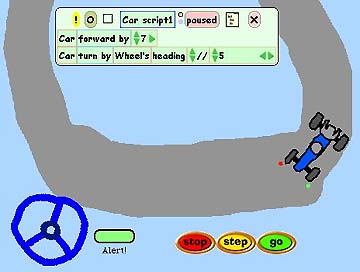
  • Squeak Etoys – Students Build Their Own Games In Four Days

    The Software Architecture Group at the Hasso-Plattner-Institut (who have produced a great online Seaside tutorial and associated book) have recently been involved in using Etoys in the classroom. They kindly sent us this report about the experience of two of their members when introducing Squeak and Etoys to high school students.

    (more…)