Author: Michael Davies

  • Etoys 4.1 now available

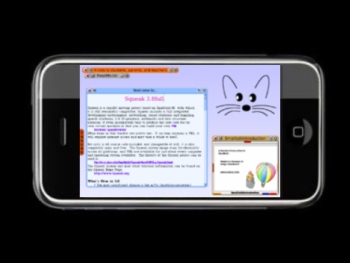
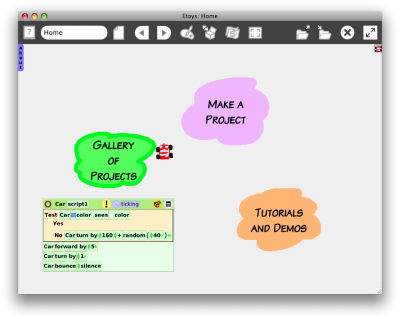
    Bert Freudenberg announced on the squeak-dev mailing list that Etoys 4.1 is now available. Etoys is a media-rich authoring environment and visual programming system with a simple, powerful scripted object model, ideal for teaching children powerful ideas in compelling ways. Based on Squeak, Etoys is available for free, with an open-source licence. You can run it on Mac OS X, Windows, and Linux (using the Etoys To Go version), or even use a plugin to run it directly in your browser. Etoys is also available on the XO OLPC laptop.

    This release includes new features such as DrGeo for exploring geometry, speech bubbles for objects, new tiles and Quick Guides in a number of languages. It also includes a large number of bug-fixes and cleanups. A number of new projects have been created to showcase the new features. Some of the new features were developed as part of Smalltalk’s participation in this year’s Google Summer of Code, which was co-ordinated by ESUG.

    You can find out more about Etoys 4.1 by reading the release notes, or by downloading the new version.

  • ESUG 2010 – Best Conference Ever?

    This year’s ESUG International Smalltalk Conference ended last Friday, though some attendees are still travelling homewards,  slowly recovering from jet lag, or waiting for lost baggage. Nevertheless, for most of us it’s an appropriate time to look back on the conference.

    The conference had a great buzz about it this year. As usual Camp Smalltalk gave early arrivals the chance to get their hands dirty and start hacking on code. Among other activities, Seaside 3.0 was finalised and announced.

    A packed official schedule kicked off with a great presentation (mp4) of a gorgeous web-based event planning tool based on Seaside. Following presentations covered topics as diverse as the challenges of development in commercial environments, using native widgets from Squeak on the iPhone, next steps for source management systems, a live workshop introduction to Wolf Pack Programming, controlling robots, a panel discussion of the complex issues of licencing and warranties, vendor roadmaps and much, much more. You can see the conference programme for more information.

    There were two events which really lifted the energy levels of the whole conference. The “Show Us Your Projects” session gave each speaker a strict ten minutes to present their pet project. These talks were crammed with too many great ideas and implementations to list – you really must keep an eye out for the video of the session. The Innovation Technology Awards had 15 entrants this year, each of whom was asked to provide a video and present their projects for voting. All the entries were very impressive, but the winners (announced during the social event at the Museo de la Ciencia) were Physical Etoys from the Universidad Abierta Interamericana team, Eliot Miranda’s Cog VM, and Mars (native widgets on OS X) by Esteban Lorenzano.

    Some other impressions of the conference can be found at the following sites (please add a comment below if you know of any other interesting posts about the conference):

    The conference was hosted by CitiLab Cornellà, who did a great job of making us feel welcome. All the sessions were live-streamed by CitiLab, and videos are being uploaded and hosted by Cincom. On-the-day support was provided by the student volunteers, who were easily identifiable by their stylish red caps!

    Thanks to everyone involved in the sponsoring, hosting and organising of the conference, and here’s looking forward to next year’s conference which is to be held in the UK.

  • Seaside 3.0 released

    Following some last minute work at this year’s second Camp Smalltalk event, the Seaside developers are pleased to announce the release of Seaside 3.0 on the eve of the ESUG 2010 Conference in Barcelona.

    Seaside has undergone a total overhaul, with many classes having been refactored to reduce complexity, decrease coupling, and improve flexibility. The packages in Seaside are now cleanly defined with clear relationships and interdependencies, allowing you to load only those pieces you require. There are improvements in testing, in portability and in performance, as well as much better tools for developers including the Seaside Control Panel for Pharo and Squeak, and the web-based administration interface.

    For more information, see the Seaside 3.0 release announcement, or the following links:

    Seaside 3.0 Detailed Release Notes
    http://seaside.st/community/development/seaside30

    Seaside One-Click Experience 3.0 (runs with one-click on Mac, Windows and Linux)
    http://www.seaside.st/distributions/Seaside-3.0-final.app.zip

    Seaside 3.0 Developer Image 3.0 (for Pharo developers)
    http://www.seaside.st/distributions/Seaside-3.0-final.zip

    SqueakSource Repository for Seaside 3.0
    http://www.squeaksource.com/Seaside30.html

  • And this time we mean it…

    In an unexpected statement today, Apple have again changed their stance on the use of third-party development tools. In particular, they say that “we are relaxing all restrictions on the development tools used to create iOS apps, as long as the resulting apps do not download any code. This should give developers the flexibility they want, while preserving the security we need”. Daring Fireball has a nice summary of the key changes to the terms and conditions.

    This puts us all back to where we were last year, with Squeak again being a realistic choice of development environments for use on the iPod Touch, iPhone, and of course the iPad. John MacIntosh’s port of the Squeak Virtual Machine to iOS, and Bert Freudenberg’s work on multi-touch support will prove very useful resources in getting keen developers up and running quickly. Unfortunately, Apple explicitly rule out any applications that can download additional code after purchase, meaning that Scratch on iOS is probably still out of bounds.

    There’s already lots of speculation about what’s driven this change of heart, based on the timing of this announcement (just after the big Apple event last week), its low profile release, and its terseness (reminiscent of Steve Jobs’ rather direct written communications), but whatever the cause, Squeak developers have cause to celebrate!

  • ESUG Innovation Technology Awards – sneak preview

    This year’s ESUG conference will host the 6th annual Innovation Technology Awards. The top 3 teams with the most innovative software will receive, respectively, €500, €300 and €200 during an awards ceremony at the conference. Developers of any Smalltalk-based software are welcome to compete, and, for the first time, this year entrants are asked to provide a 3-5min video explaining each entry.

    There are lots of interesting projects up for the competition, based on Squeak, Pharo, VisualWorks, and Smalltalk/X.  You can find out more about the competition at http://www.esug.org/Conferences/2010/Innovation+Technology+Awards, and of course, you’ll be able to see them for yourself at the conference. See you there!

  • Squeak 4.1 in production use

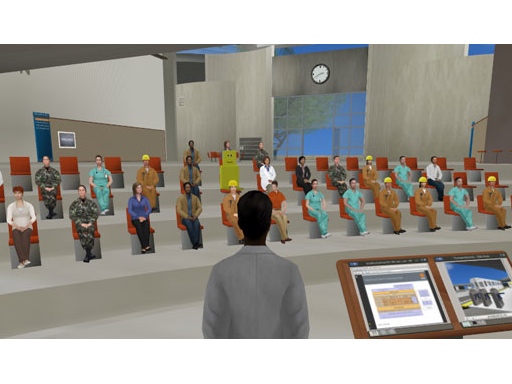
    Andreas Raab noted on the Squeak-dev mailing list and on his blog that Teleplace have decided that Squeak 4.1 is sufficiently stable to use as the basis for their commercial software. They made the massive leap from 3.8 all the way to Squeak 4.1 in this release of their Teleplace Enterprise Server 3.5, which is used to host online collaboration environments.

    It appears to have been a painless and successful activity, and is a massive vote of confidence in the ongoing changes to Squeak. If you want to see the new product in action, there’s a free trial version available at http://www.teleplace.com/trial/signup.php.

  • Google buys (part of) Instantiations

    Instantiations, the company who took over IBM’s Visual Age for Smalltalk business, have now had the Java part of their operation snapped up by Google, who were reportedly interested in Instantiation’s Java and Ajax team, especially their GWT Designer product, which is slated to become part of the Google Web Toolkit infrastructure.

    In many cases in the past, innovative companies using Smalltalk have attracted the attentions of the big players, who have then bought them and dropped all Smalltalk development in favour of Java or other enterprise environments. In this case however, Instantiations’ Smalltalk business is being spun off, and will remain in business as a separate entity focusing on development and support of Smalltalk products including VA Smalltalk, as their new homepage makes clear.

  • Seaside 3.0rc – One Click Image

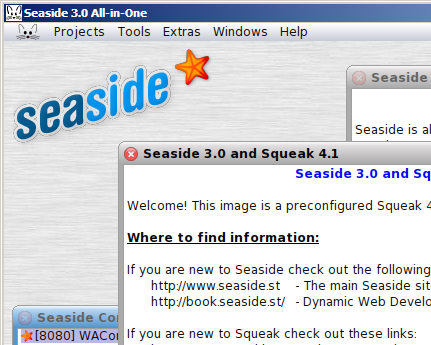
    Following on from the recent release of the Seaside release candidate for 3.0, a Squeak “One-Click” image has been put together to allow you to try out the new version with—er—one click!

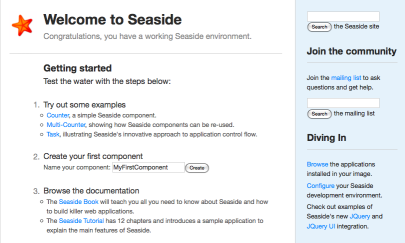
    The new image is based on Squeak 4.1, and launches fully configured with Seaside running with Comanche on port 8080, so you can immediately see the new improved Seaside welcome page at http://localhost:8080/, with links to documentation and the Seaside book.

    Seaside’s 3.0 release is faster, cleaner, better tested and has many other changes and improvements over previous releases, so it’s well worth checking out this release candidate now.

  • Smalltalk: the past, the present, and the future?

    Anyone with an interest in the continuing role and development of Smalltalk has had lots to chew on over the past few days.

    As part of  a series of investigations into the most widely-used programming languages, Computerworld Australia has published a conversation with Alan Kay about his role in the development of the “foundation of much of modern programming today: Smalltalk-80”, Object-Oriented Programming, and modern software development.

    InfoQ is running a series of interviews recorded at QCon London. One of these is a session with Ralph Johnson and Joe Armstrong discussing the Future of OOP, including their take on what Smalltalk got wrong and right.

    Finally, Gilad Bracha continues to lay out his vision for what he sees as Smalltalk’s successor, Newspeak. His latest post contains encouragement and advice for those interested in porting existing libraries and applications to Newspeak.

  • A newer, faster computer – for free!

    Eliot Miranda has announced that his new Cog VM is now available for download, bringing Just-In-Time compilation and massive speed-ups to Squeak and Pharo.

    If you’ve been following Eliot’s blog, you’ll know that he’s been working on this new VM for quite a few months now; well, it’s now ready for public consumption, and it’s blisteringly fast: up to three times faster than the existing VMs.

    The VM selectively re-compiles code to native (Intel) machine-code, based on the size and complexity of the methods, and how often they’re called. This means that the benefits of the new VM vary from task to task, but Andreas Raab estimates that you should expect a 2-3x performance improvement generally, “more towards 2x when running primitive and I/O-bound stuff; more towards 3x when running ‘pure’ Smalltalk code”.

    Eliot is interested in hearing from developers on other platforms who want to port the new VM to those platforms. In the meantime, he has also released the “Stack VM”, a cross-platform interpreter that uses context-to-stack mapping to achieve more modest performance gains.

    See Eliot’s original post and the following discussion for more details of the new VM, some notes of caution, and how to get your hands on it and use it.

    Thanks to Eliot for this great piece of work, and to Teleplace who have funded this work (and have been using it for the past year), and have agreed to release the new VM’s under the MIT Licence.