Category: Media

  • Avi Bryant Interview

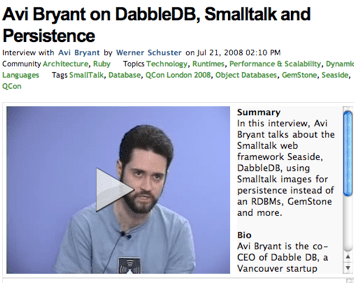
    Werner Schuster from InfoQ.com spent some time talking to Avi Bryant at QCon London 2008, and InfoQ have posted a recording of their conversation. In the interview, Avi talks about the Smalltalk web framework Seaside, DabbleDB, using Smalltalk images for persistence instead of an RDBMs, GemStone and more.

  • Get recording your Squeak videos now!

    The Squeak mailing lists have recently seen a surge of interest in getting videos published to help explain Squeak and Smalltalk to developers coming to the language and environment for the first time.

    In response to this Randal L. Schwartz has set up a new Squeak Smalltalk group on vimeo.com to allow Squeakers to easily upload and share their videos.

    Videos can be a great way to help people quickly pick up a lot of complex information, which makes this an opportunity for Squeakers old and new to help promote Squeak. If there are any topics that you think would suit a short video, why not try recording one and publishing it? If you’re the developer of a powerful Squeak developer tool, and you’re amazed that no-one seems to use all of its functionality, this would be a great way to expose all of those features in a compelling way.

    If you’re a new developer struggling with Squeak, let us know what topics you’d like to see covered in video tutorials. If you’ve got any recommendations for recording and editing software for Windows, Mac or Linux, please leave a comment.

  • Randal Schwartz to join Smalltalk podcast (warning, some recursion involved)


    Randal Schwartz notes on his blog that: 

    James Robertson of the weekly Smalltalk Industry Misinterpretations podcast has graciously offered me the opportunity to add a short weekly Squeak News segment to his podcast.  I’ll be selecting the most recent posts from news.squeak.org, and reading them at varying speeds, depending on the amount of news.  Hear the result at the current podcast, andsubscribe to get future (weekly) releases.

    It would be really cool if my appearance reading the Squeak News gets picked up for Squeak News, so I’ll be reading an article from Squeak News for the podcast about reading the articles from Squeak News for the podcast.  Turtles all the way down!
    Heh, let’s see if this breaks the intar-web.


  • German Squeak Association Meeting: Demos

    The German Squeak Association (Squeak e. V.) had its annual meeting on May 17. For the second time, the meeting was hosted by the Software Architecture Group at the Hasso-Plattner-Institut in Potsdam. Before the official part, attendees of the meeting were given the opportunity to demonstrate their Squeak projects.

    First, Tobias Pape and Arian Treffer, students of HPI, demonstrated SwaLint, a source code checker for Squeak. SwaLint is intended as a successor to SmallLint and, thanks to its flexible plug-in architecture, supports running SmallLint checks seamlessly. SwaLint can be configured in great detail: thresholds for all kinds of values can be set, and output can be filtered. Users can easily implement their own plug-ins for the tool.

    Next, Michael Haupt (HPI) gave a brief demonstration of SqueakFS, which was implemented by Johan Björk and Eskil Andréen from Stockholm University, Sweden. SqueakFS makes the contents of a running Squeak image available as part of the file system. Currently, it is limited to read-only access, but the image can already be viewed from three perspectives: all classes as a flat collection, assorted by category, and by class hierarchy.

    Robert Krahn presented SqueakSVN, which is an ongoing development effort in the Software Architecture Group at HPI. The purpose of SqueakSVN is to make Subversion version control available to Squeak developers; it is able to import Monticello projects. SqueakSVN will be released in June.

    Martin Beck is currently working on his MSc thesis in the HPI Software Architecture Group. His work is dedicated to implementing NXTalk, a Smalltalk virtual machine for the Lego Mindstorms NXT platform. Development of NXTalk application takes place in a Squeak image, and assembled NXTalk images are transferred to the NXT for execution by the dedicated NXTalk VM. In the current state, simple images can be assembled and run: Martin demonstrated a program that can be used to steer a simple NXT bestowed with two motors.

    The popular introduction to the Seaside web application framework that was produced at HPI was briefly presented by David Tibbe, one of its co-authors.

    Robert Krahn had another appearance presenting the collection of games for the XO laptop developed by HPI students. All of the games are available for download as project or SAR files.

    Finally, Carl Friedrich Bolz (Düsseldorf University), Adrian Kuhn (University of Bern), and Toon Verwaest (University of Bern) presented SPy, their ongoing effort to implement the Squeak VM in Python using the sophisticated PyPy tool chain. SPy is currently lacking GUI  and other I/O support, but is able to load images and run the tinyBenchmarks. Right after the Squeak association meeting, a PyPy development sprint in Berlin will, amongst others, bring new improvements.

    After the official part of the association meeting, special guest Dan Ingalls gave a demonstration of Lively, his current project at Sun Labs. It looks and feels, admittedly, a bit like Squeak in disguise, but in Dan’s opinion, there is nothing bad about building the “same” system several times if it’s cool. That is certainly true for Lively.

  • Squeak by Example now available in French

    Squeak by Example has been a hugely successful introduction to Squeak since its publication last year, and it has now been made available to a wider audience, following the publication of a French edition Squeak par l’exemple. As with the English edition, the book has been made available in print from print-on-demand specialists lulu.com for around €17/$20/£11, or can be downloaded from the site as a pdf.

    Squeak par l’exemple was produced thanks to the hard work of the team of translators: Martial Boniou, Mathieu Chappuis, Luc Fabresse, René Mages, Nicolas Petton, Alain Plantec, Benoît Tuduri and Serge Stinckwich.

  • Seaside: your next web framework

    Randal L. Schwartz had a “standing-room only” audience at BarCampPortland for his presentation on why web developers should consider using the Seaside web application framework. BarCampPortland is described as an “unconference for the Portland [Oregon] tech community”, and aims to offer the attendees interesting topics, cool people and great networking opportunities.

    Randal was offered a 45-minute slot, and took the opportunity to explain what makes Seaside such a powerful framework for professional web developers. His material, which incorporated feedback from colleagues on the Seaside mailing list, was very well received, and will form the basis for future presentations by Randal to raise the awareness of Seaside in the web development community.

  • New Dabble DB Demo Debuts

    Avi Bryant writes at the Dabble DB blog that the team has produced a new 8-minute demo of their product in action. This new video replaces their 2006 video which was linked to so frequently that it still shows up as #4 in the google results for “the demo“.

    Dabble DB is a tool to help you create, manage, interpret and present data via your browser. Written in Squeak using the Seaside web application framework, it has received glowing reviews since its launch in 2005.

  • Using Squeak in Education

    Hilaire Fernandes is writing a series of blog posts intended to introduce Squeak to teachers and to developers of educational software. The articles—available in both English and French—are intended to be a gentle introduction to Squeak’s features, and to highlight the ways in which it can be used in education. In each post Hilaire introduces a new topic, and explains its relevance to educational users.

    In writing this series of posts, Hilaire is able to draw on many years involvement in developing Free software in education (including Dr Geo II for the OLPC XO), and working with education professionals to incorporate such software into the school curriculum.

    The first post gives Squeak’s background and introduces Morphic – English, Français.

    The second post is an overview of how images work – English, Français.

  • “An Introduction to Seaside” now published

    Michael Perscheid announced in the Seaside mailing list the publication of a new Seaside book An Introduction to Seaside. He says that:

    “This book explains the major concepts of Seaside in a clear and intuitive style. A working example of a ToDo List application is developed to illustrate the framework’s important concepts that build upon each other in an orderly progression. Besides the notions of users, tasks, components, forms and deployment, additional topics such as persistence, Ajax and Magritte are also discussed.”

    The book is based on the online tutorial developed at the Hasso-Plattner Institut, and the content has been revised and expanded for this edition.

    The 212-page book can be previewed and ordered at online publisher lulu.com for about €20/£14/$25.

    Congratulations to all involved at the HPI Software Architecture Group for producing this great introduction to Seaside. They are: David Tibbe, Michael Perscheid, Martin Beck, Stefan Berger, Jeff Eastman, Michael Haupt, Robert Hirschfeld and Peter Osburg.

  • Free Smalltalk books

    Stéphane Ducasse maintains a great list of free Smalltalk books including online pdfs of many out-of-print books.

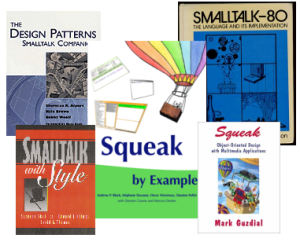
    These books span over twenty years of Smalltalk development, and includes great resources such as Smalltalk-80: The Language and its Implementation (the “Blue Book”), Smalltalk with Style(pdf), and more recent classics such as Squeak by Example (written by Stéphane Ducasse along with Andrew P. Black, Oscar Nierstrasz and Damien Pollet).

    This is a great resource that is of use to beginners and to more experienced programmers wanting to understand more of the philosophy and design decisions behind Smalltalk and Squeak.

    Links and reviews of many other (non-free!) books can be found at the Squeak wiki, John M McIntosh’s site, and Squeakland has a reading list prepared by Alan Kay for those who want to learn more about the ideas and philosophies that influenced the creation of Squeak.

    If you know of other books and online resources that should be listed here, please let us know!

    [Please note the URL has been updated to address David’s comment below. The original URL was an older page with fewer books available.]