
Antonio Moreno just let us know of this Youtube video featuring a demonstration of Squeak use in education. The demo, taken at the Salón de la Educación 2007, shows Randall Caton explaining to teachers, students and politicians how he uses Squeak with his students as part of the Nasa Connect program.
Category: Media
-
Scratch Unleashes New Projects Web Site

Creating from Scratch
New Software from MIT Media LabUnleashes Kids’ Creativity Online
A new programming language developed at the MIT Media Lab turns kids from media consumers into media producers, enabling them to create their own interactive stories, games, music, and animation for the Web.
With this new software, called Scratch, kids can program interactive creations by simply snapping together graphical blocks, much like LEGO® bricks, without any of the obscure punctuation and syntax of traditional programming languages. Kids can then share their interactive stories and games on the Web, the same way they share videos on YouTube, engaging with other kids in an online community that provides inspiration and feedback.

“Until now, only expert programmers could make interactive creations for the Web. Scratch opens the gates for everyone,” says Mitchel Resnick, Professor of Learning Research at the MIT Media Lab and head of the Scratch development team.Resnick’s Lifelong Kindergarten research group previously developed the “programmable bricks” that inspired the award-winning LEGO® MINDSTORMS® robotics kits. Just as MINDSTORMS allows kids to control LEGO creations in the physical world, Scratch allows them to control media-rich creations on the Web.
“As kids work on Scratch projects, they learn to think creatively and solve problems systematically – skills that are critical to success in the 21st century,” says Resnick.
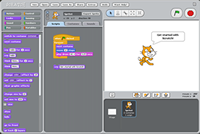
Designed for ages 8 and up, Scratch is available by free download from the Scratch website (http://scratch.mit.edu). The software runs on both PCs and Macs. The MIT Media Lab is now collaborating with other organizations – including Intel, Microsoft, Samsung, BT, the LEGO Group, Motorola, and One Laptop Per Child (OLPC) – to create other versions and applications of Scratch, including versions for mobile phones.
The name Scratch comes from the technique used by hip-hop disc jockeys, who spin vinyl records to mix music clips together in creative ways. Similarly, Scratch lets kids mix together a wide variety of media: graphics, photos, music, and sounds.
A glance at the Scratch website (http://scratch.mit.edu) reveals a kaleidoscope of projects created by kids: a story about a polar bear school, space attack games, and a break-dancing performance. Some creations are goofy and fun; some reveal serious social themes. Kids are constantly modifying and extending one another’s projects on the website – and learning from one another in the process. “It’s exciting to wake up each morning and see what’s new on the site,” said Resnick.
Scratch was developed by Resnick’s Lifelong Kindergarten research group in collaboration with UCLA educational researchers, with financial support from the National Science Foundation and the Intel Foundation. Throughout the development process, the design team received feedback from children and teens at Intel Computer Clubhouses and school classrooms.“There is a buzz in the room when the kids get going on Scratch projects,” says Karen Randall, a teacher at the Expo Elementary School in St. Paul, Minnesota. “Students set design goals for their projects and problem-solve to fix program bugs. They collaborate, cooperate, co-teach. They appreciate the power that Scratch gives them to create their own versions of games and animations.”
For more information, see http://scratch.mit.edu/about

The Lifelong Kindergarten group (http://llk.media.mit.edu) at the MIT Media Lab develops new technologies that, in the spirit of the blocks and finger paint of kindergarten, expand the range of what people can design, create, and learn.
©2007 MIT Media Laboratory
LEGO and MINDSTORMS are trademarks of the LEGO Group.
Used here with special permission. ©2007 The LEGO Group.

The development of Scratch was supported by the National Science Foundation under grant number 0325828. Any opinions, findings, conclusions, or recommendations expressed in this release are those of the authors and do not necessarily reflect the views of the National Science Foundation.
-
Don’t Miss Smalltalk Solutions – April 30th – May 2nd 2007
Smalltalk Solutions is this weekend! There will be a number of talks on Seaside. Check out the presentation listing in DabbleDB (which is written using Seaside). Gemstone will be talking about their work porting Seaside and Monticello to Gemstone and are announcing a free version of Gemstone.
Carl Gundel announced a Seaside Birds of Feather Session Wednesday May 2nd from 5 to 7pm.
Don’t miss Boris Popov’s Seaside Experience Report. Boris and DeepCove Labs have done some really excellent work! Check it out.
Don’t Miss Bert Freudenberg’s Keynote presentation about OLPC! The One Laptop Per Child initiative is a wonderful way for all smalltalkers to get involved and contribute to something that is really worthwhile!
-
SqueakFest ’07 at Columbia College Chicago

We have lift off. Columbia College Chicago and Viewpoints Research Institute today announced the dates and location for SqueakFest ’07.
SqueakFest ’07 will be held at
August 1, 2 & 3
Please mark your calendars and help spread the word about this exciting event for educators, parents, community and technical leaders, and developers. There will be hands on workshops, key note presentations, panel discussions and more. Come learn, share you experiences, and show off your Squeak Etoys projects. There are also plans for a special OLPC track where you can learn more about this worthwhile initiative.
Check back for more information as this exciting event takes shape www.squeakland.org. Please save the date!
-
Can your book do this?
As the sun rose somewhere over the Atlantic Ocean, the dark fading away, and the cold of over a month starting to thaw, on the west coast of North America it is still dark and John M. McIntosh has only a deep and tired yawn as thanks and a simple form of celebration marking the release of Sophie RC3*.
It is fitting that midnight should toll during this new release. The clock chimes to mark the occasion of new timeline commands; the ability to play movies connected and controlled by time itself, when time itself rests to zero for a new day. A new day indeed: the future of electronic books.
Sophie is free and open source software built on Squeak. You can get your own copy of Sophie and start creating your own electronic books now. Check out this new video of what Sophie can do.
Could you use Sophie to write really cool new electronic books? Sure. How about develop a new interactive brochure for your company? Yeah! How about delivering real engaging content to your potential voter base? Hmmm…
How would you use Sophie?
(*available soon watch for RC3) -
How Open Source Projects Survive Poisonous People (And You Can Too)
Someone just recommend this video to me. I thought it was very interesting perspective about orgainizing and managing an open source project so I thought I’d share it with the community.
Google Tech Talks January 25, 2007ABSTRACT
Every open source project runs into people who are selfish, uncooperative, and disrespectful. These people can silently poison the atmosphere of a happy developer community. Come learn how to identify these people and peacefully de-fuse them before they derail your project. Told through a series of (often amusing) real-life anecdotes and experiences.
-
Complete Computing System in 20K lines of Code

For those of you that couldn’t make it to Ian’s talk here is a video of the presentation. (more…)
-
New Seaside Blog

Lukas starts his blog with a nice screencast of how to install the pier blog plugin.
-
Taking the Beat of Cadence
Gilad Bracha is a legend in Object Oriented Programming. He is the Co-Author of the Java Language Specification and one of the major contributors to Strongtalk which has just been released by Sun under an Open Source License.
Gilad is forming a team at Cadence and is raising eye brows with his latest hires. Eliot Miranda and Vassili Bykov recently left Cincom to join Gilad at Cadence . Eliot is well-known known as a Master of Smalltalk Development. Vassili Bykov was the lead tool builder of VisualWorks. We can’t help wondering about the team of Gilad, Eliot, and Vassili. I spoke with Gilad about Cadence, Smalltalk, and Open Source. (more…)

 The Weekly Squeak