Category: Platforms

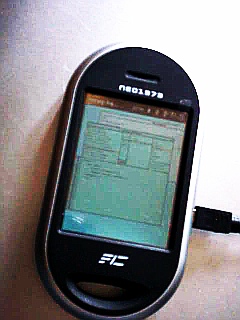
  • Squeak running on FIC Neo1973 Open Source Phone

    Squeak Neo1973

    Tony Garnock-Jones reports that
    he has succeeded in getting Squeak running on the new FIC Neo1973
    open-source GSM cellphone, which runs OpenMoko, based on OpenEmbedded.

    He used Squeak VM version 3.9, running a stripped 2.8 image (though he has also had a 3.9 image running), and is now looking at accessing the phone’s hardware, including GSM modem, GPS, Bluetooth, touchscreen, audio, battery and auxiliary buttons.

    To manage user interaction, he’s looking at using Faure to construct a stylus- or
    finger-driven UI.

    Tony is working with the OpenMoko team to get the necessary changes integrated into the main code-base, making this an easier exercise for other developers to follow. He’s also looking at getting Spoon running on the phone.

    Keep an eye on the LShift blog for progress reports.

    Like this story? Why not add it to Delicious Reddit or Digg?

  • OLPC on TV

    OLPC Size

    From: Michael Haupt,

    The German/Swiss/Austrian TV station 3sat has a weekly 30-minute show called “neues” (roughly translated “new things”) which deals with IT-related information. Yesterday’s show was focusing on bringing IT to isolated regions and emerging nations as well as developing countries. The show featured an article on mesh networks in Ecuador and the Linux4Africa project.

    Linux4Africa is a German project collecting old but functional hardware. The components are cleaned, repaired (if necessary), bestowed with an Edubuntu Linux installation, and sent to Tanzania and Moçambique.

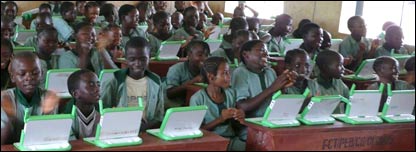
    12 of the show’s 30 minutes were dedicated to an extensive coverage of the OLPC project. Etoys and Squeak were mentioned several times during the feature. The project itself was introduced, and Bert Freudenberg was interviewed about the technical features of the XO laptop, which was presented in detail.

    There were also two interviews in the studio. Two members of GTZ (Deutsche Gesellschaft für Technische Zusammenarbeit; German Society for Technical Cooperation) responsible for XO distribution in Ethiopia talked about the project in general and about the impressive progress children made when working with the XO.

    The other interview – which filled the first slot in the OLPC coverage – featured two students from Hasso Plattner Institute, Potsdam, who have developed strategic and skill-improving games for the XO in the Software Architecture Group‘s course on software architectures.

    All in all, the editorial staff at 3sat did a tremendous job in preparing this show. To the writer’s knowledge, this was the first time the OLPC project was presented at such a level of detail in German television. Germany being a country where the the project has no actual lobby, it is important to have such media coverage – it would be nice to see much, much more of it.

    The entire show can be watched online (in German).

  • OLPC – The $100 Laptop – Goes into Production

    https://i0.wp.com/newsimg.bbc.co.uk/media/images/44015000/jpg/_44015059_galadima_416.jpg

    Five years after the concept was first proposed, the so-called $100 laptop is poised to go into mass production. Check out the BBC Article.

  • SqueakFest ’07 – Register Now!

    SqueakFest 07 Official

    Register for SqueakFest ’07.

    From Kim Rose, Viewpoints Research Institute:

    Greetings —

    Online registration is now available for SqueakFest ’07!
    http://imamp.colum.edu/eceim/squeakfest07/index.php

    We’re putting together a great three day program including hands-on workshops, panels, presentations, casual sharing time and fun social events.

    Alan Kay will give a talk about the One Laptop Per Child Initiative, the “xo” machine and Squeak Etoys on this platform.

    Registration for the entire program is $125.00. Please register
    early as this will be helpful for our planning. We also encourage
    you to BOOK YOUR HOTEL ROOM(s) EARLY! Chicago will host numerous summer events and hotels are already near capacity for August 1-3.

    Some suggested accomodations appear on the SqueakFest website:
    http://imamp.colum.edu/eceim/squeakfest07/accommodations.php

    Please forward this email to anyone you know that may be interested in attending.
    Come join us in Chicago! We look forward to seeing you there.
    cheers,
    Kim

  • If you can’t take the HEAT!

    Taking the heat

    You know what they say, “If you can’t take the heat, get out of the laptop for the worlds children business!” Pictured above is the OLPC computer running day and night (look closely and notice the Squeak E-Toys running) at scorching temperatures 52C (125F) during the day time and 22C (72F) at night. Just image running your computer laptop in an oven all day!

  • Sophie-Croquet?

    Sophie-Croquet

    By Daniel Lanovaz

    I’m ready! Sophie, Croquet, Seaside, Scratch, Plopp, OLPC … The Era of Squeak and Smalltalk is upon us!

  • Minding Your Business With Smalltalk (Part 3 of 4)

    Castle

    Previously we spoke with Michael Rueger and Steve Hunter. From Michael we found out about the perspective of writing and supporting open source software. From Steve we found out what it is like being a consumer of open source software. Today we talk with Bert Freudenberg. From Bert we hope to learn what it is like being a Smalltalk programmer contributing to open source.

    (more…)

  • Scratch Unleashes New Projects Web Site

    Scratch
    Creating from Scratch
    New Software from MIT Media Lab

    Unleashes Kids’ Creativity Online

    A new programming language developed at the MIT Media Lab turns kids from media consumers into media producers, enabling them to create their own interactive stories, games, music, and animation for the Web.

    With this new software, called Scratch, kids can program interactive creations by simply snapping together graphical blocks, much like LEGO® bricks, without any of the obscure punctuation and syntax of traditional programming languages. Kids can then share their interactive stories and games on the Web, the same way they share videos on YouTube, engaging with other kids in an online community that provides inspiration and feedback.
    Scratch To Web
    “Until now, only expert programmers could make interactive creations for the Web. Scratch opens the gates for everyone,” says Mitchel Resnick, Professor of Learning Research at the MIT Media Lab and head of the Scratch development team.

    Resnick’s Lifelong Kindergarten research group previously developed the “programmable bricks” that inspired the award-winning LEGO® MINDSTORMS® robotics kits. Just as MINDSTORMS allows kids to control LEGO creations in the physical world, Scratch allows them to control media-rich creations on the Web.

    “As kids work on Scratch projects, they learn to think creatively and solve problems systematically – skills that are critical to success in the 21st century,” says Resnick.
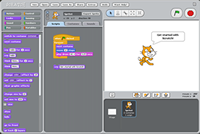
    ScratchScreen

    Designed for ages 8 and up, Scratch is available by free download from the Scratch website (http://scratch.mit.edu). The software runs on both PCs and Macs. The MIT Media Lab is now collaborating with other organizations – including Intel, Microsoft, Samsung, BT, the LEGO Group, Motorola, and One Laptop Per Child (OLPC) – to create other versions and applications of Scratch, including versions for mobile phones.

    The name Scratch comes from the technique used by hip-hop disc jockeys, who spin vinyl records to mix music clips together in creative ways. Similarly, Scratch lets kids mix together a wide variety of media: graphics, photos, music, and sounds.

    A glance at the Scratch website (http://scratch.mit.edu) reveals a kaleidoscope of projects created by kids: a story about a polar bear school, space attack games, and a break-dancing performance. Some creations are goofy and fun; some reveal serious social themes. Kids are constantly modifying and extending one another’s projects on the website – and learning from one another in the process. “It’s exciting to wake up each morning and see what’s new on the site,” said Resnick.


    Scratch was developed by Resnick’s Lifelong Kindergarten research group in collaboration with UCLA educational researchers, with financial support from the National Science Foundation and the Intel Foundation. Throughout the development process, the design team received feedback from children and teens at Intel Computer Clubhouses and school classrooms.

    “There is a buzz in the room when the kids get going on Scratch projects,” says Karen Randall, a teacher at the Expo Elementary School in St. Paul, Minnesota. “Students set design goals for their projects and problem-solve to fix program bugs. They collaborate, cooperate, co-teach. They appreciate the power that Scratch gives them to create their own versions of games and animations.”

    For more information, see http://scratch.mit.edu/about

    LifeLongKindergarten - Mit Media Lab

    The Lifelong Kindergarten group (http://llk.media.mit.edu) at the MIT Media Lab develops new technologies that, in the spirit of the blocks and finger paint of kindergarten, expand the range of what people can design, create, and learn.

    ©2007 MIT Media Laboratory

    LEGO and MINDSTORMS are trademarks of the LEGO Group.

    Used here with special permission. ©2007 The LEGO Group.

    National Science Foundation

    The development of Scratch was supported by the National Science Foundation under grant number 0325828. Any opinions, findings, conclusions, or recommendations expressed in this release are those of the authors and do not necessarily reflect the views of the National Science Foundation.

  • Don’t Miss Smalltalk Solutions – April 30th – May 2nd 2007

    Smalltalk Solutions is this weekend! There will be a number of talks on Seaside. Check out the presentation listing in DabbleDB (which is written using Seaside). Gemstone will be talking about their work porting Seaside and Monticello to Gemstone and are announcing a free version of Gemstone.

    Carl Gundel announced a Seaside Birds of Feather Session Wednesday May 2nd from 5 to 7pm.

    Don’t miss Boris Popov’s Seaside Experience Report. Boris and DeepCove Labs have done some really excellent work! Check it out.

    Don’t Miss Bert Freudenberg’s Keynote presentation about OLPC! The One Laptop Per Child initiative is a wonderful way for all smalltalkers to get involved and contribute to something that is really worthwhile!

  • Help improving the Smalltalk experience on the OLPC machine

    As you may now, the XO laptops produced by the One Laptop Per Child project include a Squeak/Etoys image in the base software. The OLPC developers decided to hide the Smalltalk development enviroment and highlight the Etoys subsystem, since that’s the part that matters in a kids machine such as the XO.

    But the power of a full-fledged Smalltalk system is still there, and you can help. As Bert Freudenberg writes to the Squeak Beginners mailing list:

    So everybody interested in making the “Smalltalk experience” on the OLPC machine an enjoyable one, please help. The VPRI group focuses on etoys and system integration, but you are invited to contribute. And, in case this has not been clear, you do *not* need an OLPC prototype to run this. It’s Squeak, after all.

    More info on how to run the OLPC version of Squeak and Etoys on your system may be found here.

    Update: changed a misleading statement.