Category: Publicity

  • Squeak BOF at OOPSLA 2008

    OOPSLA, the “original conference devoted to object-oriented programming”, is running this year on 19th-23rd October in Nashville. Göran Krampe wrote to the mailing list to let attendees know that he is organising a Squeak “Birds of a Feather” evening session on Tuesday at 18:00.

    Göran has had experience of organising these events in the past, so you can be sure that the logistics have been thought through carefully – he’s even bringing his own projector with him from Sweden, rather than rely on the equipment available at the venue! All the videos of all the presentations will be made available after the session.

    If you’re interested in attending this session, please let Göran know by adding your name to the OOPSLA 2008 page on the Squeak wiki (if you’re having trouble editing that page, the words squeak and viewpoints may be of some use to you). The wiki page also has information on some other items that may be of interest to Squeakers.

  • ESUG Innovation Awards 2008

    This year’s winners of the ESUG Innovation Technology Awards were announced at the 16th Joint International Smalltalk Conference in Amsterdam last night. There were a record-breaking 21 entrants, with a great selection of innovative ideas and products. Voting was by all attendees of the conference, and the winners were:

    1st prizeDrGeoII, Hilaire Fernandes’ development in Squeak Smalltalk of an application that allows students at primary or secondary level to create and interactively manipulate geometric figures within definable constraints, as featured on the Weekly Squeak recently (pdf description available here).

    2nd prizeseaBreeze, an application from Georg Heeg eK which allows Seaside developers to work in an interactive environment to develop web content (pdf description available here).

    3rd prize – iSqueak, a project from John M McIntosh, Grit Schuster and Michael Rueger, which allows Squeak to interact with multi-touch input devices such as the iPhone (pdf description available here).

    The competition was sponsored by ABN Amro Bank, and the winners get prizes of €500, €300 and €200.

    Following the ceremony, Georg Heeg announced that seaBreeze will be dual-licensed, with a free versions available under the MIT licence. The code will be made available once some finishing touches have been applied.

  • CMSBox wins top usability awards

    Avi Bryant alerted the Seaside mailing list to some exciting news: Cmsbox is one of the ten winners of this year’s useit.com 10 Best Application UIs of 2008, a competition intended to identify the 10 best-designed application user interfaces each year.

    Cmsbox is a powerful and flexible Content Management System (CMS) which allows users to create, edit and arrange content directly on the web site. It was built by Swiss company netstyle.ch using Squeak Smalltalk, Seaside and Scriptaculous.

    In describing the award, which is the latest in a string of awards won by CmsboxJakob Neilsen wrote that Cmsbox made it “particularly easy for direct users to create highly usable designs […] They have demonstrated that just one extra line of controls is all that is required to turn a website into a Web authoring environment. […] There are no modes to switch between, no edit windows to keep track of; it is immediately clear to users what effect their actions will have on the final layout because they are always working within that final layout”.

  • Avi Bryant Interview

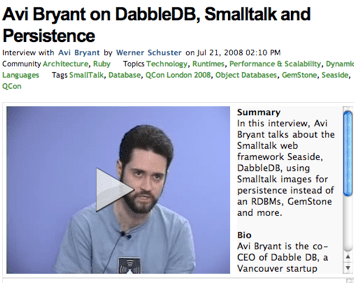
    Werner Schuster from InfoQ.com spent some time talking to Avi Bryant at QCon London 2008, and InfoQ have posted a recording of their conversation. In the interview, Avi talks about the Smalltalk web framework Seaside, DabbleDB, using Smalltalk images for persistence instead of an RDBMs, GemStone and more.

  • Plopp featured in MacWorld

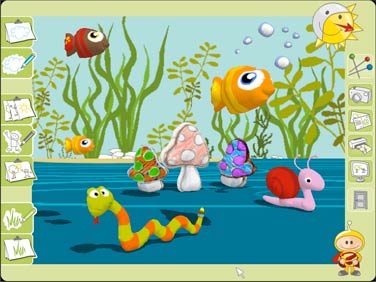
    MacWorld magazine is running a series of reviews of their favourite free and low-cost applications for the Mac, and one of their picks is Plopp, a painting tool from Impara for easily creating cartoon-like 3D scenes. Although their review doesn’t mention this (did they even know it?), Plopp was developed and runs totally in Squeak!, which of course means that it’s also available on Windows and (for free!) on Linux.

    Plopp seems to be getting a lot of attention at the moment, perhaps because you can also use it to create models for use in Second Life, so congratulations to all at Impara for the recognition their work is getting!

  • Smalltalk Solutions 2008 – slides now available

    Most of the slides from the presentations at this year’s Smalltalk Solutions conference are now on line.

    The material available includes Gilad Bracha’s talk on Newspeak, James Foster’s guide to building a Seaside application using GemStone/S, Michael Rueger’s introduction to Sophie, Arden Thomas demonstrating WebVelocity in action, and Randal Schwartz’s double-header keynote: Seaside – Your Next Web Framework and an introduction to persistency solutions for use with Seaside.  

    There are also slides from a couple of sessions looking at the reasons for the recent resurgence of interest in Smalltalk: Arden Thomas looks at the features of Smalltalk that other languages lack, and Rob Rothwell explains how Smalltalk helps with the development of healthcare applications.

    There are many more slide-packs available, and still more to be added, so please check out the conference page for more information. James Robertson is adding video and audio as it becomes available.

  • Gemstone’s MagLev presented at RubyConf

    Avi Bryant joined Gemstone’s Bob Walker at RailsConf last week for a presentation (summarised here) describing MagLev, a Ruby VM built on the same technology as Gemstone/S, offering transparent persistence, and so the possibility of massive scalability, to Ruby applications. Despite only being under development for three months, with the initial focus being on scalability rather than speed, MagLev is already able to run Ruby code at speeds comparable or better than established Ruby implementations, with orders of magnitude improvements in some cases.

    The presentation caused lots of excitement at the conference, and has sparked lots of heated debate within the Ruby development community with some very different views of MagLev from Charles NutterGiles Bowkett,  Obie Fernandez, and Antonio Cangiano, as well as an article at Slashdot and posts all over Reddit.  Avi has a blog-post addressing some of the discussion, as does Patrick Collison.

    For Smalltalkers, one particularly interesting feature of MagLev, from an interview with Bob Walker by InfoQ, is that it retains the ability to execute Smalltalk code as well as Ruby, and should support image-based development.

    [Edit: Chad Fowler had access to MagLev well before the presentation, and so offers a more considered assessment of it]

  • S3 Highlights: Lively, COLA, Huemul, Squeak on Python and more


    On 15/16 May, the workshop on Self-Sustaining Systems (S3) took place at the Hasso-Plattner-Institut in Potsdam. An exciting event at a beautiful place, it featured invited talks by Ian Piumarta, Dan Ingalls, and Richard P. Gabriel, and five presentations of reviewed papers that approached self-sustainment from different angles.

    (more…)

  • 16th International Smalltalk Joint Conference – Call for Contributions

    ESUG, the organisers of the 16th International Smalltalk Joint Conference, to be held 25-29 August 2008 in Amsterdam, have issued a call for contributions. Submissions are to be made by 1st June 2008, with notification of acceptance on 15th June 2008.

    About the Conference

    For the past 16 years, the European Smalltalk User Group (ESUG) has organised the International Smalltalk Conference, a lively forum on cutting edge software technologies that attract people from both academia and industry for a whole week. The attendees are both engineers using Smalltalk in business and students and teachers using Smalltalk both for research and didactic purposes.
    As every year, this year’s edition of the largest European Smalltalk event will include the regular Smalltalk developers conference with renowned invited speakers, a Smalltalk camp that proves fruitful for interactions and discussions. This year’s conference will also see the 4th year of the Innovation Technology Awards, where prizes will be awarded to authors of best pieces of Smalltalk-related projects.

    The conference features the following events:

    • Camp Smalltalk – There will be a Smalltalk camp on 23-24 August
    • Developers Forum
    • Technology Forum

    Developers Forum
    This year we are looking for your experience with using Smalltalk. The list of topics includes, but is not limited to, the following:

    • XP practices
    • Development tools
    • Experience reports
    • Model driven development
    • Web development
    • Team management
    • Meta-Modelling
    • Security
    • New libraries & frameworks
    • Educational material
    • Embedded systems and robotics
    • SOA and Web services
    • Interaction with other programming languages

    Technology Forum
    We are proud to announce the 4th Innovation Technology Awards. The top 3 teams with the most innovative software will receive, respectively, €500, €300 and €200 during an awards ceremony at the conference. Developers of any Smalltalk-based software are welcome to compete.

    Student Volunteer Program
    If you are a student wanting to attend ESUG, have you considered being a student volunteer? Student volunteers help keep the conference running smoothly; in return, they have free accommodations, while still having most of the time to enjoy the conference.

    We hope to see you there and have fun together.

  • Seaside: your next web framework

    Randal L. Schwartz had a “standing-room only” audience at BarCampPortland for his presentation on why web developers should consider using the Seaside web application framework. BarCampPortland is described as an “unconference for the Portland [Oregon] tech community”, and aims to offer the attendees interesting topics, cool people and great networking opportunities.

    Randal was offered a 45-minute slot, and took the opportunity to explain what makes Seaside such a powerful framework for professional web developers. His material, which incorporated feedback from colleagues on the Seaside mailing list, was very well received, and will form the basis for future presentations by Randal to raise the awareness of Seaside in the web development community.