
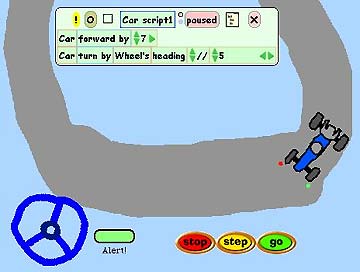
Bill Kerr tells us about a really cool new project from Mark Shuttleworth’s Foundation called Kusasa.
Check out Bills comments about learning from Play, and please be sure to follow the links on his post, they are very interesting.
Bill Kerr tells us about a really cool new project from Mark Shuttleworth’s Foundation called Kusasa.
Check out Bills comments about learning from Play, and please be sure to follow the links on his post, they are very interesting.

Check out Bert and Olpc on the tagesschau.de. The video is in German. Notice the link on the left “100-Dollar-Laptop” that will take you right to the clip. Feel free to skip the computer salesman’s comments. Who knows where they got this guy from! The project must be looking up if this is the best they can do. It’s like the debate about global warming in the U.S.A. For a long time we’d hear that scientists have reached a global consensus, all except Joe – from the Wyoming Science Club who says global warming doesn’t exist.
This is a very exciting time for olpc. Congratulations everyone.

Dan Ingalls working at Sun Labs has just released their first version of Morphic implemented completely with JavaScript which they are calling the Lively Kernel. There is no plugin required, but your browser currently must support SVG. You should use your Safari browser for best results. It will work with Firefox but you should expect bugs. It does not work with Internet Explorer yet.
Point your supported browser here to see this exciting work! Great Job to the team at Sun, Dan Ingalls, Tommi Mikkonen, Krzysztof Palacz, and Antero Taivalsaari.

David Pogue at NYTimes reviews the One Laptop Per Child computer. Don’t miss the video clip, it’s very cool.

From Michael Lucas-Smith:
Hi Everyone,
Just a heads up that Industry Misinterpretations, our Smalltalk podcast, has three podcasts specifically about Seaside coming out over the next week.
Podcast #1: Myself, James Robertson, Tamara Kogan, Martin Kobetic, Arden Thomas
Podcast #2: Myself, James Robertson, Michel Bany, Alan Knight, Arden Thomas
Podcast #3: Myself, James Robertson, The entire Gemstone GLASS team
The podcasts will be appearing here:
http://www.cincomsmalltalk.com/userblogs/cincom/blogView?content=podcasts
You can subscribe to the podcast in iTunes (just search for smalltalk) or with: http://www.cincomsmalltalk.com/rssBlog/blog_podcast.xml
They’ll also be announced on James’s blog:
http://www.cincomsmalltalk.com/blog/blogView
Cheers,
Michael

For those of you who want to see Croquet in action, check out the keynote by Justin Rattner from Intel’s developer forum in San Francisco this morning:
http://www.intel.com/pressroom/kits/events/idffall_2007/webcasts.htm
The topic is “The rise of the 3D Internet” and Croquet is featured both in the talk in general (as an example of P2P collaboration environment) and live via a Qwaq Forums demonstration (about 15mins into the talk).
Also, a link to the press release of the Qwaq/Intel collaboration:
http://www.intel.com/pressroom/archive/releases/20070920corp_a.htm
http://www.qwaq.com/press/release_2007-09-20.html

See IEEE Software
September/October: Dynamically Typed Languages

Gary Chambers released new UI Enhancements for Squeak. You can now access these changes from the Squeak Source Repository or through Package Universes. You can read more by following the following threads here and here. Also check out the new UI team. Our thanks to Gary and the UI Team!!

From: Michael Haupt,
The German/Swiss/Austrian TV station 3sat has a weekly 30-minute show called “neues” (roughly translated “new things”) which deals with IT-related information. Yesterday’s show was focusing on bringing IT to isolated regions and emerging nations as well as developing countries. The show featured an article on mesh networks in Ecuador and the Linux4Africa project.
Linux4Africa is a German project collecting old but functional hardware. The components are cleaned, repaired (if necessary), bestowed with an Edubuntu Linux installation, and sent to Tanzania and Moçambique.
12 of the show’s 30 minutes were dedicated to an extensive coverage of the OLPC project. Etoys and Squeak were mentioned several times during the feature. The project itself was introduced, and Bert Freudenberg was interviewed about the technical features of the XO laptop, which was presented in detail.
There were also two interviews in the studio. Two members of GTZ (Deutsche Gesellschaft für Technische Zusammenarbeit; German Society for Technical Cooperation) responsible for XO distribution in Ethiopia talked about the project in general and about the impressive progress children made when working with the XO.
The other interview – which filled the first slot in the OLPC coverage – featured two students from Hasso Plattner Institute, Potsdam, who have developed strategic and skill-improving games for the XO in the Software Architecture Group‘s course on software architectures.
All in all, the editorial staff at 3sat did a tremendous job in preparing this show. To the writer’s knowledge, this was the first time the OLPC project was presented at such a level of detail in German television. Germany being a country where the the project has no actual lobby, it is important to have such media coverage – it would be nice to see much, much more of it.
The entire show can be watched online (in German).

