This month marks 29 years since the birth of Squeak Smalltalk. That is nearly three decades of exploration, invention, and collaboration – all made possible by the ambition and generosity of those who have shaped Squeak over the years.
On this occasion, it is fitting to pause and give thanks:
To those who, in the early years, had the vision and energy to create something enduring.
To those who continue to share insights and encouragement, answer questions, and work to resolve difficult issues on the mailing lists, sustaining collaboration and shared purpose.
To the programmers who work tirelessly on the system and the virtual machine, ensuring that Squeak remains robust, modern, and ready for the challenges ahead.
To the maintainers who incorporate patches and merges, smoothing the flow of progress and keeping the platform healthy.
To the unsung heroes who support the infrastructure, making sure our tools and resources are available and reliable.
To the academic community at large who continues to explore, teach, and contribute to Squeak.
To those who provide financial support, helping sustain the project and its infrastructure.
And to everyone else not mentioned in this brief list.
Each contribution, whether large or small, has helped Squeak remain vibrant and resilient – a system that is both a playground for ideas and a platform for serious development.
As we look forward to the next year, let this anniversary be a moment of encouragement. There is always more to explore, more to refine, and more to create together. Your help makes a difference and keeps Squeak a programming system that is a joy to use, where everything is available to see, understand, modify, and extend for any purpose. With 30 just around the corner, now is a good time to reflect that you make a difference, and that Squeak would not continue without the efforts of its community.
Here’s to another year of invention, collaboration, and joy with Smalltalk and Squeaking!
Tony Garnock-Jones recently announced on the Squeak Developers mailing list (here) a new contribution to the Squeak community: Multicast, a project that brings UDP multicast socket support to Squeak.
The project has been published on SqueakSource (here), where you can obtain the code and experiment with it directly. Tony also provided the file-in code with his announcement.
What Does Multicast Do?
Multicast provides the necessary support code for creating and using UDP multicast sockets within Squeak. This makes it possible for Squeak images to participate in group communication over networks – an important feature for distributed applications and collaborative tools. Check out the mailing list thread for more information on what multicasting does.
Current Status and Platform Support
Tested on macOS: Initial testing has been done successfully.
Linux support: Testing is planned soon.
Windows users: Contributions are welcome – help testing Multicast on Windows would be especially valuable.
Requirements
To use Multicast, you will need:
A current Trunk version of Squeak
The SocketPlugin enabled
How to Help
Community involvement is encouraged! If you are running Squeak on Linux or Windows, testing Multicast and reporting results would be a great way to contribute.
Have a great time with Smalltalk and keep on Squeaking!
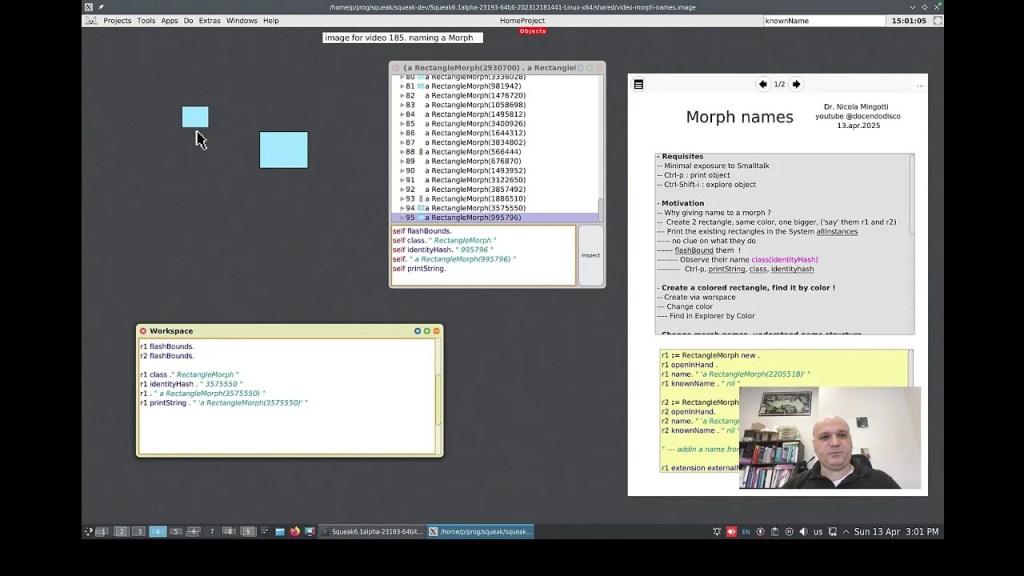
Dr. Nicola Mingotti has released a new in-depth tutorial video that explores how to identify and name Morphs in the Squeak/Smalltalk environment. If you have ever wondered how to refer to a specific Morph – for example, how to say “make that Morph yellow” – this video walks you through several effective techniques.
Throughout the video, you will learn how to use tools such as the object explorer and the workspace to better understand and interact with objects in Squeak. The tutorial introduces a variety of methods, including assigning names to Morphs, identifying them using properties such as identityHash and knownName, and inspecting objects with user interface tools that are not immediately obvious to new users.
This tutorial is particularly useful for those who wish to go beyond the basics and gain more precise control over their Squeak projects. It also includes several helpful interface tips that may be difficult to discover independently.
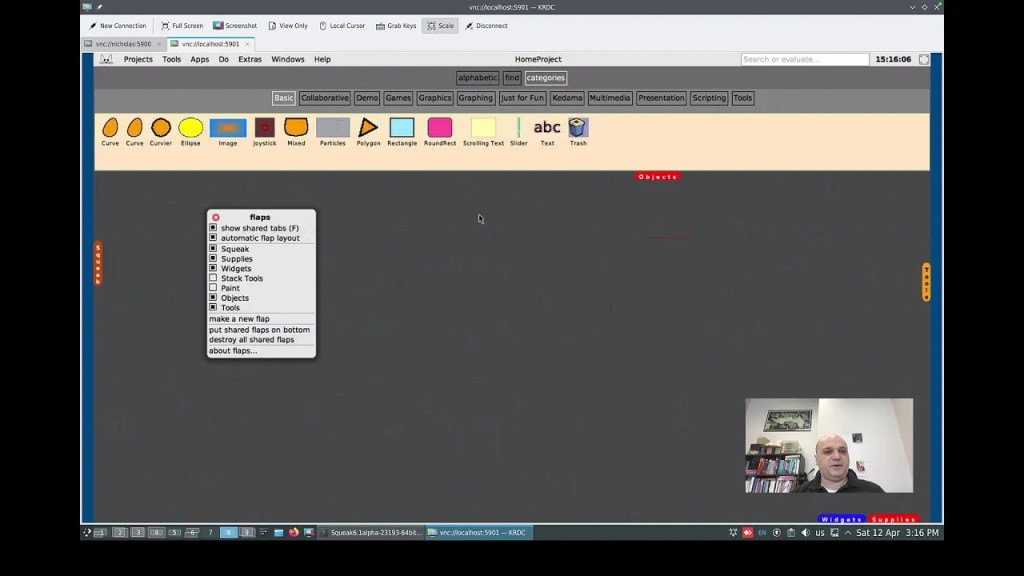
Dr. Nicola Mingotti has created a short introductory video, “Flaps in Squeak Smalltalk,” that explains how to get started using flaps in the Squeak environment. In the video, he demonstrates how to enable flaps, use them to drag objects into the Squeak World, and explores a few basic configuration options. If you are new to flaps or looking for a quick overview, this video provides a clear and helpful starting point. You can watch it here.
Have a great time with Smalltalk and keep on Squeaking!
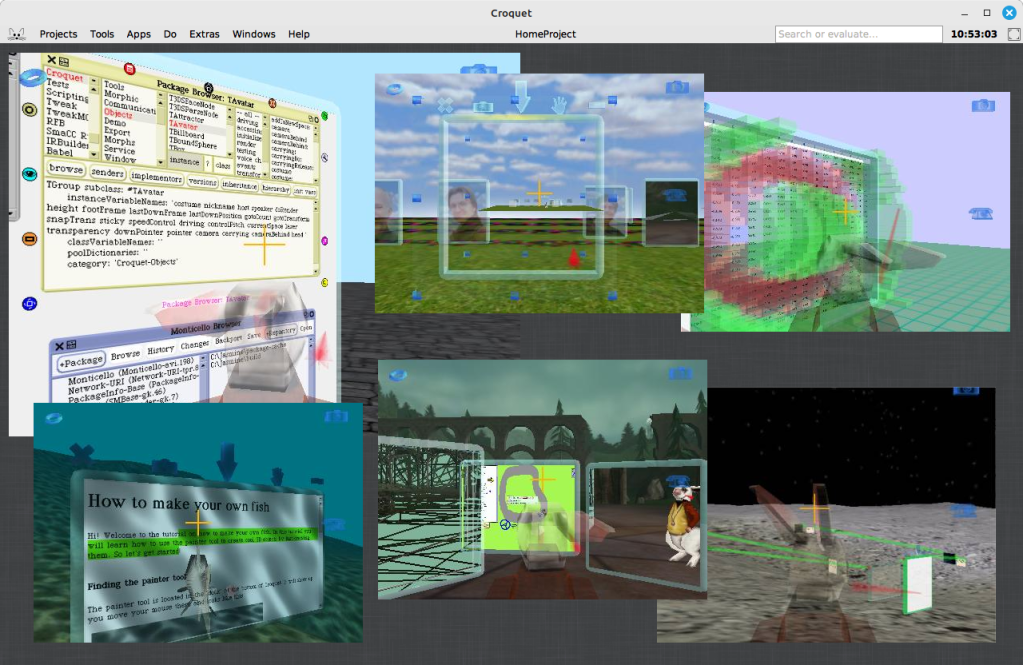
An initiative has recently emerged within the Squeak community to explore bringing Croquet into the modern Squeak 6.0 environment, with their efforts opening up possibilities for personal and educational applications, and potentially paving the way for long-term developments. Community members Edwin Ancaer and Timothy have taken it upon themselves to explore, port, and troubleshoot Croquet – an ambitious collaborative 3D environment originally designed to run in earlier 32-bit versions of Squeak.
Croquet was a groundbreaking software architecture designed for deep collaboration, originally built as an open, free, and highly portable extension of the Squeak programming system. It provided a platform for both development and real-time collaborative work, with no separation between user and developer environments. Focused on 3D shared spaces, Croquet enabled users to interact in context-based collaborations, observing each other’s actions and focus in real time. A collaboration protocol called TeaTime powered this synchronization, and rendering was based on OpenGL. While newer, proprietary descendants of Croquet have evolved since, the version being revived in Squeak 6.0 reflects this original, exploratory vision.
Croquet Jasmine, a developer’s release of the system, is available and can be run live in a web browser using the SqueakJS virtual machine – allowing others to easily explore Croquet without a local setup. You can try a live version here: codefrau.github.io/jasmine/.
Technical Hurdles and Graphics Considerations
Efforts began early in the process, building on Nikolay Suslov’s work to get the original Open Croquet running on the latest versions of Squeak 5.x. His work laid the groundwork for achieving compatibility with Squeak 6.0. You can explore his repository here: github.com/NikolaySuslov/croquet-squeak. You can also check out detailed steps Nikolay has provided to bring Croquet into an early alpha version of Squeak 6.0 here.
A primary obstacle encountered was the tight coupling between Croquet and OpenGL 1. As Vanessa Freudenberg pointed out, OpenGL has been deprecated on macOS for years, complicating efforts to run the system on 64-bit machines. Vanessa suggested considering Vulkan or OpenGL 4 as possible alternatives for the rendering backend.
In consideration of a long-term solution, it is helpful to explore the potential paths forward, each with its own trade-offs:
Re-implement OpenGL 1 as a compatibility layer – Offers limited long-term value and would still not work effectively on macOS due to deprecated OpenGL support and the absence of modern graphics capabilities. Efforts like MoltenGL, which aim to bridge OpenGL to Metal, do not support OpenGL 1, making this path particularly challenging.
Migrate to a modern OpenGL (3.x or 4.x) – More viable than OpenGL 1 in terms of features, and partially supported on macOS (up to OpenGL 4.1). However, it is deprecated and no longer maintained on Apple platforms, making it an unstable foundation for future development.
Adopt Vulkan for high performance – A modern, low-overhead graphics API designed as a successor to OpenGL. While Vulkan is not natively supported on macOS, it can be used via MoltenVK, which translates Vulkan calls to Metal. This option requires significant integration work but offers the most long-term potential across platforms.
For a long-term solution, Vulkan appears to be the most promising path – essentially a modern, cross-platform successor to OpenGL, developed to overcome many of its limitations. Although not natively supported on Apple platforms, Vulkan’s compatibility through MoltenVK makes it a viable candidate for achieving performance and portability across environments.
While these options are worth exploring for long-term solutions, they may be unnecessarily complex for personal or educational use. However, the current efforts could prove valuable down the road by revealing key details, helping future work begin from well-understood points in the development process.
Vanessa has managed to run Croquet Jasmine without modifying the Smalltalk code by using the browser-based SqueakJS VM, with a custom OpenGL 1 implementation written in JavaScript. This was accessed via FFI and mapped to modern WebGL. The approach preserves the original graphics code inside the image while offloading rendering to the browser, and could serve as a model for similar efforts going forward.
Debugging and the Role of C in a Self-Hosting Environment
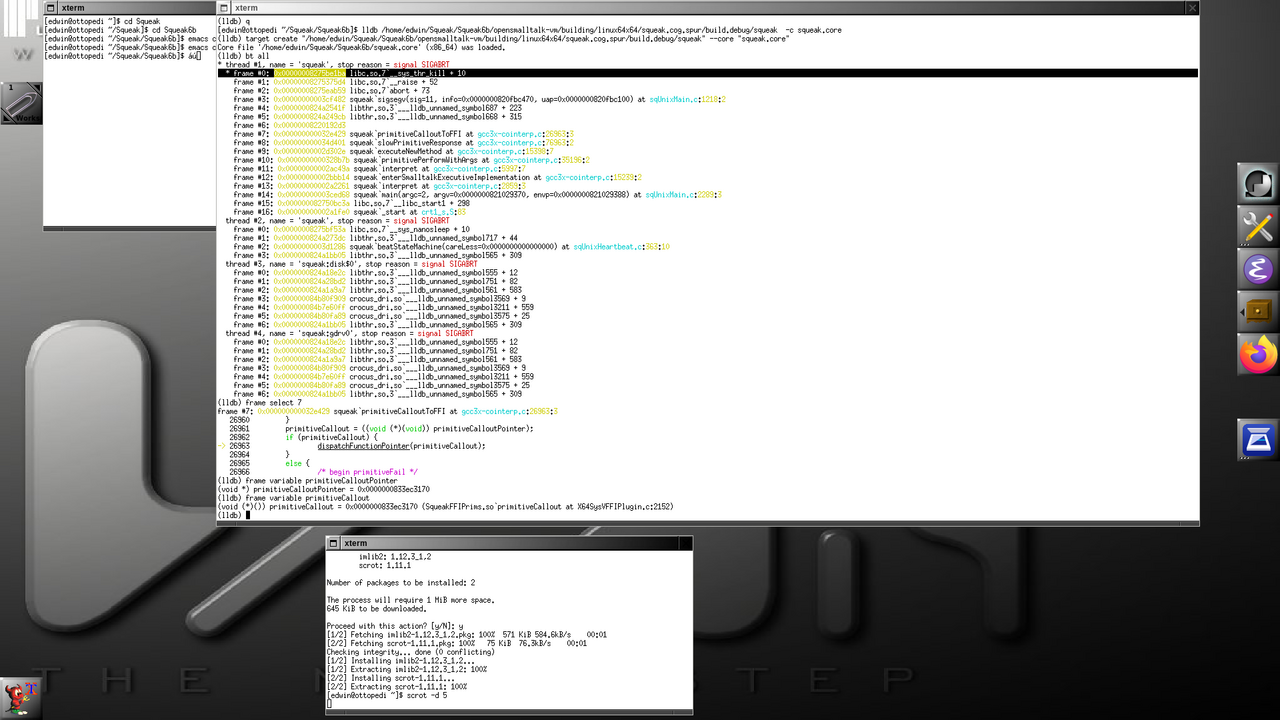
In efforts to get Croquet working with Squeak 6.0, contributors encountered challenges requiring low-level debugging. Their focus shifted to analyzing behavior via the debug VM, aiming to isolate root causes of instability or failure.
One may wonder why Squeak, being a self-hosting environment, might still require work in C. The environment is written in Smalltalk and is capable of building and evolving itself entirely from within. This self-hosting capability enables fast iteration, deep system visibility, and live modification of running code – all without leaving the environment.
However, Squeak runs on a virtual machine, with performance-critical parts written in a restricted subset of Smalltalk known as Slang (Swiki link). Slang is not a separate language, but a subset of Smalltalk designed to be translatable into C for compilation. This allows the virtual machine, which is largely written in Smalltalk, to be compiled into efficient native code for multiple platforms. When issues arise at the VM level – such as those involving primitives, foreign function interfaces, or memory management – developers must drop down into the generated C code to diagnose and resolve them. You can read more about the Squeak VM on the Swiki here and here.
The benefit of this design is excellent portability: the Smalltalk environment remains consistent across platforms, while only the VM layer needs to be recompiled or adapted for different operating systems or hardware. Having this level of separation allows the Squeak image to remain consistent across multiple platforms without exposing the underlying hardware implementation to the image code itself.
Further analysis suggested that inconsistencies between expected and actual behavior in the virtual machine’s handling of system-level function calls were at the heart of the issue – at least for now. By carefully tracing how external interfaces were being resolved and invoked, the contributors were able to isolate a likely point of failure. The realization was met with enthusiasm, signaling meaningful progress toward resolving the issue.
The Irony of Debugging and Systems Development
Edwin humorously remarked that he never expected working in Smalltalk would lead him back to debugging C code – a twist that underscores the unpredictable nature of systems development. Tim Rowledge added that, during his time at ParcPlace, it was an inside joke that those who got hooked on Smalltalk inevitably ended up spending too much time writing C, while the C++ fans who joined the team found themselves writing Smalltalk instead. The irony of this unexpected reality highlights the surprising paths developers take when working with complex systems.
Looking Ahead
We extend deep appreciation to Nikolay Suslov for his foundational work in bringing the original Open Croquet to Squeak 5.x, which has served as a solid base for moving toward compatibility with Squeak 6.0. A special thanks also goes to Edwin and Timothy for their time, dedication, and resourcefulness in troubleshooting and adapting Croquet to modern Squeak 6.0 systems. Their efforts contribute to the broader community by preserving an important piece of Squeak history and helping to lay the groundwork for future advancements.
The effort to bring Croquet to Squeak 6.0 is ongoing. We wish those involved continued success and invite anyone curious to jump in, contribute, and join the effort to keep Squeak a vibrant environment for innovation and exploration!
Have a great time with Smalltalk and keep on Squeaking!
Congratulations to the newly elected members of the Squeak Oversight Board for 2025. We are grateful to everyone who ran and offered their time in support of the community – it truly takes everyone’s contributions to help Squeak succeed. A big thank you as well to Patrick for once again running the election and handling the process so smoothly. Whether new to the board or continuing your service, we appreciate your dedication and look forward to a productive and exciting year ahead.
Below is Patrick’s official announcement to the Squeak Developers mailing list:
Hi Everyone,
I’m very pleased to announce your Squeak Oversight Board for 2025.
They are:
Marcel Taeumel
Vanessa Freudenberg
Eliot Miranda
Tim Rowledge
David T. Lewis
Christoph Thiede
Rachel Crowther
I would like to thank everyone that served on the board in the term of 2024. Thank you for your contributions to Squeak!
Thank you to everyone that ran this year and for everyone that voted. We are looking forward to a great year in the Squeak community!
Please help me to welcome and congratulate your new board for 2025!!
Dr. Nicola Mingotti has created a highly useful video tutorial, “The Squeak Smalltalk Help System”, where he demonstrates how to use and implement the Squeak Help System in your projects. In the video, Dr. Mingotti walks you through a step-by-step guide on creating documentation for your code, providing valuable insights into integrating the help system into your workflow. You can check out his video here.
Additionally, Dr. Mingotti offers supporting materials in his Swiki article here, which includes code snippets and further comments to aid your understanding.
Overview of the Squeak Help System
One of the many great features of Squeak is its rich set of help documentation. The default Squeak image comes with valuable documentation that covers topics such as: How to Use Squeak, How to Contribute to Squeak, Tutorials, The Terse Guide to Squeak, and Using WebClient and WebServer. This documentation is easily searchable, making it a highly useful resource for your projects.
Help System vs. Code Comments
It is important to note that the Squeak Help System is not intended to replace code comments. Squeak/Smalltalk provides excellent functionality for adding comments directly in your code, and these should remain the primary way to document code behavior, logic, and functionality. The Help System is designed for documentation outside the scope of code comments, such as explaining overall project goals, providing tutorials, or offering guidance on using tools and features in your project.
Features of the Help System
The help documentation system offers a variety of features, including text styling (bold, italics, strikethrough, underline), code formatting and syntax highlighting, and URLs, to name a few.
Additionally, you can add images to your documentation. This feature is currently available in the Trunk image, but you can implement it in other images as well by using its code as a reference. For the 6.0 image, you can perform a fileout of the SqueakHelpTextImage class from the Trunk image and then filein it into the 6.0 image. Alternatively, you can create your own code to implement this functionality! Thanks to Christoph Thiede for providing guidance on how he implemented this feature. You can find his post here.
How to Insert an Image into Your Help Page
Open a Workspace window.
In the Workspace, perform a “do it” on the following code: Clipboard clipboardText: Character startOfHeader asString.
In your help page window, move your cursor to the location where you want to insert the image. Paste the clipboard contents (Ctrl+v or Cmd+v on Mac). At this point, you won’t see anything yet.
(Optional) Skip this step if you prefer typing the code manually. Copy the following code, replacing /path/to/file/image.png with the actual path and filename of your image: SqueakHelpTextImage forForm: (ImageReadWriter formFromFileNamed: '/path/to/file/image.png')
Return to your help page window and move your cursor to the same location where you want to insert the image. PressAlt+5 (or Cmd+5 on Mac), then select “Custom attribute…” from the bottom of the list.
When the Input Requested box appears, paste the image code from Step 4 (or manually type it in) into the field labeled “Enter expression for text attribute:”. You should now see a shaded outline where the image will appear.
Save your changes by pressing Ctrl+s (or Cmd+s on Mac).
Your image is now successfully inserted into your help document!
Conclusion
A big thank you to Dr. Nicola Mingotti for his helpful video tutorial on using the Squeak Help System, which offers a step-by-step guide for integrating the help system into your workflow. His Swiki article is also a helpful resource with code snippets and additional comments. Be sure to check out his materials to further enhance your understanding of Squeak and the Help System!
Have a great time with Smalltalk and keep on Squeaking!
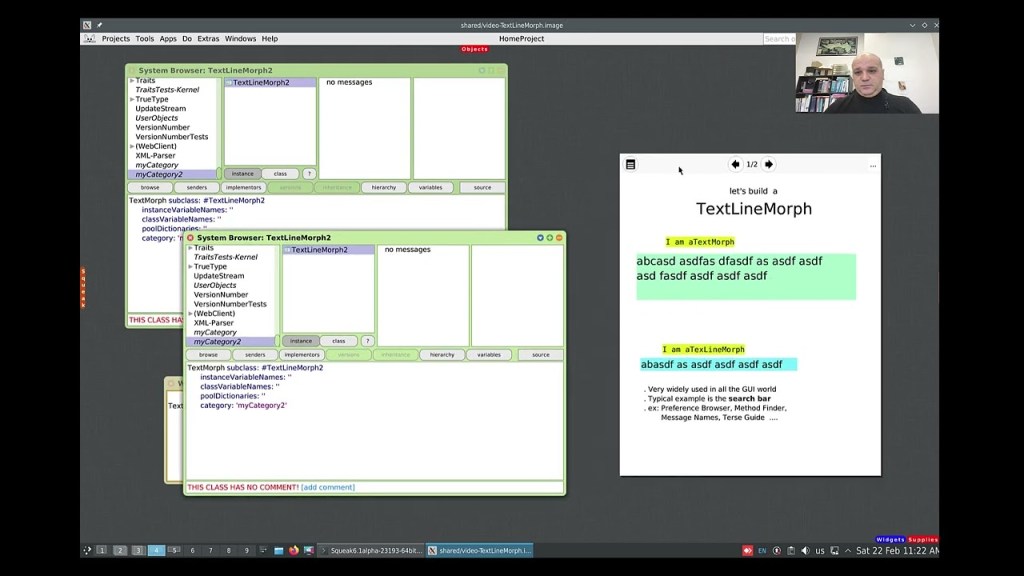
While working with Morphs can be quite easy at times, working with both text and Morphs might not always seem as straightforward. Dr. Nicola Mingotti provides a helpful video that demonstrates a commonly needed functionality in graphical interfaces, where you would typically want to accept a single line of textual data. Check out his video to see how this can be easily accomplished. You can view the video demonstration “Make a TextLineMorph in Squeak Smalltalk”here.
Have a great time with Smalltalk and keep on Squeaking!
The following announcement was made by Patrick Rein on the Squeak Developers mailing list (here). Please announce your candidacy on Squeak-dev or vote for a candidate. Now is the time to be involved!
Hi All,
It’s that time again to raise your voices and elect your board! Can you believe it’s been over a year and one day already?
It’s a time for you to stand up, help your community and volunteer to serve!
Squeak wants you!
Every year we elect the SOB (Squeak Oversight Board) consisting of seven members from our community. The current board members are:
Now until Friday 21st of March 2025, 18.00 UTC: Nominations of SOB members and campaigning!
Candidates should nominate themselves and start their campaign on the squeak-dev mailing list. Or if you nominate someone else, make sure that person really wants to run. 🙂 I will not put anyone on the candidate list until that person makes it known on squeak-dev that he/she intends to run.
During this period, the candidates should ideally present themselves on squeak-dev, unless they have already done so, and the community can ask questions.
I encourage you to reach out to potential candidates, people that are active in the community and represent your views, and ask them to run.
Some people will not run without encouragement. Also, I know that some people wait to the last minute to run for the board to see if others will run but please consider getting this year off to a faster start and just jump right in!
The schedule and process are as follows:
Now until Friday 21st of March 2025, 18.00 UTC: Nominations of SOB members and campaigning!
Friday 21st of March 2025, 18.00 UTC: Candidate list is finalized.
Friday 21st of March 2025, ~19.00 UTC: Online election starts.
Friday 4th of April 2025, 19.00 UTC: Online election ends.
Results will be announced immediately after the election ends.
The voting period is two weeks long and ballots are sent out via email.
And how do you end up on the voter list? See below. 🙂
IMPORTANT: New voters will NOT be added once the election is started.
You MUST try to get on the voter list before the online election starts or you will NOT be able to vote. If your email address has changed please try to make sure it is changed on the list of voters before the election starts.
If you were invited to vote last year you are already on the voter list, no worries! If you are a new Squeaker and wish to vote you should do ONE of the following:
Get a “known” Squeaker to vouch for you. If a known Squeaker sends an email to voters (at) squeak.org giving me a name and email for you, then I will add you.
Send an email to voters (at) squeak.org yourself (and CC to squeak-dev if you like) with information/arguments showing me that you are indeed serious about voting and that you are indeed a Squeaker.
When the voting period starts all voters will receive an email with instructions and a link to the voting website.
If there are any further questions, just reply in this thread and I will closely track it – or send email to voters (at) squeak.org which points to me.
Would you like to view a demonstration of how to take advantage of the Morphic animation system in Squeak? If so, you are in luck! A new video has recently been posted that takes you through the steps of doing just that. The Morphic animation system in Squeak offers a simple way to animate and interact with objects in your environment. Whether you are building basic animations or more complex interactive systems, Morphic provides a wealth of possibilities for both beginners and seasoned developers alike. You can watch the video titled “A BlinkingRectangle Morph in Smalltalk” here.
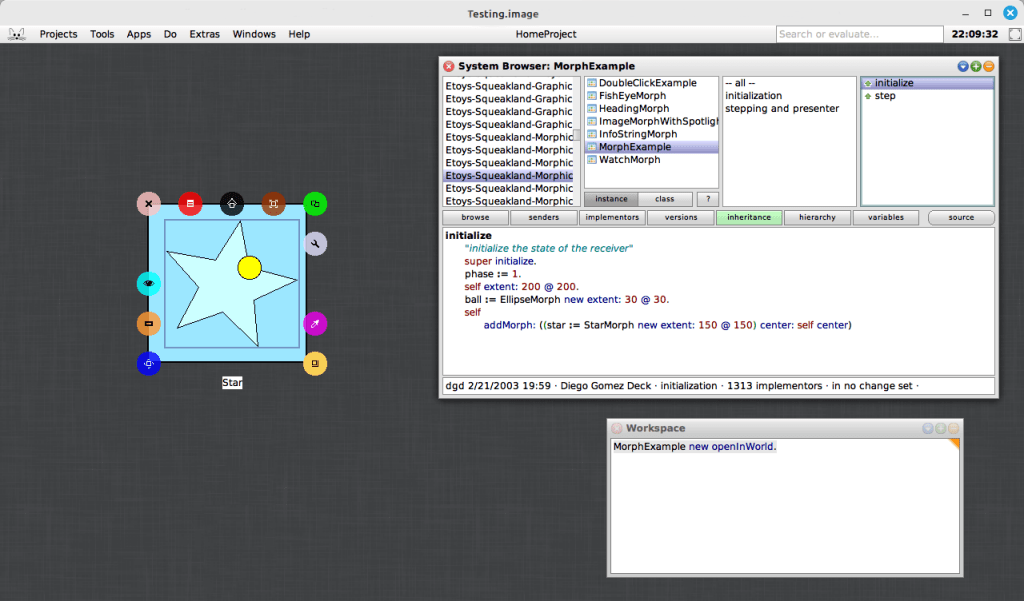
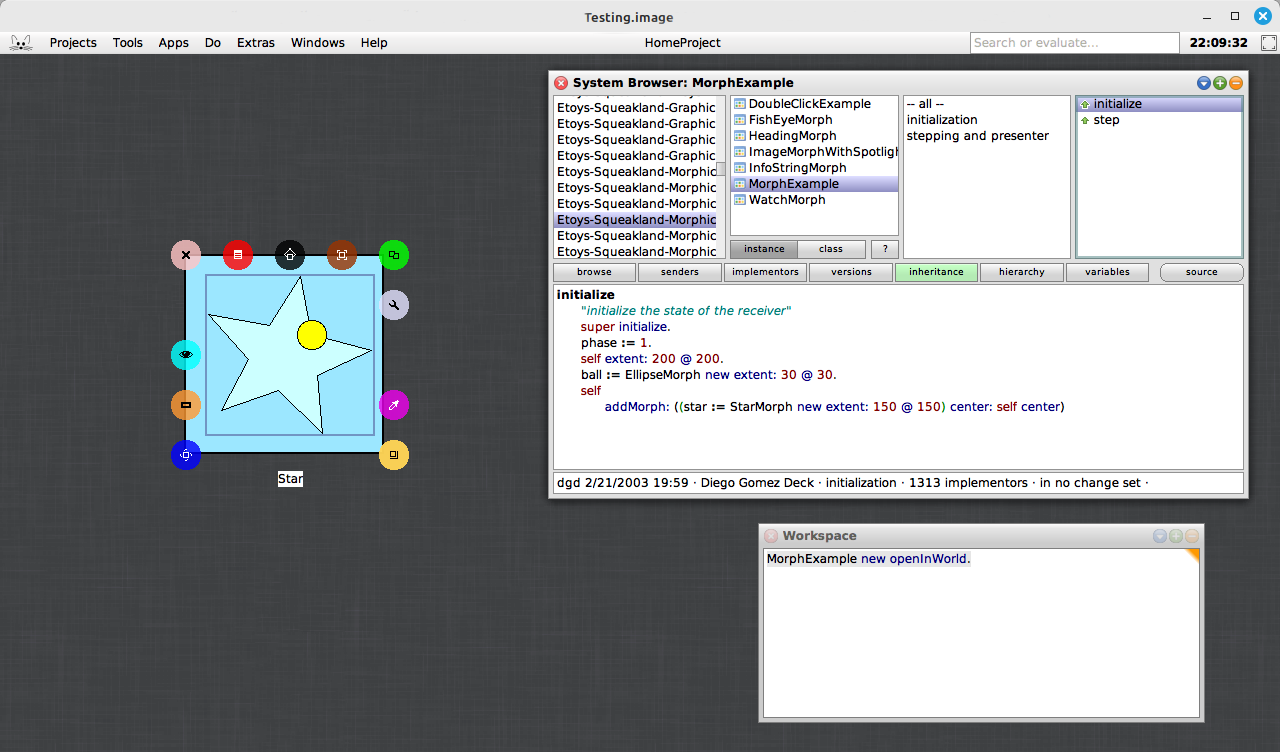
In addition to the video tutorial, you can explore a very simple, yet powerful example included in the Squeak image. This example morph can be found with the somewhat hard-to-remember name, MorphExample. By evaluating “MorphExample new openInWorld” (without the surrounding parentheses) in a Workspace, you can discover how easy it is to make morphs perform various actions. This demonstration emphasizes the beauty of the Morphic system’s simplicity: you do not need to write complex code to animate objects. Instead, you can focus on creating rich, interactive applications and interfaces with just a few lines of code.
One of the most compelling aspects of the Morphic system is how effortlessly it enables dynamic, real-time interaction, especially when used within the Smalltalk environment. Compared to many other graphical frameworks, where handling interactions often requires more complex event handling and manual updates, Morphic allows you to create interactive, animated objects with minimal code. For example, you can open a halo on the star, resize or rotate it, and the animation will continue to perform and adjust dynamically to the star’s new dimensions. This responsiveness highlights the simplicity and flexibility of the Morphic system, making it an ideal choice for building interactive systems without the need for manual recalculations or updates.
If you are interested in delving deeper into the Morphic system, you can access Chapter 12 of Squeak by Example for more detailed explanations and examples. The book offers a clear guide to the system, making it an excellent resource for developers looking to better understand Morphic. You can read the full chapter here.
For those who want to learn more about using halos with morphs in Squeak, there is another excellent video resource available. The video “Morphic Halo icons in Squeak Smalltalk” demonstrates how to interact with the Morphic halo icons to manipulate morphs in the Squeak environment. Whether you are new to Squeak or already familiar with the basics, this video provides valuable insights into how halos can be used to interact with morphs. Check it out here.
Have a great time with Smalltalk and keep on Squeaking!







 The Weekly Squeak