You know what they say, “If you can’t take the heat, get out of the laptop for the worlds children business!” Pictured above is the OLPC computer running day and night (look closely and notice the Squeak E-Toys running) at scorching temperatures 52C (125F) during the day time and 22C (72F) at night. Just image running your computer laptop in an oven all day!
Category: Squeak
-
Squeak in North Carolina Schools
The University of North Carolina Wilmington (UNCW) has published the following press release:
Wilmington, N.C. – While demand for Information Technology (IT) professionals is projected to increase over the next five years, a dwindling number of American students are choosing to specialize in IT fields. Now, a grant-funded partnership between the University of North Carolina Wilmington and the New Hanover, Pender and Brunswick County schools is addressing that issue by infusing IT skills into the curriculum in grades 7-12.
[…]
The three-year-long project will work directly with about 75 educators who teach the Science, Technology, Engineering, Mathematics (STEM) curricula and 150 of their students in grades 7-12. Teachers and students will learn to use “Squeak” software to create virtual models that simulate actual science and math-related experiments. For example, students could create a computer model to study the transmission of a disease, an activity that could be too dangerous to study in a physical laboratory.
“It may be difficult to study the spread of a virus for real in middle school,” said Gene Tagliarini, associate professor of computer science and grant coordinator. “But you can simulate an epidemic using the Squeak tool, which can create models to study things as abstract as balancing equations or as concrete as building a bridge.”
[…]
You can read the complete press release on the UNCW website.
-
or Squeak, or something.
I know that this is not a ringing endorsement, but a mention is a mention, and I thought it was cool that we made the list. Plus it’s a cool story. Why Spend More Than Five Minutes on a GUI?
-
Minding Your Business With Smalltalk (Part 3 of 4)

Previously we spoke with Michael Rueger and Steve Hunter. From Michael we found out about the perspective of writing and supporting open source software. From Steve we found out what it is like being a consumer of open source software. Today we talk with Bert Freudenberg. From Bert we hope to learn what it is like being a Smalltalk programmer contributing to open source.
-
Scratch Unleashes New Projects Web Site

Creating from Scratch
New Software from MIT Media LabUnleashes Kids’ Creativity Online
A new programming language developed at the MIT Media Lab turns kids from media consumers into media producers, enabling them to create their own interactive stories, games, music, and animation for the Web.
With this new software, called Scratch, kids can program interactive creations by simply snapping together graphical blocks, much like LEGO® bricks, without any of the obscure punctuation and syntax of traditional programming languages. Kids can then share their interactive stories and games on the Web, the same way they share videos on YouTube, engaging with other kids in an online community that provides inspiration and feedback.

“Until now, only expert programmers could make interactive creations for the Web. Scratch opens the gates for everyone,” says Mitchel Resnick, Professor of Learning Research at the MIT Media Lab and head of the Scratch development team.Resnick’s Lifelong Kindergarten research group previously developed the “programmable bricks” that inspired the award-winning LEGO® MINDSTORMS® robotics kits. Just as MINDSTORMS allows kids to control LEGO creations in the physical world, Scratch allows them to control media-rich creations on the Web.
“As kids work on Scratch projects, they learn to think creatively and solve problems systematically – skills that are critical to success in the 21st century,” says Resnick.
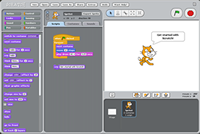
Designed for ages 8 and up, Scratch is available by free download from the Scratch website (http://scratch.mit.edu). The software runs on both PCs and Macs. The MIT Media Lab is now collaborating with other organizations – including Intel, Microsoft, Samsung, BT, the LEGO Group, Motorola, and One Laptop Per Child (OLPC) – to create other versions and applications of Scratch, including versions for mobile phones.
The name Scratch comes from the technique used by hip-hop disc jockeys, who spin vinyl records to mix music clips together in creative ways. Similarly, Scratch lets kids mix together a wide variety of media: graphics, photos, music, and sounds.
A glance at the Scratch website (http://scratch.mit.edu) reveals a kaleidoscope of projects created by kids: a story about a polar bear school, space attack games, and a break-dancing performance. Some creations are goofy and fun; some reveal serious social themes. Kids are constantly modifying and extending one another’s projects on the website – and learning from one another in the process. “It’s exciting to wake up each morning and see what’s new on the site,” said Resnick.
Scratch was developed by Resnick’s Lifelong Kindergarten research group in collaboration with UCLA educational researchers, with financial support from the National Science Foundation and the Intel Foundation. Throughout the development process, the design team received feedback from children and teens at Intel Computer Clubhouses and school classrooms.“There is a buzz in the room when the kids get going on Scratch projects,” says Karen Randall, a teacher at the Expo Elementary School in St. Paul, Minnesota. “Students set design goals for their projects and problem-solve to fix program bugs. They collaborate, cooperate, co-teach. They appreciate the power that Scratch gives them to create their own versions of games and animations.”
For more information, see http://scratch.mit.edu/about

The Lifelong Kindergarten group (http://llk.media.mit.edu) at the MIT Media Lab develops new technologies that, in the spirit of the blocks and finger paint of kindergarten, expand the range of what people can design, create, and learn.
©2007 MIT Media Laboratory
LEGO and MINDSTORMS are trademarks of the LEGO Group.
Used here with special permission. ©2007 The LEGO Group.

The development of Scratch was supported by the National Science Foundation under grant number 0325828. Any opinions, findings, conclusions, or recommendations expressed in this release are those of the authors and do not necessarily reflect the views of the National Science Foundation.
-
A report from Squeak’s booth @ Smalltalk Solutions 2007
William Hartford writes:
Fellow Squeakers,
As most of you know, due to the fantastic work of Chris Cunnington, Squeak was able to acquire a booth at Smalltalk Solutions this year. I was lucky enough to get the opportunity to volunteer to work the booth for the two days of the convention. We had a fabulous location and got a tremendous amount of traffic. The Smalltalk community, while small, is one of the most intelligent, kind, supportive, and fun communities I have ever been involved in. I would like to thank all Smalltalk Solution attendees for there kind words, Squeak cheerleading, and help with answering questions when the crowds got large.
Bert Freudenberg was kind enough to lend us a OLPC laptop. This was the major draw of non-Smalltalkers to our booth. Many of the people knew nothing of Smalltalk but had heard of the OPLC project. The etoys demo was beautiful and if gave us a real opportunity to explain a little about Squeak, Smalltalk, and etoys.
Tim Rowledge generously sent me 45 silver and 5 gold badges. We were able to sell 27 silver badges raising $324 Canadian for the Squeak Foundation. The badges are beautiful and if you have not yet had the opportunity to buy one I recommend that you do. If you are in the Toronto area come out to the Beach Outings Club and I will have some on hand.
I could not of dreamed how well it went. The booth was fantastic, the people were kind, and the interest in Squeak exceeded my expectations.
Thanks for all the support,
Will Harford -
Don’t Miss Smalltalk Solutions – April 30th – May 2nd 2007
Smalltalk Solutions is this weekend! There will be a number of talks on Seaside. Check out the presentation listing in DabbleDB (which is written using Seaside). Gemstone will be talking about their work porting Seaside and Monticello to Gemstone and are announcing a free version of Gemstone.
Carl Gundel announced a Seaside Birds of Feather Session Wednesday May 2nd from 5 to 7pm.
Don’t miss Boris Popov’s Seaside Experience Report. Boris and DeepCove Labs have done some really excellent work! Check it out.
Don’t Miss Bert Freudenberg’s Keynote presentation about OLPC! The One Laptop Per Child initiative is a wonderful way for all smalltalkers to get involved and contribute to something that is really worthwhile!