David Pogue at NYTimes reviews the One Laptop Per Child computer. Don’t miss the video clip, it’s very cool.

David Pogue at NYTimes reviews the One Laptop Per Child computer. Don’t miss the video clip, it’s very cool.
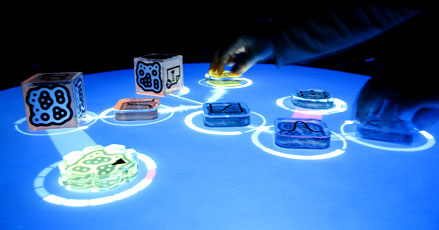
Simon Holland yesterday announced on the squeak-dev list the release of a Squeak client for TUIO under the MIT licence. TUIO allows the rapid development of table-based tangible user interfaces (TUI) and multi-touch interactive surfaces.
TUIO uses the reacTIVision computer vision system to track physical objects in real time. This system is also used in reactable – the electronic music interface used by Björk in her current world tour.
The Squeak package includes the Tuio client and demonstration application program. To make practical use of Tuio for Squeak you will need a webcam or other camera, and should download the free Reactivision application for your operating system.
(Image shows reactable in action from http://mtg.upf.edu/reactable )
From Michael Lucas-Smith:
Hi Everyone,
Just a heads up that Industry Misinterpretations, our Smalltalk podcast, has three podcasts specifically about Seaside coming out over the next week.
Podcast #1: Myself, James Robertson, Tamara Kogan, Martin Kobetic, Arden Thomas
Podcast #2: Myself, James Robertson, Michel Bany, Alan Knight, Arden Thomas
Podcast #3: Myself, James Robertson, The entire Gemstone GLASS team
The podcasts will be appearing here:
http://www.cincomsmalltalk.com/userblogs/cincom/blogView?content=podcasts
You can subscribe to the podcast in iTunes (just search for smalltalk) or with: http://www.cincomsmalltalk.com/rssBlog/blog_podcast.xml
They’ll also be announced on James’s blog:
http://www.cincomsmalltalk.com/blog/blogView
Cheers,
Michael

For those of you who want to see Croquet in action, check out the keynote by Justin Rattner from Intel’s developer forum in San Francisco this morning:
http://www.intel.com/pressroom/kits/events/idffall_2007/webcasts.htm
The topic is “The rise of the 3D Internet” and Croquet is featured both in the talk in general (as an example of P2P collaboration environment) and live via a Qwaq Forums demonstration (about 15mins into the talk).
Also, a link to the press release of the Qwaq/Intel collaboration:
http://www.intel.com/pressroom/archive/releases/20070920corp_a.htm
http://www.qwaq.com/press/release_2007-09-20.html
Tony Garnock-Jones reports that
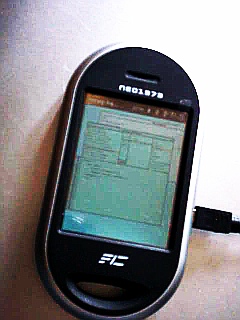
he has succeeded in getting Squeak running on the new FIC Neo1973
open-source GSM cellphone, which runs OpenMoko, based on OpenEmbedded.
He used Squeak VM version 3.9, running a stripped 2.8 image (though he has also had a 3.9 image running), and is now looking at accessing the phone’s hardware, including GSM modem, GPS, Bluetooth, touchscreen, audio, battery and auxiliary buttons.
To manage user interaction, he’s looking at using Faure to construct a stylus- or
finger-driven UI.
Tony is working with the OpenMoko team to get the necessary changes integrated into the main code-base, making this an easier exercise for other developers to follow. He’s also looking at getting Spoon running on the phone.
Keep an eye on the LShift blog for progress reports.
Like this story? Why not add it to Delicious Reddit or Digg?

See IEEE Software
September/October: Dynamically Typed Languages
Following Stéphane Ducasse’s announcement last week, the finishing touches were applied at a blistering pace, and Squeak By Example has now been published! You can order the book in hardcopy from print-on-demand specialists lulu.com. There is also an accompanying website http://SqueakByExample.org, where you can download the book as a PDF.
The book is intended as an introduction and tutorial for both students and developers, and will guide readers gently through the language and tools by means of a series of examples and exercises. The book helps you get started with A Quick Tour of Squeak and guides you through A First Application.
The Smalltalk language is introduced in three chapters on Syntax in a Nutshell, Understanding Message Syntax and The Smalltalk Object Model. Development with Squeak is covered in The Squeak Programming Environment and SUnit. Several of the key classes are presented in chapters on Basic Classes, Collections, Streams and Morphic.
The book concludes with chapters on Classes and Metaclasses and Frequently Asked Questions.
Congratulations to co-authors Oscar Nierstrasz, Stéphane Ducasse, Damien Pollet, Andrew P. Black, Damien Cassou and Marcus Denker for producing such a great resource for new Squeakers!
The European Smalltalk User Group (ESUG) has organised the International Smalltalk Conference for the last 14 years, and this year, at Lugano in Switzerland, the program included a number of presentations interesting to Squeakers. These included:
There’s lots more material, and links to photographs taken during the events, at the ESUG 2007 media page.
The squeak-dev mailing list is currently fired up with a debate that will be of great interest for students of the theory of language design – and for students of the politics of language design!
It started with a question by Fabio Filasieno wondering why Squeak doesn’t have a “pipe” construct to the language to allow the result of a message-send to be the recipient of the next message, thus removing the need for parentheses, so
((1 to: 100) select: [ :each | each odd ] ) sum.
becomes
1 to: 100 | select: [ :each | each odd ] | sum.
The debate has continued for days, including topics such as:
Is piping the right term?
What characters could be used without confusion?
Should a proliferation of parentheses should be seen as a ‘code smell’, so the algorithm is the thing to fix, rather than the syntax?
Why not just use an “asPipe” message which would alter the operation of the cascades to give this without changing the language?
Is the benefit of this change enough to make it worth changing the syntax of Smalltalk?
Do languages that don’t change stagnate?
Was the brace syntax a step too far?
What’s the EBNF for Smalltalk? (This got a definitive answer [for 2.7])
What are the differences between Smalltalk, Lisp and Perl approaches (with Randal Schwartz revealing himself to be a long-time Smalltalker)?
Alan Kay has also contributed some remarks on the early development of Smalltalk, and possible future directions.
Follow the discussion:
Fabio’s original email
The harvesting thread
or look for any of the myriad threads with “pipe” in the title.