
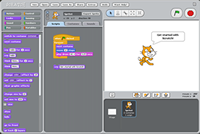
It’s out! The MIT Media Lab’s Lifelong Kindergarten group with John Maloney, who most of you know as one of the major contributors to Squeak, have released Scratch. Scratch is a new programming language that lets you create your own interactive stories, games, music, and art. I spoke with John about Scratch.
Category: Squeak
-
Charting Seaside
What do you do when you want to add charts and graphs to your seaside application? Check out the SeaChart web site.
SeaChart is a live demo application that showcases serveral SeaChart components. SeaChart components are standard Seaside components that you can embed into your Seaside application. Each demo includes the rendered component and the sourcecode to crate it.
-
MousePhone
How do you get the mouse to talk?
Davide Varvello recently
announced success using
Skype Voip with Squeak. -
Nicholas Negroponte discusses OLPC
In a keynote speech at NECC, Nicholas Negroponte, founder of the One Laptop Per Child initiative, explains what he hopes to achieve through the project–and educators offer their reactions.
Source: Bert’s blog
OLPC video from NECC
Just found a nice video on youtube about the $100 laptop at NECC 06, including a cameo of our very own Kim Rose (at 3:21) while the speaker is mentioning “creativity” – very apt, I’d say.
-
Croquet Edit and Create 3d Objects

Howard Stearns recently replied to a question from Mathieu. I thought I’d reproduce his response here. Howard gives a lot of very good information about Croquet support for third party tools….
-
Exupery Talk
Bryce Kampjes: Exupery Talk from Brussels2006 Smalltalk party
Handout: Exupery Design.
This is a very informative video exploring Exupery for those of you following compiler and VM developments. The video ends a few minutes before the talk is finished. Our thanks to Göran Krampe for filming it.
-
Creating SqueakSource
SqueakSource is a web based repository for versioning and storing Squeak code. The subject of creating a squeakSource image came up on the beginners list.
Franz Josef Konrad posted a very nice “how to create your own SqueakSource image” response. By running your own squeakSource you can share code with other developers or use it just to keep track of your own stuff. Here are the steps to create a squeakSource image:
-
Gjallar demo at OOPSLA 2006
See Göran Krampe’s Gjallar demo at OOPSLA 2006, Tim’s pointer update, board information and a License update.