Author: Michael Davies

  • Squeak on the iPhone – available for download!


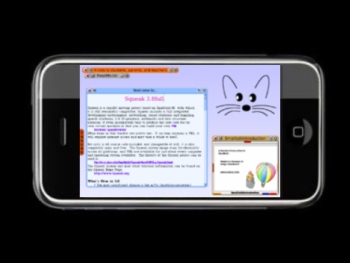
    Michael Rueger and John MacIntosh are proud to announce that their Squeak iPhone/Touch port is now available for download. The source code, along with installation instructions and other useful resources, is available at a new website: http://isqueak.org.

    As had been discussed earlier, Michael notes that due to the legal requirements of the Apple Developer agreement at this time, they cannot distribute a fully functional Squeak VM via the Apple Store. However Licenced iPhone developers can deploy the VM as an Ad Hoc VM for testing to a limited number of devices.

    In addition, anyone who has access to the Apple SDK can compile and run the port in the iPhone emulator. 

    Michael and John would like to thank ESUG for sponsoring their work.

  • BabyIDE – A New Interactive Development Environment

    Trygve Reenskaug wrote to the Squeak dev mailing list to announce the release of BabyIDE, an IDE which which runs on Squeak Smalltalk, and is based on his exploration of a new development paradigm, called DCI. The aim of the DCI (Data-Context-Interaction) paradigm is to minimise any gaps between the programmer’s mental model of the program and the program that is actually stored and executed in the computer, by presenting system operations as networks of communicating objects.

    Trygve, who is based at the Department of Informatics at the University of Oslo, has written a detailed overview (pdf) of the thinking behind his work on BabyIDE and BabyUML.

  • ESUG ’08 – Seaside Sprint


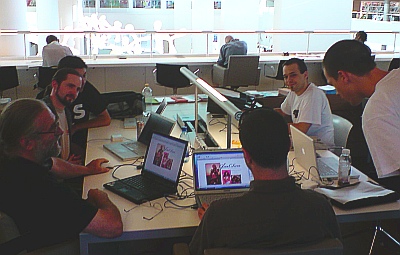
    Following the conclusion of ESUG‘s 16th Joint International Smalltalk Conference in Amsterdam, the Seaside developers held a Seaside Sprint. The aim of the sprint was to address a number of outstanding issues in order to move Seaside 2.9 towards release.

    The sprint was a great success with 14 developers working on a number of issues. Eighteen key bugs were resolved, and progress was made in a number of other areas. The attendees had a range of levels of knowledge and experience, from the core developers, to those seeing Seaside code for the first time

    The Sprint attendees would like to thank Café Kobalt and the Amsterdam Bibliotheek who provided essential facilities including free internet access, and great food and drink.

  • ESUG Innovation Awards 2008

    This year’s winners of the ESUG Innovation Technology Awards were announced at the 16th Joint International Smalltalk Conference in Amsterdam last night. There were a record-breaking 21 entrants, with a great selection of innovative ideas and products. Voting was by all attendees of the conference, and the winners were:

    1st prizeDrGeoII, Hilaire Fernandes’ development in Squeak Smalltalk of an application that allows students at primary or secondary level to create and interactively manipulate geometric figures within definable constraints, as featured on the Weekly Squeak recently (pdf description available here).

    2nd prizeseaBreeze, an application from Georg Heeg eK which allows Seaside developers to work in an interactive environment to develop web content (pdf description available here).

    3rd prize – iSqueak, a project from John M McIntosh, Grit Schuster and Michael Rueger, which allows Squeak to interact with multi-touch input devices such as the iPhone (pdf description available here).

    The competition was sponsored by ABN Amro Bank, and the winners get prizes of €500, €300 and €200.

    Following the ceremony, Georg Heeg announced that seaBreeze will be dual-licensed, with a free versions available under the MIT licence. The code will be made available once some finishing touches have been applied.

  • Squeak projects at Camp Smalltalk

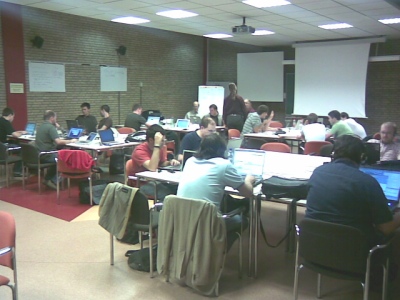
    Over fifty Smalltalk developers have spent the last two days working on a variety of Camp Smalltalk projects before this year’s ESUG Conference. A number of projects were based on Squeak:

    The SqueakNOS team are working to get rid of the need to have an OS underlying the Squeak image. They have now got to the point where any image can run on their VM with minor changes. They can boot from USB memory, and are making progress on accessing SD memory cards.

    The Amelia Project aims to use OpenCroquet to develop a three-dimensional multiuser collaborative virtual environment to help teachers organizing computer-mediated activities where children can collaborate, negotiate and make decisions regarding the spatial configuration of school spaces. Filipe Santos was able to work with other Squeak developers to move his work forward.

    The MOOSE team worked on their collaborative research platform for Software Analysis and Information Visualisation, and were able to make significant progress with migrating their FAMIX2 meta-model to Squeak using Fame.

    Hilaire Fernandes and Michael Reuger began exploring how to integrate DrGeoII, a tool for interacting with geometric figures, into the Sophie multimedia authoring environment.

    Giovanni Corriga worked on the code for the KomHttpServer, and delivered a number of bug-fixes.

    Lukas Renggli and Philippe Marschall were able to fix a number of bugs in Magritte, and add new functionality to Pier, as well as releasing a new maintenance version of Seaside.

  • SqueakDBX: beta release for OpenDBX plugin

    A team of students from UTN (National Technological University in Argentina) co-ordinated by Estaban Lorenzano has just announced the first beta release of SqueakDBX, a package to allow Squeak to access OpenDBX functionality, so allowing users to perform relational database operations (DDL, DML and SQL) through a truly open source library. OpenDBX can interact with major database engines such as Oracle and MSSQL besides open source databases such as Postgresql and MySQL. SqueakDBX can also integrate with GLORP.

    From the release notes, the key features for this release are:

    • Tested on 3.10 and Pharo. 
    • Support for Linux and OSX. 
      • Proved on windows (through MinGW), but some changes in OpenDBX are still needed (next version will have full compatibility).
    • Tested on PostgreSQL, MySQL and Oracle. 
      • MS SQL Server, Firebird, Interbase, SQLite, SQLite3 and Sybase tests will be available as soon as possible. 
    • Transactional management.
    • Automatic conversion of resultset columns (a String) into squeak types. 
      • Large objects (clob, blob, arrays, and so on) are not yet supported.
    • Special OpenDBX options: multi-statments, compression, paged results. 
    • Automated database connection release on garbage collection (although manual disconnection is recommended)
    • Error handling

    Some benchmark testing has been carried out, and the performance of the drivers appears to be comparable with native drivers.

    The team are very keen to get feedback, bug reports, experiences on different platforms etc, and welcome any contributions. Sources can be download from SqueakSource (it requires FFI installed). Full documentation, installation and getting started instructions can be found at the SqueakDBX wiki page.

    This project has been selected as part of ESUG SummerTalk 2008.

  • New Screencasts on DrGeoII

    Hilaire Fernandes has announced that he has created over 50 screencasts illustrating the capabilities of DrGeoII. DrGeoII allows students at primary or secondary level to create and interactively manipulate geometric figures within definable constraints.

    It is written using Morphic in Squeak Smalltalk, and can be embedded and mixed with existing Morph elements of the Squeak environment on the OLPC XO to produce some very impressive-looking activities to help students learn about mathematics and physics. The DrGeo wiki has lots of useful advice on how to get the best from the application.

    Development of Dr. Geo II was partly sponsored by TOP, the Taiwan Open Source Project, with funding from the Taiwan Ministry of Economy, and by ESUG to promote the Smalltalk language.

  • All new Monticello 2

    Colin Putney has announced the release of Monticello 2.0, a ground-up rewrite, using a new, more flexible and more performant versioning engine. Monticello is a distributed optimistic concurrent versioning system for Squeak code written by Avi Bryant and Colin Putney with contributions from many members of the Squeak community.

    The new version has a number of changes that Colin believes address problems uncovered while developing and using the first version. The new release manages versioning at a finer level: individual program elements – classes, methods, instance variables, etc. This means that Monticello 2 can be used to version arbitrary snippets of code. These might correspond to packages, change sets, or any other method a programmer chooses to separate “interesting” code from the rest of the image.

    According to the discussion that followed the announcement, the new code also manages updates more quickly and with less network and disc traffic, is more extensible, and has better separation of core and UI elements (which will ease porting to other Smalltalks).

    Older versions of the code are available on SqueakMap and SqueakSource, as well as the wiresong site, but in his email Colin says that the latest version should always be available at http://www.wiresong.ca/static/releases/Monticello-current.zip (I assume that requires a manual download and file-in – please let me know in the comments if there’s an easier way to do this). The zip file also has step-by-step instructions on how to use the (very different) user interface.

  • CMSBox wins top usability awards

    Avi Bryant alerted the Seaside mailing list to some exciting news: Cmsbox is one of the ten winners of this year’s useit.com 10 Best Application UIs of 2008, a competition intended to identify the 10 best-designed application user interfaces each year.

    Cmsbox is a powerful and flexible Content Management System (CMS) which allows users to create, edit and arrange content directly on the web site. It was built by Swiss company netstyle.ch using Squeak Smalltalk, Seaside and Scriptaculous.

    In describing the award, which is the latest in a string of awards won by CmsboxJakob Neilsen wrote that Cmsbox made it “particularly easy for direct users to create highly usable designs […] They have demonstrated that just one extra line of controls is all that is required to turn a website into a Web authoring environment. […] There are no modes to switch between, no edit windows to keep track of; it is immediately clear to users what effect their actions will have on the final layout because they are always working within that final layout”.

  • New Video Tutorial – Squeak Bug/Fix Reporting

    Ken Causey has added a very useful video to the Squeak Smalltalk group at vimeo.com, in which he demonstrates the entire process of creating and submitting a bug/fix or enhancement for Squeak. Along the way he also explains how to track down simple bugs, how to manage changesets, and how to navigate your way around the Mantis bug tracking system.