Author: Michael Davies

  • Squeak ported to Syllable

    Syllable

    Squeak has just been ported to Syllable Desktop OS by Kelly Wilson. The Syllable project has an active community which aims to develop easy-to-use Free Software operating systems for the home and small office user. Syllable Desktop OS is a continuation of work on AtheOS operating system, which has been around for a few years, being originally inspired by the AmigaOS.

    There are no video and sound drivers available yet, but headless Squeak programs run happily – the site has a screenshot showing the Seaside web application framework running in the ABrowser web browser. Kelly’s now looking for advice to get video working.

  • Seaside startup snapped up

    Auctomatic

    The news is spreading that Auctomatic, a Vancouver-based startup using Seaside, has been bought by Live Current Media for $5 million. The company, which produces a tool to ease selling and inventory management for eBay sellers, was funded by a number of investors including Paul Graham’s technology investment company Y Combinator, and its staff including founders Kulveer Taggar, Harjeet Taggar and Patrick Collison will join the new owners. Lots more details are available from Phillip Kast’s blog.
    It looks like Vancouver is becoming a very exciting place to be for Seaside developers!

    [Edit: Corrected the information about Y Combinator]

  • Sophie multimedia authoring environment hits 1.0

    Maus multimedia in Sophie

    Great news from the Sophie team – they’ve now released Sophie 1.0, available now from the Sophie website.

    Sophie is software for writing and reading rich media documents in a networked environment. The team’s goal is to open up the world of multimedia authoring to a wide range of people and institutions and in so doing to redefine the notion of a book or “academic paper” to include both rich media and mechanisms for reader feedback and conversation in dynamic margins.

    The team has produced lots of tutorial and documentation information, including some screencasts showing how easy multimedia authoring can be. Download Sophie to find out for yourself!

    Sophie is based on Squeak, and so runs on Mac, Windows and Linux operating systems.

  • Squeak 3.10 now released!

    Squeak 3.10

    Squeak version 3.10 has just been released onto the ftp server. This marks the completion of the development effort and gives Squeak developers an opportunity to check compatibility of packages and ports; work is still under way to produce final and fully packaged release files and once this has been completed, the squeak.org images on the Download page will be updated to point to fully packaged versions of this new release. Normal Squeak users are advised to wait for the packaged versions to be made available before upgrading.

    The goal of the 3.10 release was to improve the process of making Squeak releases and to improve the quality of the code. The release team concentrated on improving the coverage of unit tests, in making Squeak more modular, and in getting rid of non-core and unsupported code. In addition, many bugs were fixed.

    Highlights were:
    – Removal of non-core code.
    – Consistent use of Monticello to manage package dependencies.
    – Use of Package Universes for managing package compatibility issues.
    – Bug policy requiring all fixes to include unit tests.
    – Image fully tested on Mac OS X Tiger, Windows XP and Simply MEPIS 6.5 Linux.

    Thanks to the 3.10 release team including Ralph Johnson, Edgar De Cleene, and the many other Squeakers who contributed ideas, bug-fixes and support. Their work has given us an excellent release, and one which will be a great starting point for eventual progress to 4.0.

    Discussions and planning for 3.11 is already beginning on the mailing list, including topics such as:
    – the removal of major packages such as eToys and Nebraska to become loadable via Package Universes, and use of MinimalMorphic instead of the full Morphic suite.
    – migration to the improved packaging and loading functionality of tools currently under development such as DeltaStreams or Monticello2.
    – all code under old licences has been identified, and its replacement will be a priority.
    If you have an interest in how Squeak develops in the future, now is the time to have your say!

    For more information about this release, see the 3.10 page on the swiki or the welcome notes in the image itself.

    [Edited to clarify status of this release]

  • Squeak accepted into Google Summer of Code 08

    Google Code

    Giovanni Corriga has announced that Squeak is one of the 175 Free and Open Source projects accepted as mentoring organisations for this year’s Google Summer of Code.

    Students interested in joining the programme will receive a stipend of $4,500 and can find out more at the Squeak summary page, and list of proposed projects. You’re encouraged to visit the #squeak and #gsoc irc channels on irc.freenode.org to discuss your application and additional project proposals. Applications open on 24th March, and more details of the process can be found at the GSoC blog.

    Congratulations to Giovanni who managed the application process and everyone who contributed project ideas.

  • Squeak VM now in Debian distro

    Debian

    José L. Redrejo Rodríguez has announced that the Squeak VM is now officially included in the Debian distribution. This reflects the acceptance of the Debian administrators of the completion of the migration of the VM code from the old Apple licence to the MIT licence, (meaning that this page now needs updating). The package should be appearing in the mirrors in short order, see the changelog notice for more details.

    There’s still work to do in removing or re-licensing the remaining legacy code in the images, but this is an important step forward in the recognition of Squeak as Free software.

  • Dan Ingalls demos Lively at Google

    Dan Ingalls gave an interesting Tech Talk on the Lively kernel (best viewed in Safari 3 apparently) at Google a few weeks ago – what better way to (re)introduce our new board member?

  • Squeak by Example, 2.0!

    Squeak By Example

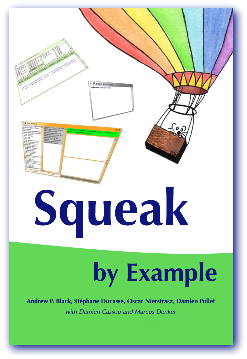
    Stéphane Ducasse has just announced that the second edition of Squeak By Example has just been published. It is available for download from the Squeak By Example website, or if you prefer paper to phosphors, you can order a hard copy from print-on-demand publishers lulu.com for only €16.18/$20.10/£11.07.

    Licensed under the creative commons by-sa licence, the first edition was a great success, with over 20,000 downloads in less than six months. For the second edition, the authors Oscar Nierstrasz, Stéphane Ducasse, Damien Pollet and Andrew P. Black, have reviewed and revised the contents based on feedback from readers.

    At over 300 pages, the book is an excellent introduction to developing in Squeak, and the overall organization and choice of topics makes it a great reference work.

  • Talk on “Newspeak” today

    Jens Lincke informed the mailing list that the Software Architecture Group at the University of Potsdam are hosting a talk today (11th March) by Gilad Bracha on Newspeak, described as a new dynamic language, descended from Smalltalk and Self.

    From Jens’ note:

    Newspeak is a new dynamic language, descended from Smalltalk
    and Self. Like Self, Newspeak is a message based language: all
    computation – even an object’s own access to its internal structure – is
    performed by sending messages to objects. However, like Smalltalk,
    Newspeak is class-based. Classes can be nested arbitrarily, as in Beta.
    Since all names denote message sends, all classes are virtual; in
    particular, superclasses are virtual, so all classes act as mixins.
    There is no static state in Newspeak. Instead, top level classes act as
    module definitions, which are independent, immutable, self-contained
    parametric namespaces. They can be instantiated into modules which may
    be stateful and mutually recursive. Naturally, like its predecessors,
    Newspeak is reflective: a mirror library allows structured access to the
    program meta-level. In this talk, we’ll expand on these topics,
    illustrating interesting uses such as class hierarchy inheritance and
    domain specific language support.

    Gilad Bracha is a Distinguished Engineer at Cadence Design Systems.
    Previously, he was a Computational Theologist and Distinguished Engineer
    at Sun Microsystems. He is co-author of the Java Language Specification,
    and a researcher in the area of object-oriented programming languages.
    Prior to joining Sun, he worked on Strongtalk, the Animorphic Smalltalk
    System. He received his B.Sc in Mathematics and Computer Science from
    Ben Gurion University in Israel and a Ph.D. in Computer Science from the
    University of Utah.

    The talk is from 16:00-17:00, at the Hasso Plattner Institut, B-E.2 (library). Directions can be found at: http://www.hpi.uni-potsdam.de/hpi/campus/anfahrt.html

  • Don’t forget to vote!

    Vote badge Just a quick reminder that you only have until 8th March to register your votes for the candidates for the Squeak Foundation Board 2008.

    There are 12 candidates standing for the 7 places and Göran Krampe has posted information on the election process including statements by the candidates.

    Voting is open to all Squeakers rated as Apprentice or higher on people.squeakfoundation.org. If you’re eligible to vote, you should have received an email at your registered address.