Author: Michael Davies

  • Calling all Smalltalkers!

    Luc Fabresse invites all Smalltalkers to submit your Smalltalk based software to the 7th ESUG Innovation Technology Awards. The top 3 teams with the most innovative software will receive, respectively, €500, €300 and €200 during an awards ceremony at the 18th International Smalltalk Joint Conference 2010 in Barcelona, Spain.

    No constraints are put on the software except that it should be Smalltalk-based or Smalltalk-related and all flavours of Smalltalk are accepted. Last year’s entries included student projects, one-man labours of love, and full commercial applications.

    Don’t forget that early registrations for the conference are only open for another month. You can register at http://registration.esug.org/ (running on Seaside). This server comes with new features: you can now do a group registration and make a single payment; it also allows you to book and pay for reduction tickets (typically for Golden and Platinum sponsors).

    The ESUG 2010 conference preliminary schedule is available at http://www.esug.org/Conferences/2010

  • Squeak running on iPad

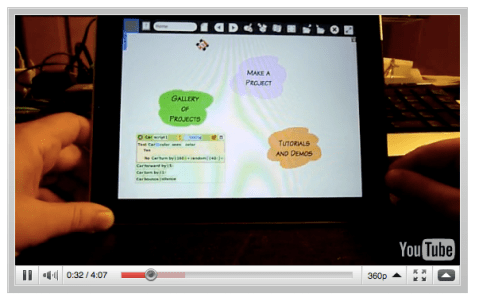
    Bert Freudenberg has recently got Squeak working on the iPad, and has the video to prove it!

    Bert’s work is based on John McIntosh‘s original port of the Squeak Virtual Machine to Apple’s touch-based OS, modified slightly to enable multi-touch and keyboard input. Bert also added multi-touch handling to Morphic. Interestingly, he notes that “Morphic was designed to handle multiple ‘hands’ (pointing devices) from the beginning”, so Squeak has always been multi-touch capable, and just let down by operating systems until now!

    Bert’s work will help the Etoys team prepare their application for the next machine from OLPC, the XO-3, which will also be a touch device. The new version of the Sugar OS for the new device is still being developed, so it looks as though Etoys is well ahead of the curve.

    Given the recent changes to Apple’s licence terms for iOS developers, it’s looking increasingly likely that we will see Squeak-based applications appearing for the iPad in the future. After a forty year wait, the Dynabook is nearly here!

  • JNIPort: Running Java from Squeak

    Joachim  Geidel has published a preview release of JNIPort, a Smalltalk library which allows Java code to be invoked from Smalltalk. It acts as a bridge between the world of Smalltalk objects and a Java Virtual Machine (JVM) where Java code is executing.

    The port to Pharo and Squeak is not yet finished: it lacks support for callbacks from Java to Smalltalk, and is a work in progress. Joachim is particularly interested in feedback from Squeak 4.1 users.

    JNIPort was originally written by Chris Uppal for Dolphin Smalltalk and published under a liberal licence which permits its use in commercial and non-commercial software. Joachim Geidel originally ported JNIPort to VisualWorks in 2006 and is now building on that work to make it available to Pharo and Squeak. The goal is to publish a stable release for VisualWorks, Pharo and Squeak in Q3/2010.

    In addition to giving Smalltalk programs access to Java libraries and services, the interactivity of Smalltalk makes it an ideal environment to experiment and prototype new Java functionality.

    Once it’s installed, calling some Java can be as simple as three lines in your workspace:

    jvm := JVM current.
    class := jvm findClass: #’java.lang.System’.
    class currentTimeMillis_null

    Installation instructions documentation and much more information are on the JNIPort Wiki.

  • All you ever heard about graphics anti-aliasing is wrong!

    Juan Vuletich has been working for some time on Morphic 3, a research and development project aimed at building the next standard in 2D user interfaces. One of his aims is to do mathematically proved alias-free rendering. In order to achieve these objectives, he has been experimenting with several techniques and design features, some which are new and others are not, but have never been consistently applied to a 2D GUI.

    Juan’s contention is that, although the theory behind sampling is about 80 years old, existing graphics software completely ignore the theory and that his quest for higher quality results has resulted in the idea of applying the Sampling Theory which allows for mathematically proved alias free rendering. He informed the squeak-dev mailing list of his latest post which makes the startling claim that “I developed new drawing algorithms that give better results than those in Cairo, AGG, etc.” and he has created some examples showing some of the problems with existing algorithms, and how his approach improves these issues.

    Juan is preparing the algorithms for release, which will involve him publishing it in a  journal or as a Ph.D. thesis, and securing it for free use by either putting the code in the public domain or releasing it under the MIT licence.

    Juan’s work on Morphic 3 is supported by ESUG’s Support Your Project programme.

  • Google Summer of Code – work begins!

    Good news from Mariano Martinez Peck, one of the key organisers of the joint Smalltalk entry into this year’s Google Summer of Code: the students started work on their projects this week!

    Following Google’s decision to focus on fewer organisations last year, ESUG co-ordinated a joint application for projects across all Smalltalk dialects this year, and were so successful in this venture that they got approval for 6 projects. You can find out more about the selected projects at the projects page.

    For the last two weeks or so, students have been talking and discussing with their mentors, reading and investigating about the projects, and perhaps getting an early start on their development work. This was in line with the GSoC deadlines that you can read at the ESUG GSoC site and at the GSoC blog.

    The organisers have told students to ask in case of problems or questions to their mentors but also to the community through the mailing list, so be prepared to help out with questions and issues that the students may have.

    Mariano says “Good luck to all students and enjoy this wonderful opportunity you have. Now we are in the best part of the program!”

  • Squeakfest 2010 – University of North Carolina

    Rita Freudenberg has announced that “The official Squeakfest website is now live and ready for you to propose a presentation, workshop, or panel.”

    Squeakfest is an annual conference where developers and users of the Etoys media-rich authoring and experimentation environment (based on Squeak) get together to share ideas, experiences, and their enthusiasms with colleagues from around the world.

    This year’s conference will be held at University of North Carolina in Wilmington, North Carolina, in the USA from 26th—28th July, and the theme for will be “Etoys in the STEM classroom.”

    The conference will offer an opportunity to reflect on the achievements of the NSF-funded project “Using Squeak to Infuse Technology (USeIT)” which is now reaching its 3rd year.

    The team are keen to hear from individuals and groups with experience teaching with Etoys, as well as non-classroom Etoys use, particularly as it relates to OLPC pilots or homeschooling. More information will be added to the website as it becomes available, but the organisers ask presenters to get presentation information to them by completing and submitting the online form no later than 11th June, 2010.

    To get a flavour of what to expect at the conference, have a look at our report from last year’s Squeakfest.

  • Workshop on Self-Sustaining Systems 2010

    The Workshop on Self-sustaining Systems (S3) is a forum for discussion of topics relating to computer systems and languages that are able to bootstrap, implement, modify, and maintain themselves. One property of these systems is that their implementation is based on small but powerful abstractions; examples include (amongst others) Squeak/Smalltalk, COLA, Klein/Self, PyPy/Python, Rubinius/Ruby, and Lisp. Such systems are the engines of their own replacement, giving researchers and developers great power to experiment with, and explore future directions from within, their own small language kernels.

    S3 will take place September 27-28, 2010 at The University of Tokyo, Japan. It is an exciting opportunity for researchers and practitioners interested in self-sustaining systems to meet and share their knowledge, experience, and ideas for future research and development.

    See the conference website for details and deadlines.

  • ESUG 2010 Conference – in Barcelona

    For the past 18 years, the European Smalltalk User Group (ESUG) has organised the International Smalltalk Conference, a lively forum on cutting edge software technologies that attract people from both academia and industry for a whole week. The attendees are both engineers using Smalltalk in business and students and teachers using Smalltalk both for research and didactic purposes.

    This year’s conference will be held at Citilab-Cornellà in Cornellà, Barcelona, on 13th—17th September. As in previous years, this year’s edition of the largest European Smalltalk event will include the regular Smalltalk developers conference with renowned invited speakers, and a Smalltalk camp that proves fruitful for interactions and discussions.

    This year will also see:

    • the 6th annual Innovation Technology Awards where prizes will be awarded to authors of best pieces of Smalltalk-related projects
    • an international workshop on Smalltalk and dynamic languages
    • for the first time there will be a business day on Thursday 16th September 2010 with a focus on “Agile Development Processes and Smalltalk”

    ESUG is sponsoring 10 free entrance tickets. To get a free ticket you should send a mail to the esug board (board@esug.org) with a subject of [ESUG 2010 Free entrance] + your name, with an small statement putting your case. Note that students can get free registration and hosting if they enrol into the the Student Volunteers program (see below).

    You can support the ESUG conference in many different ways:

    • Sponsor the conference. New sponsoring packages are described at http://www.esug.org/supportesug/becomeasponsor/
    • Submit a talk, a software or a paper to one of the events. See below.
    • Attend the conference! We’d like to beat the previous record of attendance (156 participants at Brest and 170 people at Amsterdam)!

    Developers Forum: International Smalltalk Developers Conference

    This year we are looking for YOUR experience on using Smalltalk. In addition, we are looking for tutorials. The list of topics includes, but is not limited to the following:

    • XP practices
    • Development tools
    • Experience reports
    • Model driven development
    • Web development
    • Team management
    • Meta-Modeling
    • Security
    • New libraries & frameworks
    • Educational material
    • Embedded systems and robotics
    • SOA and Web services
    • Interaction with other programming languages

    Submissions due on 1 July  2010
    Notification of acceptance on 15 of July 2010
    More information at http://www.esug.org/conferences/2010

    Innovation Technology Award

    We are proud to announce the 6th Innovation Technology Awards. The top 3 teams with the most innovative software will receive, respectively, 500 Euros, 300 Euros and 200 Euros during an awards ceremony at the conference. Developers of any Smalltalk-based software are welcome to compete. This year you are asked to provide 3-5min videos explaining your entry. More information can be found at http://www.esug.org/Conferences/2010/Innovation+Technology+Awards

    Student Volunteer Program

    If you are a student wanting to attend ESUG, have you considered
    being a student volunteer? Student volunteers help keep the
    conference running smoothly; in return, they have free
    accommodations, while still having most of the time to enjoy the conference. More information at http://www.esug.org/Conferences/2010/Student+Volunteers+program

  • Squeak Video Tutorials, 74 and counting!

    Chris Cunnington reminded the Squeak-dev mailing list that for a while now he’s been creating video tutorials explaining aspects of Squeak. In fact he’s been working at this for so long that he now has over 70 videos available!

    The videos give snappy introductions to topics as varied as: using SqueakSource to download Squeak applications; the mysteries of the red, blue, and yellow mouse buttons; how to use morphs; and using Croquet to interact in 3D environments (as seen above).

    If you want to learn about Squeak, or to find out more about Squeak applications you’ve never used before, these are a great resource, so head over to Chris’ Smalltalk Medicine Show channel on YouTube. If you know of other great videos for newcomers to Squeak and Smalltalk, please let us know in the comments.

  • Squeak 4.1 released

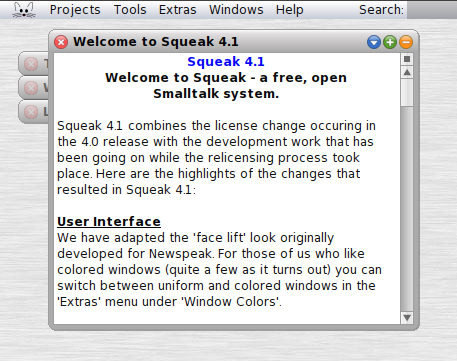
    Squeak 4.1 has now been released! This version combines the licence change occurring in the 4.0 release with the development work that has been going on while the re-licensing process took place.

    Much of the work in this release has been focused on fundamental improvements. Major achievements are the integration of Cog’s closure implementation, the improved UI look and feel, the new anti-aliased fonts, the core library improvements, and the modularity advances.

    One key focus for this release was to address the issues that have been known to frustrate developers using Squeak for the first time. A much improved set of UI widgets, the new menu bar including the fast search control, integrated help, improved test coverage, more class and method comments, and integrated syntax highlighting all make the system more accessible. The new full closures, the new traits implementation, multiple improvements to the collections and streams classes, the new NumberParser hierarchy all help make development easier and produce cleaner, faster code. Deploying your completed applications will be made easier by the work done on making many modules unloadable, and by support for other cleanup activities.

    To download the Squeak 4.1 release please visit http://ftp.squeak.org/4.1 or go to the squeak.org homepage and use the Download links on the right hand side.