Category: Applications

  • Squeak Etoys – Students Build Their Own Games In Four Days

    The Software Architecture Group at the Hasso-Plattner-Institut (who have produced a great online Seaside tutorial and associated book) have recently been involved in using Etoys in the classroom. They kindly sent us this report about the experience of two of their members when introducing Squeak and Etoys to high school students.

    (more…)

  • New Dabble DB Demo Debuts

    Avi Bryant writes at the Dabble DB blog that the team has produced a new 8-minute demo of their product in action. This new video replaces their 2006 video which was linked to so frequently that it still shows up as #4 in the google results for “the demo“.

    Dabble DB is a tool to help you create, manage, interpret and present data via your browser. Written in Squeak using the Seaside web application framework, it has received glowing reviews since its launch in 2005.

  • What’s the difference?

    Fully Functional Babbage Difference Machine

    The following was posted to the Squeak-Dev Mailing list by Markus Denker. The quote speaks for itself and it does give one pause to consider the implications to our community. It also strikes me as relevant to a lot of other development communities too. Great ideas are still very powerful and inspiring, but the idea alone is still seen as only half the process. We all know that there is a lot of very interesting problems that arise while we transform our ideas into working code. We also know that it is much easier to build onto a working system, or take what we learned from the process of building a working system to the next generation. While the idea itself can be seen as a great accomplishment, the realization of the idea by itself confers even greater benefits to the community. What projects have you left undone? What’s the difference?

    “One of the sad memories of my life is a visit to the celebrated mathematician and inventor, Mr Babbage. He was far advanced in age, but his mind was still as vigorous as ever. He took me through his work-rooms. In the first room I saw parts of the original Calculating Machine, which had been shown in an incomplete state many years before and had even been put to some use. I asked him about its present form.
    ‘I have not finished it because in working at it I came on the idea of my Analytical Machine, which would do all that it was capable of doing and much more. Indeed, the idea was so much simpler that it would have taken more work to complete the Calculating Machine than to design and construct the other in its entirety, so I turned my attention to the Analytical Machine.’”

    “After a few minutes’ talk, we went into the next work-room, where he showed and explained to me the working of the elements of the Analytical Machine. I asked if I could see it. ‘I have never completed it,’ he said, ‘because I hit upon an idea of doing the same thing by a different and far more effective method, and this rendered it useless to proceed on the old lines.’ Then we went into the third room. There lay scattered bits of mechanism, but I saw no trace of any working machine. Very cautiously I approached the subject, and received the dreaded answer, ‘It is not constructed yet, but I am working on it, and it will take less time to construct it altogether than it would have token to complete the Analytical Machine from the stage in which I left it.’ I took leave of the old man with a heavy heart.”

    — Lord Moulton

    Marcus Denker http://www.iam.unibe.ch/~denker

  • Sophie multimedia authoring environment hits 1.0

    Maus multimedia in Sophie

    Great news from the Sophie team – they’ve now released Sophie 1.0, available now from the Sophie website.

    Sophie is software for writing and reading rich media documents in a networked environment. The team’s goal is to open up the world of multimedia authoring to a wide range of people and institutions and in so doing to redefine the notion of a book or “academic paper” to include both rich media and mechanisms for reader feedback and conversation in dynamic margins.

    The team has produced lots of tutorial and documentation information, including some screencasts showing how easy multimedia authoring can be. Download Sophie to find out for yourself!

    Sophie is based on Squeak, and so runs on Mac, Windows and Linux operating systems.

  • Qwaq releases Hydra multi-core Squeak VM

    Qwaq in use

    Andreas Raab writes on the mailing list that:

    In its ongoing commitment to Open Source, Qwaq has decided to release the first multi-core capable Croquet VM under the MIT license.

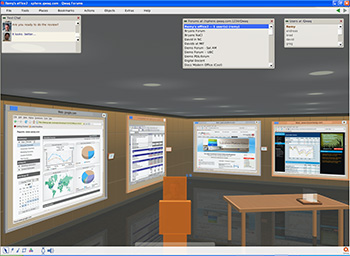
    Hydra VM is a virtual machine capable of running multiple Croquet images side-by-side, therefore being able to effectively utilize multi-core CPUs. Hydra VM is still in an early phase of development, but given the (very successful) early results, Qwaq has decided to make it available to general public in the hope that other people will help Igor [Stasenko] to make further progress in developing Hydra VM.

    Source code and binaries for Windows can be found at the Qwaq website.

  • Randal Schwartz Talks With Leo about Squeak, EToys and OLPC

    Randal Schwartz and Leo

    Don’t miss this fun new video from Randal Schwartz and Leo about Squeak, EToys and OLPC.  Randal builds a very nice car demo.

  • The Golight: Tool Support for Test-Driven Development

    SqueakSVNAt the Hasso-Plattner-Institut (HPI) in Potsdam, all Bachelor students have to participate in a software development project in their final year. Said projects are usually issued by industry collaborators, and hence are “real” development tasks that often yield actual products. The different HPI research groups coach the student project groups.

    This year’s Bachelor project of the Software Architecture Group was issued by CollabNet, the company that spawned Subversion. The students are working on SqueakSVN to make SVN version control and tooling available in Squeak.

    Coaching in the Software Architecture Group includes training in agile methodologies, with a strong emphasis on Extreme Programming. Of course, this includes heavy testing.

    The students were facing the question of how to make the current project status perceivable in a motivating way. Ideally, the status should be immediately visible when entering the project room in the morning, without the need to start up a Squeak image and run all the tests first.

    ampel2They came up with a really nice idea: the “test stoplight”, or, rather, “golight” to make it sound more positive. It’s as simple as this. A wooden board, three red, yellow, and green light bulbs, sockets, power supply lines, and an USB-controlled multiway connector make up the hardware part of the golight.

    Realizing the software part was also easy. One computer plays the role of a dedicated test server, running a Squeak image. In this image, a process checks out the most recent version of the software from the repository every five minutes, runs all the tests, and switches on the light corresponding to the color of the TestRunner bar. At night, it switches the lights off entirely.
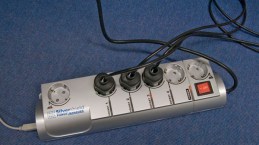
    leiste.jpgThe software does not even have to know anything about the protocol used to drive the multiway connector. The connector comes with a set of command-line tools that can be run from Squeak using OSProcess. These are currently limited to the Windows operating system, but since controlling the connector is basically about writing some data to a serial connection, it should not be too hard to come up with solutions for other platforms.

    This morning, when I first saw the golight, it was showing green.

    Feel free to contact us for detailed building instructions and information related to the software!

  • Immersive Education Summit Ad-Hoc Meeting

    Immersive Education Summit

    Well I couldn’t resist. Aaron E. Walsh sent out an invitation to the SqueakCroquet communities for an ad-hoc Immersive Education Meeting. The Boston Digital Summit held in January covered the Education Grid, this meeting was a chance to review this information for those that were not able to make it to the summit.

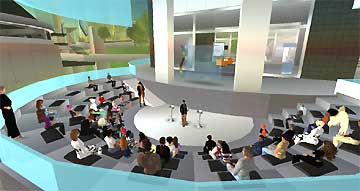
    Second Life was quite an experience. I had to sign up and go through some training, figure out how to get to Sun’s virtual auditorium and sit down. It was quite amusing to see some people show up on stage and not know how to sit down either, so I didn’t feel so bad. Maybe I should have spent more time in the training.

    Aaron, reviewed the details of the Education Grid. The Grid is an education content virtual repository focused on interoperability, standards, and quality educational content. The goal is to provide standards that allow content to be developed to operate in different virtual worlds. These standards must be open source to ensure that content can be made freely available.

    Content is just a piece of the puzzle in education. Educators also need tools to be able to evaluate the progress of students. There are a number of general tools that should be developed and made available in a consistent way for each offering. Aaron mentioned, “While it is possible to record everything that happens in a virtual world there is no way an educator could watch everything a student did in an activity that might take 2 hours.” Tools that allow educators to evaluate raw data, to assess progress and to track grades, and to create content are essential.

    Quality content will be assured by having a Peer Review of offerings before the become part of the grid. The peers will be selected from the community and people with special expertise will be sought to make sure that the education goals are met, the content is accurate, standards are followed, and licensing is compatible to be a part of the grid.

    Licensing and interoperability were the major concerns once Aaron opened the floor to questions. Ownership of the content was also discussed. Aaron mentioned that a not-for-profit organization would own the grid, but that the grid would be virtual and would be hosted by multiple organizations. I’m not sure there was a full answer about the ownership of the content. I would have suggested that copyright stay with the author or developing organization, and that the grid would receive unlimited rights to distribute the content, much in the same way were are trying to organize the Squeak community.

    Well I ran out of time but Aaron did a very nice job of wrapping it up just a few minutes over. Thank you! The concept is really a terrific idea. I hope that our communities will join together and support developing freely available virtual world educational materials. Aaron mentioned that other meetings will be held in Croquet, I look forward to that. I hope to see you there. Hopefully that meeting will be just as well attended as the SL meeting.

  • Qwaq is Hiring!

    https://i0.wp.com/www.qwaq.com/images/Slide4_60pct.jpg

    We reported earlier that Qwaq received funding, well today Qwaq announced that it is hiring. They are looking for a Software Quality Engineer and a Senior Unix System Administrator. Qwaq builds secure 3d virtual worlds for business collaboration that is written in Squeak and Croquet. It is very exciting to watch this company grow. We will be watching.