Category: Conferences

  • Squeakfest a roaring success

    logoFest

    The US Squeakfest finished last week, following on from the previous Brazilian event, and it was a great success. Perhaps the best way to give a flavour of the excitement of the events and the enthusiasm of the attendees is to quote Timothy Falconer’s report:

    As I write this, I’m flying home from Squeakfest USA.  Sitting here, staring at my laptop, I’m completely unable to find appropriate words to describe the magic and friendship of the last few weeks.  So many passionate talks, so many stirring examples, so many last minute details and surprises.

    I’m tired.  That much is clear.  Blame it on three conferences in four weeks and roughly fifteen thousand miles of travel in between.  Were it not for my many Squeaker traveling companions, I’d have curled up to hibernate long ago.  Truly the best part of the last month has been the company I’ve kept: Rita, Yoshiki, Marta, Kim, Scott, Alex, Bert, Ted, Bill, Randy, both Kathleens, Avigail, and Milan. Sharing the adventure with people of such talent and humor has truly been an embarrassment of riches.

    As for the presentations, workshops, and hallway talks, there’s just too much to say.  With dozens of sessions between the two Squeakfests, my mind’s a blur with memories of enthusiasm and insight, along with strengthened motivation to support and expand our vibrant Etoys community.

    Rather than summarize my recollections, I’ll instead point you to the video on the Squeakland website http://squeakland.org/resources/audioVisual/#cat865 (scroll down to Squeakfest Brasil and Squeakfest USA).

    We managed to capture nearly all of Squeakfest USA on our live webcast feed, though we lost the first half of the presentation from South Korea.  Also, the final roundtable wasn’t posted at the request of one of the participants. My apologies for the audio problems on the first morning.  If you start at the beginning, know that the sound does get better.  Also, if the video screen is at times too hard to read, the blame rests with the web stream, which reduced quality to improve bandwidth.  We will be posting better video from both events in the future, particularly of the children’s workshop, so stay tuned.

    I’d like to give a special thanks to Rita Freudenberg, our education director, who earned the “most traveled” award for her trips from Germany to both Brazil and Los Angeles.  When you total her air distance, she flew more than 40,000 kilometers (25,000 miles), which means she effectively circled the globe for Squeakland in the last month.  Her insight, passion, and hard work in the last eight months were instrumental in both Squeakfests.  As with her husband Bert, her continuing efforts on behalf of the Etoys community are unparalleled.  Also a big thanks to Marta, Bruno, Kim, and Kathryn for tending to the many details of both conferences.  Your hard work really showed.   Most of all, I’d like to thank everyone at Viewpoints Research Institute for their time and talent in the last year.  Your guidance has greatly helped Squeakland Foundation as we take and carry the Etoys torch into the future.
    Wow! What more is there to say? Let’s hope that ESUG 2009 proves to be as inspiring!

  • ESUG Innovation Technology Awards – Time is running out!

    esug-logo

    The Innovation Technology Awards session is one of the real highlights of the annual International Smalltalk Conference organised by ESUG each year.

    Noury Bouraqadi has just posted to remind everyone that you only have until 1st July to nominate your work for an award. Put together a brief description of your work, which can be in any Smalltalk dialect, make it available for inspection online, and be prepared to demonstrate it to a constant stream of inquisitive Smalltalkers during the conference, and you could win up to €500 in addition to the recognition and respect of your peers.

    Have a look at Noury’s site for an introduction to the ideas that have proved popular in the past, or our own details of last year’s winners.

    All the administrative details can be found on the ESUG 2009 website – so get those application forms in now!

    And in case you’ve forgotten, this year’s conference is in Brest, France from 31 August—4 September, 2009. It will be preceded by Camp Smalltalk running on the weekend of 29—30 August 2009, and incorporates the International Workshop on Smalltalk Technologies on 31 August.

  • Back to the Future: Programming in Smalltalk

    back-to-the-future

    More exciting conference news for Smalltalk aficionados: James Foster has announced on his blog that this year’s OOPSLA conference will include several tutorials with a Smalltalk theme including his “Back to the Future: Programming in Smalltalk” in which he will look at the “new” ideas from Smalltalk that are still influencing newer programming languages. He will examine some of these ideas and present a number of tutorial exercises that explore some of Smalltalk’s  fundamentally different approach to language design and object orientation, including the following aspects:

    • All values are objects, even integers, booleans, and characters (no boxing/unboxing);
    • Classes and methods are objects (supporting reflection);
    • The language has only five reserved words;
    • All control flow (looping and conditional branching) is done through message sends;
    • Programming is done by sending messages to existing objects; and
    • The base class library can be modified.

    James works on Gemstone’s high performance product family based on Smalltalk, but intends the exercises to be relevant across different versions.

    This year’s OOPSLA will be held in Orlando, Florida from 25 to 29 October, and will also be co-located with the Dynamic Languages Symposium, which will doubtless have lots to interest Smalltalkers.

    On the other hand, if you’re looking for a European break this year, don’t forget that the 2009 International Smalltalk Conference, organised by ESUG, will be held in Brest, France, from 31 August to 4 September, and also has a great set of sessions lined up.

  • Squeak and Seaside BOFs at OOPSLA ’08

    Nicolas Chen has posted a very interesting report on the Squeak and Seaside ‘Birds of a Feather’ sessions at this year’s OOPSLA Conference in Nashville, Tennessee. Speakers included Michael Lucas-Smith of Cincom talking  about their WebVelocity development tool for Seaside; Göran Krampe on Blackfoot, his lightweight SCGI-based KomHttpServer replacement for Seaside deployment; Dave Ungar (ex-Sun Labs, now at IBM Research) on his work on multi-core Squeak; and Jecel Assumpcao Jr. on Smalltalk Hardware Design, and his Siliconsqueak project.

    As promised, Göran has published videos of the sessions; see his blog for details.

  • Squeak BOF at OOPSLA 2008

    OOPSLA, the “original conference devoted to object-oriented programming”, is running this year on 19th-23rd October in Nashville. Göran Krampe wrote to the mailing list to let attendees know that he is organising a Squeak “Birds of a Feather” evening session on Tuesday at 18:00.

    Göran has had experience of organising these events in the past, so you can be sure that the logistics have been thought through carefully – he’s even bringing his own projector with him from Sweden, rather than rely on the equipment available at the venue! All the videos of all the presentations will be made available after the session.

    If you’re interested in attending this session, please let Göran know by adding your name to the OOPSLA 2008 page on the Squeak wiki (if you’re having trouble editing that page, the words squeak and viewpoints may be of some use to you). The wiki page also has information on some other items that may be of interest to Squeakers.

  • ESUG ’08 – Seaside Sprint


    Following the conclusion of ESUG‘s 16th Joint International Smalltalk Conference in Amsterdam, the Seaside developers held a Seaside Sprint. The aim of the sprint was to address a number of outstanding issues in order to move Seaside 2.9 towards release.

    The sprint was a great success with 14 developers working on a number of issues. Eighteen key bugs were resolved, and progress was made in a number of other areas. The attendees had a range of levels of knowledge and experience, from the core developers, to those seeing Seaside code for the first time

    The Sprint attendees would like to thank Café Kobalt and the Amsterdam Bibliotheek who provided essential facilities including free internet access, and great food and drink.

  • ESUG Innovation Awards 2008

    This year’s winners of the ESUG Innovation Technology Awards were announced at the 16th Joint International Smalltalk Conference in Amsterdam last night. There were a record-breaking 21 entrants, with a great selection of innovative ideas and products. Voting was by all attendees of the conference, and the winners were:

    1st prizeDrGeoII, Hilaire Fernandes’ development in Squeak Smalltalk of an application that allows students at primary or secondary level to create and interactively manipulate geometric figures within definable constraints, as featured on the Weekly Squeak recently (pdf description available here).

    2nd prizeseaBreeze, an application from Georg Heeg eK which allows Seaside developers to work in an interactive environment to develop web content (pdf description available here).

    3rd prize – iSqueak, a project from John M McIntosh, Grit Schuster and Michael Rueger, which allows Squeak to interact with multi-touch input devices such as the iPhone (pdf description available here).

    The competition was sponsored by ABN Amro Bank, and the winners get prizes of €500, €300 and €200.

    Following the ceremony, Georg Heeg announced that seaBreeze will be dual-licensed, with a free versions available under the MIT licence. The code will be made available once some finishing touches have been applied.

  • Squeak projects at Camp Smalltalk

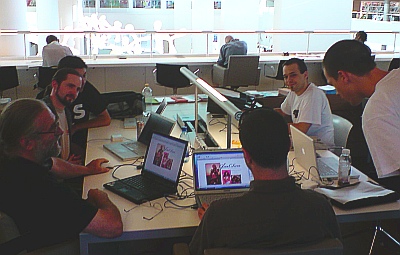
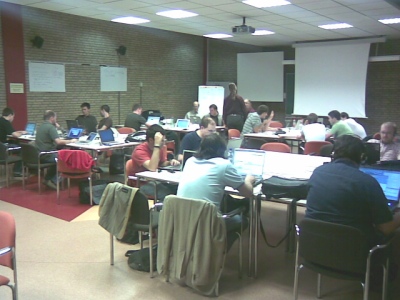
    Over fifty Smalltalk developers have spent the last two days working on a variety of Camp Smalltalk projects before this year’s ESUG Conference. A number of projects were based on Squeak:

    The SqueakNOS team are working to get rid of the need to have an OS underlying the Squeak image. They have now got to the point where any image can run on their VM with minor changes. They can boot from USB memory, and are making progress on accessing SD memory cards.

    The Amelia Project aims to use OpenCroquet to develop a three-dimensional multiuser collaborative virtual environment to help teachers organizing computer-mediated activities where children can collaborate, negotiate and make decisions regarding the spatial configuration of school spaces. Filipe Santos was able to work with other Squeak developers to move his work forward.

    The MOOSE team worked on their collaborative research platform for Software Analysis and Information Visualisation, and were able to make significant progress with migrating their FAMIX2 meta-model to Squeak using Fame.

    Hilaire Fernandes and Michael Reuger began exploring how to integrate DrGeoII, a tool for interacting with geometric figures, into the Sophie multimedia authoring environment.

    Giovanni Corriga worked on the code for the KomHttpServer, and delivered a number of bug-fixes.

    Lukas Renggli and Philippe Marschall were able to fix a number of bugs in Magritte, and add new functionality to Pier, as well as releasing a new maintenance version of Seaside.

  • Conference news: ESUG 2008 – more information

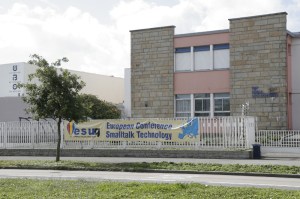
    A set of posts to the squeak mailing lists has given more details about the 16th International Smalltalk Joint Conference organised by the European Smalltalk Users’ Group, to be held 25-29 August 2008 at CWI in Amsterdam.

    Programme Details

    Mathieu van Echtelt writes that the programme features more than 40 presentations on, among others, the following subjects:

    Programming Language Platforms

    • Newspeak (New open source dynamic language focusing on modularity, security and interoperability)
    • Cog (New highly optimized open source Squeak VM)
    • Maglev (Highly scalable Ruby VM)
    • OpenCroquet (Deeply collaborative, multi-user online Smalltalk development environment)

    Web Frameworks

    • Seaside (The continuation & component-based web framework)
    • WebVelocity
    • AidaWeb (Smalltalk Web Application Server)
    • WebTerminal

    Model Driven Engineering:

    • The Meta Environment Language Workbench
    • ObjectStudio ModelingTool
    • Fame; Meta-modeling Framework
    • MBA Smalltalk; to manage your objects

     
    Additionally, the winners of the ABN Amro sponsored Innovation Awards will be presented.

    Booking Accommodation 

    Noury Bouraqadi notes that discount hotel rates for conference attendees are available until 11 July.

    Seaside Sprint

    Lukas Renggli has announced that the core Seaside dev team will be holding the first official Seaside Sprint, starting after the conference closes at 14:00 on 29 August, and finishing when the last participant collapses over their smoking keyboard. He invites anyone interested in working on Seaside or related code to participate. The venue details will be announced once agreed.

    Camp Smalltalk

    As usual, the weekend preceding the conference will be used to host Camp Smalltalk, an opportunity to work with colleagues on a number of exciting projects. See the Camp Smalltalk page for more information.

  • Smalltalk Solutions 2008 – slides now available

    Most of the slides from the presentations at this year’s Smalltalk Solutions conference are now on line.

    The material available includes Gilad Bracha’s talk on Newspeak, James Foster’s guide to building a Seaside application using GemStone/S, Michael Rueger’s introduction to Sophie, Arden Thomas demonstrating WebVelocity in action, and Randal Schwartz’s double-header keynote: Seaside – Your Next Web Framework and an introduction to persistency solutions for use with Seaside.  

    There are also slides from a couple of sessions looking at the reasons for the recent resurgence of interest in Smalltalk: Arden Thomas looks at the features of Smalltalk that other languages lack, and Rob Rothwell explains how Smalltalk helps with the development of healthcare applications.

    There are many more slide-packs available, and still more to be added, so please check out the conference page for more information. James Robertson is adding video and audio as it becomes available.