Category: Development

  • The Golight: Tool Support for Test-Driven Development

    SqueakSVNAt the Hasso-Plattner-Institut (HPI) in Potsdam, all Bachelor students have to participate in a software development project in their final year. Said projects are usually issued by industry collaborators, and hence are “real” development tasks that often yield actual products. The different HPI research groups coach the student project groups.

    This year’s Bachelor project of the Software Architecture Group was issued by CollabNet, the company that spawned Subversion. The students are working on SqueakSVN to make SVN version control and tooling available in Squeak.

    Coaching in the Software Architecture Group includes training in agile methodologies, with a strong emphasis on Extreme Programming. Of course, this includes heavy testing.

    The students were facing the question of how to make the current project status perceivable in a motivating way. Ideally, the status should be immediately visible when entering the project room in the morning, without the need to start up a Squeak image and run all the tests first.

    ampel2They came up with a really nice idea: the “test stoplight”, or, rather, “golight” to make it sound more positive. It’s as simple as this. A wooden board, three red, yellow, and green light bulbs, sockets, power supply lines, and an USB-controlled multiway connector make up the hardware part of the golight.

    Realizing the software part was also easy. One computer plays the role of a dedicated test server, running a Squeak image. In this image, a process checks out the most recent version of the software from the repository every five minutes, runs all the tests, and switches on the light corresponding to the color of the TestRunner bar. At night, it switches the lights off entirely.
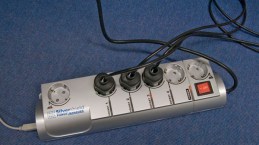
    leiste.jpgThe software does not even have to know anything about the protocol used to drive the multiway connector. The connector comes with a set of command-line tools that can be run from Squeak using OSProcess. These are currently limited to the Windows operating system, but since controlling the connector is basically about writing some data to a serial connection, it should not be too hard to come up with solutions for other platforms.

    This morning, when I first saw the golight, it was showing green.

    Feel free to contact us for detailed building instructions and information related to the software!

  • Dynamic Languages Symposium (DLS) 2008 – Call For Papers

    Cern

    Call For Papers

    *** Dynamic Languages Symposium (DLS) 2008 ***

    July 8, 2008 (Tuesday)

    Co-located with ECOOP 2008, Paphos, Cyprus

    Sponsored by ACM SIGPLAN

    http://www.swa.hpi.uni-potsdam.de/dls/dls08/

    ——————————-
    IMPORTANT DATES
    ——————————-
    Submission deadline: April 25, 2008 (hard deadline) Author notification: May 23, 2008 Camera-ready copy due: June 6, 2008 DLS 2008: July 8, 2008

    ——————————-
    ABOUT DLS
    ——————————-
    The Dynamic Languages Symposium (DLS) at ECOOP 2008 in Paphos, Cyprus, is a forum for discussion of dynamic languages, their implementation and application. While mature dynamic languages including Smalltalk, Lisp, Scheme, Self, Prolog, and APL continue to grow and inspire new converts, a new generation of dynamic scripting languages such as Python, Ruby, PHP, Tcl, and JavaScript are successful in a wide range of applications.

    DLS provides a place for researchers and practitioners to come together and share their knowledge, experience, and ideas for future research and development.

    DLS 2008 invites high quality papers reporting original research, innovative contributions or experience related to dynamic languages, their implementation and application. Accepted Papers will be published in the ACM Digital Library.

    ——————————-
    TOPICS OF INTEREST
    ——————————-
    Areas of interest include but are not limited to:

    – Innovative language features and implementation techniques
    – Development and platform support, tools
    – Interesting applications
    – Domain-oriented programming
    – Very late binding, dynamic composition, and runtime adaptation
    – Reflection and meta-programming
    – Software evolution
    – Language symbiosis and multi-paradigm languages
    – Dynamic optimization
    – Hardware support
    – Experience reports and case studies
    – Educational approaches and perspectives
    – Object-oriented, aspect-oriented, and context-oriented programming

    ——————————-
    SUBMISSION GUIDELINES
    ——————————-
    We invite original contributions that neither have been published previously nor are under review by other refereed events or publications. Research papers should describe work that advances the current state of the art. Experience papers should be of broad interest and should describe insights gained from substantive practical applications. The program committee will evaluate each contributed paper based on its relevance, significance, clarity, and originality.

    Papers are to be submitted electronically at http://www.swa.hpi.uni-potsdam.de/dls/dls08/ in PDF format. Submissions must not exceed 12 pages and need to use the ACM format, templates for which can be found at http://www.acm.org/sigs/pubs/proceed/template.html.

    ——————————-
    PROCEEDINGS
    ——————————-
    Accepted Papers will be published in the ACM Digital Library.

    ——————————-
    PROGRAM COMMITTEE
    ——————————-

    Chair: Johan Brichau (Université catholique de Louvain, Belgium)

    Joe Armstrong (Ericsson AB, Sweden) Pierre Cointe (École des Mines de Nantes, France)William R. Cook (University of Texas at Austin, USA) Pascal Costanza (Vrije Universiteit Brussel, Belgium) Wolfgang De Meuter (Vrije Universiteit Brussel, Belgium) Maja D’Hondt (IMEC, Belgium) Robert Hirschfeld (Hasso-Plattner Institüt, Germany) Roberto Ierusalimschy (PUC-Rio, Brazil) Andy Kellens (Vrije Universiteit Brussel, Belgium) Michele Lanza (University of Lugano, Switzerland) Michael Leuschel (University of Düsseldorf, Germany) Oscar Nierstrasz (University of Berne, Switzerland) Kent Pitman (PTC, USA) Lynne Shaw (CheckFree Investment Services, USA) David Ungar (Sun Microsystems, USA) Peter Van Roy (Université catholique de Louvain, Belgium) Martin von Löwis (Hasso-Plattner Institüt, Germany) Daniel Weinreb (ITA Software, USA)

  • Self-Sustaining Systems *Call for Papers*

    s3
    Workshop on Self-sustaining Systems (S3) 2008
    May 15-16, 2008
    Potsdam, Germany
    http://www.swa.hpi.uni-potsdam.de/s3/

    Call for papers:

    The Workshop on Self-sustaining Systems (S3) is a forum for discussion of topics relating to computer systems and languages that are able to bootstrap, implement, modify, and maintain themselves. One property of these systems is that their implementation is based on small but powerful abstractions; examples include (amongst others) Squeak/Smalltalk, COLA, Klein/Self, PyPy/Python, Rubinius/Ruby, and Lisp. Such systems are the engines of their own replacement, giving researchers and developers great power to experiment with, and explore future directions from within, their own small language kernels.

    S3 will be take place May 15-16, 2008 at the Hasso-Plattner-Institute in Potsdam, Germany. It is an exciting opportunity for researchers and practitioners interested in self-sustaining systems to meet and share their knowledge, experience, and ideas for future research and development.

    — Invited talk:

    Ian Piumarta: Late-bound Object Lambda Architectures (Viewpoints Research Institute, USA)

    — Submissions and proceedings:

    S3 invites submissions of high-quality papers reporting original research, or describing innovative contributions to, or experience with, self-sustaining systems, their implementation, and their application. Papers that depart significantly from established ideas and practices are particularly welcome.

    Submissions must not have been published previously and must not be under review for any another refereed event or publication. The program committee will evaluate each contributed paper based on its relevance, significance, clarity, and originality. Revised papers will be published as post-proceedings in the Springer LNCS series.

    Papers should be submitted electronically via EasyChair at
    http://www.easychair.org/conferences/?conf=s3 in PDF format.
    Submissions must be written in English (the official language of the
    workshop) and must not exceed 20 pages. They should use the LNCS format, templates for which are available at http://www.springer.de/comp/lncs/authors.html.

    — Venue:

    Hasso-Plattner-Institut (Potsdam, Germany)

    — Important dates:

    Submission of papers: February 15, 2008
    Author notification: April 11, 2008
    Revised papers due: April 25, 2008

    S3 workshop: May 15-16, 2008

    Final papers for LNCS post-proceedings due: June 6, 2008

    — Chairs:

    * Robert Hirschfeld (Hasso-Plattner-Institut Potsdam, Germany)
    * Kim Rose (Viewpoints Research Institute, USA)

    — Program committee:

    * Johan Brichau, Universite Catholique de Louvain, Belgium
    * Pascal Costanza, Vrije Universiteit Brussel, Belgium
    * Wolfgang De Meuter, Vrije Universiteit Brussel, Belgium
    * Stephane Ducasse, INRIA Lille, France
    * Michael Haupt, Hasso-Plattner-Institut, Germany
    * Robert Hirschfeld, Hasso-Plattner-Institut, Germany
    * Dan Ingalls, Sun Microsystems Laboratories, USA
    * Martin von Lšwis, Hasso-Plattner-Institut, Germany
    * Hidehiko Masuhara, University of Tokyo, Japan
    * Ian Piumarta, Viewpoints Research Institute, USA
    * David Ungar, IBM, USA

    — Registration fees:

    Early (until April 18, 2008)
    * Regular participants: EUR 160
    * Students: EUR 80

    Late (after April 18, 2008)
    * Regular participants: EUR 170
    * Students: EUR 90

  • Squeak BOF at OOPSLA – highlights + videos

    OOPSLA 2007

    Alexandre Bergel and Göran Krampe reported on the mailing-list (1, 2) the highlights of the Squeak BOF session at OOPSLA 2007 on Monday:

    • Jamie Douglass discussed CAT, an alternative to SmaCC
    • Andrew P. Black showed “Squeak by Example” (and sold a few more copies!)
    • Alessandro Warth showed how to implement a JavaScript interpreter in 300 lines of code by using OMeta (SqueakMap page, paper[pdf] co-authored with Ian Piumarta)
    • Göran gave a presentation on DeltaStreams
    • Maurice Rabb talked about condensing the change and sources files of Squeak
    • Alexandre Bergel introduced Athena Smalltalk – a Smalltalk Virtual Machine in Java, and intended to be embedded in Java applications (project homepage)
    • Bert Freudenberg and Yoshiki Ohshima demonstrated eToys on the OLPC XO laptop

    Göran filmed the event, and has made the videos available at his blog.

    Alexander Lazarevič is making compressed versions available through an online player:

  • New Seaside Tutorial By Hasso-Plattner-Institute

    Hasso-Plattner-Institute Seaside Tutorial

    Michael Perscheid announced that the Hasso-Plattner-Institute has just finished a new Seaside Tutorial. Thanks for your hard work! Great Job!

    From Michael:

    Dear list,

    We proudly present a new Seaside tutorial (for Squeak 3.10 and Seaside 2.8).
    This tutorial was produced by the Software Architecture Group at the Hasso-Plattner-Institute (University of Potsdam). In ten chapters we describe step by step the development of a ToDo-application and thereby demonstrate the main parts of the sophisticated web framework Seaside.

    Since this is the first version we hope that you can help to improve the quality by providing feedback.

    Have a look at: http://www.swa.hpi.uni-potsdam.de/seaside/tutorial

    Regards
    Michael Perscheid

  • See Bert and OLPC on German TV (in German)

    Bert and Olpc on German TV

    Check out Bert and Olpc on the tagesschau.de. The video is in German. Notice the link on the left “100-Dollar-Laptop” that will take you right to the clip. Feel free to skip the computer salesman’s comments. Who knows where they got this guy from! The project must be looking up if this is the best they can do. It’s like the debate about global warming in the U.S.A. For a long time we’d hear that scientists have reached a global consensus, all except Joe – from the Wyoming Science Club who says global warming doesn’t exist.

    This is a very exciting time for olpc. Congratulations everyone.

  • Dan’s the Man! Check out Dan Ingalls work. Squeak in JavaScript.

    Squeak in JavaScript

    Dan Ingalls working at Sun Labs has just released their first version of Morphic implemented completely with JavaScript which they are calling the Lively Kernel. There is no plugin required, but your browser currently must support SVG. You should use your Safari browser for best results. It will work with Firefox but you should expect bugs. It does not work with Internet Explorer yet.

    Point your supported browser here to see this exciting work! Great Job to the team at Sun, Dan Ingalls, Tommi Mikkonen, Krzysztof Palacz, and Antero Taivalsaari.

  • Pretty Cool NYTimes OLPC Review

    OLPC Interface

    David Pogue at NYTimes reviews the One Laptop Per Child computer.  Don’t miss the video clip, it’s very cool.

  • Tangible User Interface for Squeak

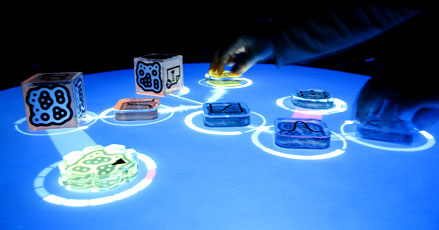
    Reactable in action

    Simon Holland yesterday announced on the squeak-dev list the release of a Squeak client for TUIO under the MIT licence. TUIO allows the rapid development of table-based tangible user interfaces (TUI) and multi-touch interactive surfaces.

    TUIO uses the reacTIVision computer vision system to track physical objects in real time. This system is also used in reactable – the electronic music interface used by Björk in her current world tour.

    The Squeak package includes the Tuio client and demonstration application program. To make practical use of Tuio for Squeak you will need a webcam or other camera, and should download the free Reactivision application for your operating system.

    (Image shows reactable in action from http://mtg.upf.edu/reactable )

  • Don’t Miss Cincom’s Seaside Podcasts Next Week

    Seaside Sign Small

    From Michael Lucas-Smith:

    Hi Everyone,

    Just a heads up that Industry Misinterpretations, our Smalltalk podcast, has three podcasts specifically about Seaside coming out over the next week.

    Podcast #1: Myself, James Robertson, Tamara Kogan, Martin Kobetic, Arden Thomas

    Podcast #2: Myself, James Robertson, Michel Bany, Alan Knight, Arden Thomas

    Podcast #3: Myself, James Robertson, The entire Gemstone GLASS team

    The podcasts will be appearing here:
    http://www.cincomsmalltalk.com/userblogs/cincom/blogView?content=podcasts
    You can subscribe to the podcast in iTunes (just search for smalltalk) or with: http://www.cincomsmalltalk.com/rssBlog/blog_podcast.xml
    They’ll also be announced on James’s blog:
    http://www.cincomsmalltalk.com/blog/blogView

    Cheers,
    Michael