Category: Squeak

  • Algernon: your personal assistant for Squeak

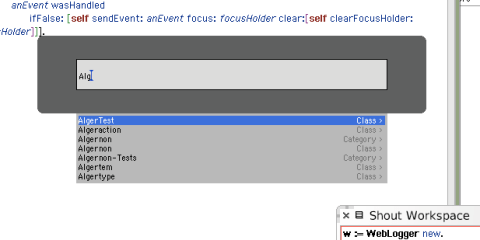
    A team of undergraduates at the University of Illinois at Urbana-Champaign have just released “Algernon”, a new keyboard-based launcher to help you navigate around your Squeak environment.

    Algernon was developed by Erik Hinterbichler and Joey Hagedorn with their CS598 classmates, working with Professor Ralph Johnson of the Software Architecture Group at UIUC. The developers say that Algernon provides lightning quick access to categories, classes, morphs, and global variables in your image, and is inspired by tools such as Quicksilver and LaunchBar for Mac OS X. Like Quicksilver, it learns from your behaviours, and will prioritise options that you use most often. It is triggered by pressing Control-Space Shift-Return, though this can be changed by editing Algernon>>activationString.

    Algernon can be downloaded from SqueakMap using the SqueakMap package loader or from Squeaksource using Monticello, and requires KeyBinder to be installed as a prerequisite.

    [Edited in light of Erik’s comments below.]

  • Squeak and the filesystem

    One of the stumbling blocks for experienced developers looking at Squeak for the first time is the concept of the “image”. Many developers, especially from the UNIX world are used to managing their source code and other resources with a host of file-based utilities, including editors, archivers and change-management tools.

    The Squeak philosophy that everything happens within the image can make the transition to Squeak painful for such developers, but there are tools out there to help with the transition. Two such tools were discussed recently on the #squeak irc channel.

    Johan Björk announced the release of SqueakFS, which allows you to browse and search all objects contained in your squeak image from your local file system. SqueakFS is currently read-only, but the developers are interested in adding editing capabilities. The file system functionality is provided by a socket client built on top of FusePython. This client translates file system paths into squeak objects and queries a server running in the squeak image for details on these objects. In order to do this, SqueakFS uses FusePython for file system support and is dependent on both FUSE and Python and will only work on UNIX systems. SqueakFS has been developed and tested on Linux 2.6 and MacOS Leopard running on Intel systems.

    Brian Rice pointed to another recent project, Stave, which mounts sources on a webDAV share, and so provides an editable WebDAV interface to Squeak’s class system. With the use of a WebDAV filesystem or a webDAV-enabled editor, this enables a file-based view on Squeak. Stave is intended primarily for use with external editors, and hasn’t been tested with search tools.

  • New Dabble DB Demo Debuts

    Avi Bryant writes at the Dabble DB blog that the team has produced a new 8-minute demo of their product in action. This new video replaces their 2006 video which was linked to so frequently that it still shows up as #4 in the google results for “the demo“.

    Dabble DB is a tool to help you create, manage, interpret and present data via your browser. Written in Squeak using the Seaside web application framework, it has received glowing reviews since its launch in 2005.

  • Using Squeak in Education

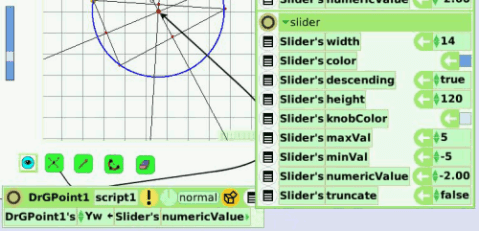
    Hilaire Fernandes is writing a series of blog posts intended to introduce Squeak to teachers and to developers of educational software. The articles—available in both English and French—are intended to be a gentle introduction to Squeak’s features, and to highlight the ways in which it can be used in education. In each post Hilaire introduces a new topic, and explains its relevance to educational users.

    In writing this series of posts, Hilaire is able to draw on many years involvement in developing Free software in education (including Dr Geo II for the OLPC XO), and working with education professionals to incorporate such software into the school curriculum.

    The first post gives Squeak’s background and introduces Morphic – English, Français.

    The second post is an overview of how images work – English, Français.

  • Squeak Project in Google Summer of Code 2008

    The Google Summer of Code team have announced that the Squeak Project is one of 175 Free and Open Source projects that have been accepted into their programme for 2008.

    This year’s submission was explicitly under the “Squeak Project” title, to allow for projects from the wider community developing based on the Squeak environment.

    The current list of projects with assigned students consists of:

    Congratulations to Giovanni Corriga and colleagues on the SoC mailing list who put the Squeak Project submission together, and best wishes to the students and mentors for a productive and enjoyable experience. We’re all looking forward to seeing your work!

  • Waveplace in the US Virgin Islands

    WavePlace

    WavePlace 2

    Hi everyone,
    We’ve just posted two new videos from the St John Waveplace pilot, which concluded three weeks ago. The first shows mentoring during the pilot. The second shows students presenting their Etoys storybooks.
    1) Scenes from the St John pilot (4 minutes)
    2) The St John Storybook Awards (8 minutes)
    We will be posting the actual storybooks to our website soon so you can see them for yourself.
    In other news, the Haiti pilot will resume next week, since things have calmed down in Port-Au-Prince. The kids and teachers are well.
    As always, if you’d like to hear more from us, please subscribe to our newsletter or donate money on our website to help with our courseware and pilots.
    Take care,
    Tim
    Timothy Falconer
    Waveplace Foundation
    610-797-3100
  • Free Smalltalk books

    Stéphane Ducasse maintains a great list of free Smalltalk books including online pdfs of many out-of-print books.

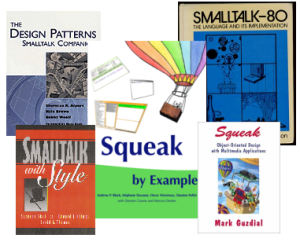
    These books span over twenty years of Smalltalk development, and includes great resources such as Smalltalk-80: The Language and its Implementation (the “Blue Book”), Smalltalk with Style(pdf), and more recent classics such as Squeak by Example (written by Stéphane Ducasse along with Andrew P. Black, Oscar Nierstrasz and Damien Pollet).

    This is a great resource that is of use to beginners and to more experienced programmers wanting to understand more of the philosophy and design decisions behind Smalltalk and Squeak.

    Links and reviews of many other (non-free!) books can be found at the Squeak wiki, John M McIntosh’s site, and Squeakland has a reading list prepared by Alan Kay for those who want to learn more about the ideas and philosophies that influenced the creation of Squeak.

    If you know of other books and online resources that should be listed here, please let us know!

    [Please note the URL has been updated to address David’s comment below. The original URL was an older page with fewer books available.]

  • Squeak ported to Syllable

    Syllable

    Squeak has just been ported to Syllable Desktop OS by Kelly Wilson. The Syllable project has an active community which aims to develop easy-to-use Free Software operating systems for the home and small office user. Syllable Desktop OS is a continuation of work on AtheOS operating system, which has been around for a few years, being originally inspired by the AmigaOS.

    There are no video and sound drivers available yet, but headless Squeak programs run happily – the site has a screenshot showing the Seaside web application framework running in the ABrowser web browser. Kelly’s now looking for advice to get video working.

  • The Year of Smalltalk

    The Year of Smalltalk

    Randal L. Schwartz just announced that he will be giving a 3 hour tour of Seaside at OSCON 2008. We are very proud to have Randal on the Squeak Foundation Board. We are looking forward to more of his “Year of Smalltalk“.

    [Edit: corrected spelling]

  • What’s the difference?

    Fully Functional Babbage Difference Machine

    The following was posted to the Squeak-Dev Mailing list by Markus Denker. The quote speaks for itself and it does give one pause to consider the implications to our community. It also strikes me as relevant to a lot of other development communities too. Great ideas are still very powerful and inspiring, but the idea alone is still seen as only half the process. We all know that there is a lot of very interesting problems that arise while we transform our ideas into working code. We also know that it is much easier to build onto a working system, or take what we learned from the process of building a working system to the next generation. While the idea itself can be seen as a great accomplishment, the realization of the idea by itself confers even greater benefits to the community. What projects have you left undone? What’s the difference?

    “One of the sad memories of my life is a visit to the celebrated mathematician and inventor, Mr Babbage. He was far advanced in age, but his mind was still as vigorous as ever. He took me through his work-rooms. In the first room I saw parts of the original Calculating Machine, which had been shown in an incomplete state many years before and had even been put to some use. I asked him about its present form.
    ‘I have not finished it because in working at it I came on the idea of my Analytical Machine, which would do all that it was capable of doing and much more. Indeed, the idea was so much simpler that it would have taken more work to complete the Calculating Machine than to design and construct the other in its entirety, so I turned my attention to the Analytical Machine.’”

    “After a few minutes’ talk, we went into the next work-room, where he showed and explained to me the working of the elements of the Analytical Machine. I asked if I could see it. ‘I have never completed it,’ he said, ‘because I hit upon an idea of doing the same thing by a different and far more effective method, and this rendered it useless to proceed on the old lines.’ Then we went into the third room. There lay scattered bits of mechanism, but I saw no trace of any working machine. Very cautiously I approached the subject, and received the dreaded answer, ‘It is not constructed yet, but I am working on it, and it will take less time to construct it altogether than it would have token to complete the Analytical Machine from the stage in which I left it.’ I took leave of the old man with a heavy heart.”

    — Lord Moulton

    Marcus Denker http://www.iam.unibe.ch/~denker