

Etoys, children, a funny hat and a handmade Smalltalk balloon. What more could you ask for! Looks like a great day for everyone.
Read more about it here: http://squeaklandnews.blogspot.de/
Etoys, children, a funny hat and a handmade Smalltalk balloon. What more could you ask for! Looks like a great day for everyone.
Read more about it here: http://squeaklandnews.blogspot.de/

Don’t miss Tim’s interview with SmalltalkInspect! You can find it here: Smalltalk under the Pi: an Interview with tim Rowledge
In this episode we talk to tim Rowledge about his work on Smalltalk VMs over the years, especially for the RISC OS Platform and ARM machines.. The latest and probably hottest thing in this arena is his port of Squeak to the Raspberry Pi. This is not only cool in itself, but more importantly enables Raspberry Pi users to use Scratch and EToys on this little machine on RISC OS (the Raspbian Linux version existed before). You can probably imagine how much fun we had in recording this session.

It’s that time again. Time to pack up the kids and join us at SqueakFest 2013. Don’t forget to bring your XO computer!
If you can’t make it please consider a donation to help cover travel costs: Donate
For more information see: Squeakfest 2013
From Rita:
There will be a Squeakfest again in Uruguay at June, 7th – 9th, this time in Atlantida. Etoys will cover the major part of the event, but there will also be workshops in Python, turtle art and robotics. After all, Uruguay is the country with XO-laptops in every elementary school and teachers are using the software which comes with Sugar.
http://squeakfest2013.weebly.com/
From our education team, Randall Caton and myself are going to present Etoys workshops. This year, I’ll introduce Kedama. I’m looking forward to an inspiring event!
If you want to help or know someone who would like to, I created a crowdfunding page to collect money to help to cover our travel cost. Please share as you like!
http://crowdfundedu.com/fundraiser/educators-to-squeakfest
Greetings,
Rita

Don’t miss the new Etoys book: http://wiki.squeakland.org/index.php/LearningWithEtoysI3.
Etoys is:
All school children should have the opportunity to engage with computers in the most meaningful way. Learning to think and using the computer to discover and work with powerful ideas is the knowledge of true value. The community of Etoys users is working toward the dream of having all students become computer literate. This book only covers a small portion of those items. As you and your students learn some of the basic techniques, you will find more and more uses for them. The process of learning Etoys is just that, a process; the learning is on-going even though projects are begun and finished. Students will enjoy becoming experts and sharing their knowledge with others in the classroom.
Imagine this: A group of learners want to visualize what they Imagine so they go to Etoys to Invent their dreams and Inspire each other by building on their various Etoys projects. Today’s learners need this kind of experience to be prepared for the future.
For more information about Etoys visit www.squeakland.org

Voting is now under way in this year’s elections for the Squeak Oversight Board.
After some prompting from their colleagues, the following people have thrown their hats into the ring:
If you are one of the 460 registered members of the Squeak community you should have received an email “Poll: Squeak Oversight Board Election 2011” sent by Göran Krampe, who is running the election. If you’ve not got an email and you should have, email voters@squeak.org and Göran will see what he can do.
Find out more at the election wiki page.
Voting closes on 10th April at 18.00 UTC.

Janko Mivšek wrote to the squeak-dev mailing list that “we are preparing an application to this year’s Smalltalk Google Summer of Code under the ESUG umbrella, as last year”.
Google Summer of Code is a global program sponsored by Google that offers student developers stipends to write code for various open source software projects. The Smalltalk community has a successful record of participation in the scheme, under the aegis of ESUG in recent years, and our organisers are looking for students and ideas, (and even better, students with ideas) for our entry in this year’s programme.
Janko asks Smalltalkers to “please start thinking about ideas what projects would be nice to have. Also start looking around for students. How to approach the universitites near by you, do you know who to contact there, etc”.
To see last year’s ideas and projects, visit the site for last year’s students. You can find out more at the new Smalltalk GSoC 2011 website: http://gsoc2011.esug.org, and don’t forget to ensure you’re aware of the GSOC timeline.
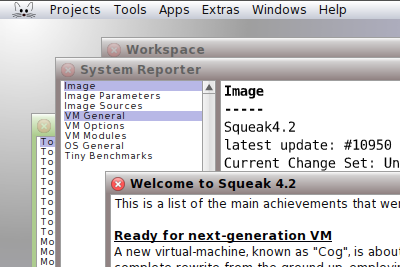
Squeak4.2-10966.zip is now available at http://ftp.squeak.org/4.2. This is intended to be the actual-released 4.2 image, unless, as Chris Muller says, “we find some problem, which we won’t!”.
Some of the new features in this release are:
See Help > Welcome Workspaces > Welcome to Squeak 4.2 for more details of the changes in this image.
Note that users on Macs may find that the mouse buttons work in an unexpected order in this image. This is expected behaviour to allow for the grand reunification of mouse button handling in the upcoming version of the VM, which will restore the standard behaviour. In the meantime, use the Swap Mouse Buttons preference to keep things sane.
Congratulations to Chris Muller who has been leading the effort to get this release out the door, as well as the many contributors who provided updates, error checking, bug fixes and moral support for the process.

Sean DeNigris has been doing some great archaeology recently, and with help from some of the original Sophie team, he has managed to get some of Sophie’s rich multimedia capabilities working in mainstream Squeak images.
Sophie is a multimedia editing environment that was originally written in Squeak, although more recently it has been rewritten in Java.
The screenshot above shows a video being played by the QuickTime plugin, and being presented as a morph in Squeak. Sean shows in his blog post how to get this up and running in a few minutes in Squeak on OS X. There’s also a great discussion on the squeak-dev mailing list.
There’s still lots of gems to be uncovered in the Sophie code base, but this is a great starting point!
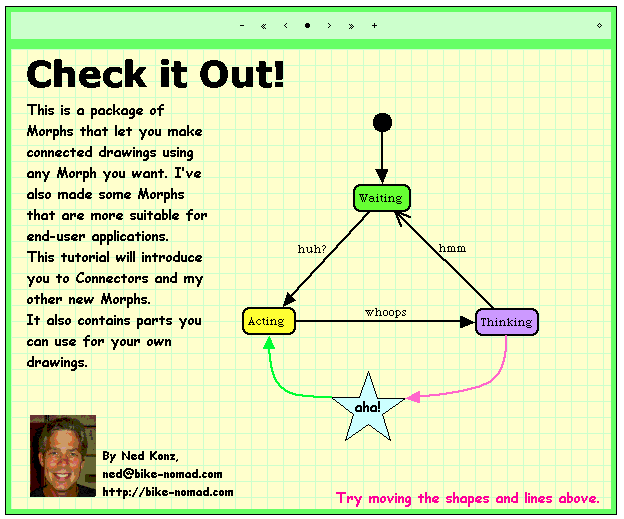
Chris Muller has recently updated Connectors to work with Squeak 4.2 images. Connectors gives you the ability to turn Morphic into a drawing environment for making connected diagrams. This tool was developed by Ned Konz many years ago and hasn’t been able to load in an up-to-date image for some time.
A Connector is a Morph that looks like a line and has a constraint on either end that keeps the ends attached to some other Morph. You can specify properties such as width, borders, fills, end-decorations for each connector, as well as determining the path the connector takes and what labels it should have. The package also comes with other tools to aid in the creation of smart drawings. See the tutorial for more information.
The updated package is available on SqueakSource.
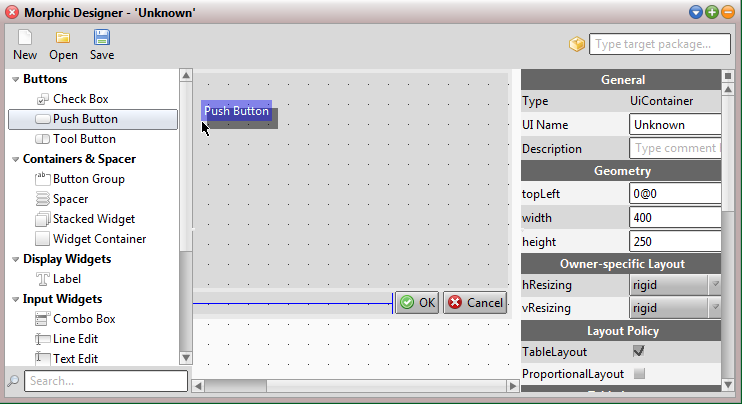
The staff and students at the Hasso Plattner Insitute have set up a new site to share the impressive work they are doing using Squeak. The projects they are showcasing include some gorgeous UI Widgets and a new UI Designer (shown above).
Each project is available at the Institute’s SqueakSource server, and can be loaded using Metacello configurations. All configurations were tested and run in the current Squeak (Trunk) versions (4.1, 4.2). The site is built using Trac project management software, which provides for issue/bug tracking if you do find any problems.
Many thanks to the Software Architecture Group, led by Prof. Dr. Robert Hirschfeld at the Hasso Plattner Insitute (University of Potsdam), for sharing these great projects.
(Note that Firefox currently gives a warning about the site due to an incomplete certificate chain, but this should be fixed soon).
 The Weekly Squeak