
You’ve only four more days to cast your votes for the Squeak Leadership Team elections—see previous post for details. If you’ve not received any voting details by now, check that you’re still accessing the account you registered with. If you haven’t registered yet, then it’s too late – but as Göran has said, there’s one of these every year!
Category: Squeak
-
Squeak Foundation Election 2009

As Göran posted recently, it is time to consider the membership of the Squeak Leadership Team (the “board”) for the coming year.
Nominations are currently open for candidates interested in working with colleagues to maintain and co-ordinate the various interest groups and activities that support the Squeak community.
If you think that you can make a difference to Squeak, put your name forward on the squeak-dev mailing list by 22nd February. All candidates are asked to make themselves available on the list for questions and discussion with the community until the end of February.
Voting begins on 1st March for one week. If you’ve voted in previous elections, your name should already be registered. If not, then contact Göran explaining why you’re interested in voting (see the election page for more details).
The list of candidates, and more details of the process to be followed can be found on the Election 2009 page.
-
Squeak 4.0 is coming…
On Squeak Mailing list Matthew Fulmer just wrote (we stressed some lines):
[…]
Squeak 4.0 is within sight. With this release, the four-year
relicensing project of the Leadership team will be complete. We
will be able to incorporate under SFLC, and Pharo will be one
step closer to a 1.0 release.Squeak 4.0 will be the first official squeak release with no
code under SqueakL; everything in the .image, .changes, and
.sources files will be under either the MIT license or the
Apache license.
[…]Are you ready for the Open Squeak4?
-
Soup for Squeak

Zulq Alam has been working on Soup, a Squeak port of Beautiful Soup, the tolerant HTML/XML parser written in Python, which is extremely useful when you need to scrape data from a web page. He has recently announced a working release and gave some example of its usage.
Zulq notes that there’s still plenty of work to do on this port:
- No attempt is made to deal with different character sets and encodings.
- The parser will not convert entity or char references.
- The parser will not accept options such as whether to convert entities, which entities to convert, what to parse, etc.
- The parser will only do HTML; there are no configurations for other XML flavours yet.
He adds that the project repository is globally writable, and he looks forward to your feedback and contributions.
-
Squeak goes to Mars

Esteban Lorenzano gave Squeakers on Mac OS X a nice little Christmas present to see out 2008, with the release of Mars, an MVC framework for Squeak built using Cocoa. Mars is a plugin, and will run in any fork of Squeak, and as you can see above, is integrated with OmniBrowser.
Esteban notes that one of his main objectives in developing Mars is to keep it small and simple, in order to allow it to be executed in small environments such as the iPhone, (using John McIntosh’s new VM and Edgar de Cleene’s SqueakLightII minimal images).
Mars is MIT licensed, and can be downloaded from the Mars homepage, which also has posts following the progress of Esteban’s work. Esteban adds that Mars is still in the pre-alpha stage, and he looks forward to bug reports, feature requests, comments, and of course, code.
-
Building user interfaces in Squeak
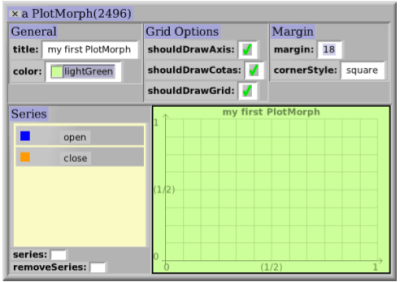
Chris Muller has released a thoroughly updated and documented version of his user interface framework Maui. Chris has described Maui as a “naked objects” Morphic-based UI builder that allows rapid UI creation based on object-message composition.
Maui includes a number of light satellite frameworks that supply various application services like documents, object-search, background process management with progress monitoring. It also provides a number of tools which allow applications to be synthesized quickly, without the need to write any user-interface code.
Chris has written a fifty page document describing Maui and giving examples of how to use it to build user interfaces for complex applications. In this document he also discusses future work for Maui, including the tantalising possibility of extending it to support the development of web applications.
-
Aliens coming to Squeak

John McIntosh has ported Newspeak‘s Aliens FFI implementation to Squeak. John notes that the port is in its early days, and more work and support will be needed to implement Aliens support across the full range of Squeak platforms.
As a result of this interest in Aliens, Gilad Bracha has written a post giving an overview of Aliens, the thinking that went into it, and how it works. FFI allows a programming language to make use of services written in another language, and Gilad suggests that the lack of a standard, fully-featured FFI has been an ongoing problem for Smalltalk developers. In particular, John writes that “Squeak VM’S existing FFI has been found to be buggy bloated and slow” (though see Andreas’ comments on this below).
John’s code, under the Apache licence, is available at http://www.squeaksource.com/Alien.html, and more information on his implementation can be found at the Alien swiki page.
-
Exploring history using Squeak multimedia

Germán Arduino writes with news of a very interesting multimedia application his company has been developing for the Spanish state of Extremadura. The application consists of a number of units, each developed in Squeak using the multimedia-application framework FMA, originally developed by Diego Gómez Deck. The application will be available in Spanish, English and Portuguese, and is intended to be used by visitors to the region. It includes a variety of games, puzzles and quizzes to help the user test their understanding.
Germán notes that, as usual with all the Extremadura projects, the software is open sourced and is available to download from Squeaksource, under the name Albaplata project.
Germán’s post on the project has more information and screenshots.
-
Monticello 2 podcast
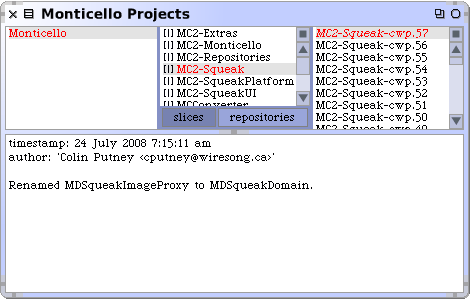
As we mentioned recently, Colin Putney has been working on Monticello 2, a ground-up rewrite of the distributed optimistic concurrent versioning system for Squeak code written by Avi Bryant and Colin Putney with contributions from many members of the Squeak community. This version offers a new, more flexible and more performant versioning engine, as well as many improved features.
James Robertson of Cincom recently spoke to Colin on his Industry Misinterpretations podcast, where they discussed the changes in the new version, and how these would help developers to maintain and share code. The podcast is available here.
-
Smalltalk on Eclipse

Having seemingly started to lose interest in Smalltalk when it sold off its VisualAge for Smalltalk business to Instantiations, it looks like IBM is now keen to develop its own Smalltalk IDE. The IBM Smalltalk Tools Development Team is working to support Smalltalk in Eclipse. They’re working with a strong understanding of Eclipse and ENVY Smalltalk, and with support from the Instantiations team, and seem to be making great progress: the screenshot above shows a class browser perspective in Eclipse.
Although the product is still only available internally, the team are sharing their experiences in developing what they’re calling “WRATH”, having presented updates at EclipseCon and Smalltalk Solutions, and talking to James Robertson on the Industry Misinterpretations podcast.


