
Category: Squeak

  • Squeak Board candidates wanted

    An Election Entertainment - Hogarth

    Göran Krampe has begun the process for this year’s elections for the Squeak Oversight Board.
    The Squeak Oversight Board (SOB) consists of seven members from our community, all of whom are elected by popular vote. The members are responsible for

    • building a legal presence – currently by working with the Software Freedom Law Center as part of their Conservancy;
    • providing the network services that support the various mailing lists and repositories that in turn make a community possible;
    • helping coordinate the various interest groups and projects being pursued by Squeakers;
    • making decisions where there is no clear community consensus.

    The current board members are:

    • Jecel Assumpcao Jr
    • Ken Causey
    • Bert Freudenberg
    • Craig Latta
    • Andreas Raab
    • Randal Schwartz
    • Igor Stasenko

    (From http://www.squeak.org/Foundation/Board)

    The schedule and process of the Election is as follows:

    Nominations

    Candidates should nominate themselves by 3rd March and start their campaign on the squeak-dev mailing list. Or if you nominate someone else, make sure that person really wants to run. Göran will not put anyone on the candidate list until that person makes it known on squeak-dev that he/she does run.

    Final candidate list

    The list will be closed on 3rd March. The candidates should ideally present themselves on squeak-dev, unless they have already done so, and the community can ask questions.

    Online election starts

    The voting period starts on 10th March 6PM (18.00 UTC) and is one week long. Ballots are sent out via email.

    Online election ends

    The voting process will end on 17th March 6PM (18.00 UTC). Results will be announced immediately when the election ends.

    Registering

    If you were invited to vote last year you are already on the voter list, no worries! If you are a new Squeaker and wish vote do ONE of the following:

    • Get a “known” Squeaker to vouch for you. If a known Squeaker sends an email to voters@squeak.org giving your name and email address then Göran will add you.
    • Send an email to voters@squeak.org yourself (and CC to squeak-dev if you like) with information/arguments showing that you are indeed serious about voting and that you are indeed a Squeaker.

    When the voting period starts all voters will receive an email with instructions and a link to the voting website.

    More information

    Everything about the election, including schedule above and more, can be tracked here:

    http://wiki.squeak.org/squeak/6150

  • Squeak on Android

    Andreas Raab has announced a new home for some work he’s been doing recently to port Squeak to the Android platform:

    http://code.google.com/p/squeak-android-vm/

    He’s aware that lots of things are still missing that would be required to support a full port (including text input and network support). But he’s still interested to hear if (and how well) it works for other Android-based cell phones. So if you have a Motorola Droid or or a T-Mobile G1 give it a shot and post some benchmark results.

    Andreas reports that “performance on the Nexus One is about what one would expect: With roughly 1M sends/sec and 30M bytecodes/sec it’s not exactly rocking but it’s quite usable for most tasks on a mobile device. (Input is *terrible* though; Squeak’s UI is not made for fat-fingered clicks like mine :-)”

    If you’d like to be added as developer, please send Andreas your Google Account email address so that he can add you to the project. But, he warns that “unless you know how to deal with both the Android SDK and NDK, Java, JNI, and the Squeak VM it will be a very steep learning curve”.

    (Of course, for those of us still using iPhones, there also John McIntosh’s iPhone port of Squeak.)

  • New Development Model, two months on.

    It has been two months since the Squeak Oversight Board first put forward their “New Community Development Model”. At the time the proposal caused a lot of heated debate on the squeak-dev mailing list, with concerns being expressed that similar efforts in the past had had little lasting impact, and had caused great frustration for those pushing those earlier efforts.

    The motives of the Board were to “get rid of as many hurdles as possible in the contribution process [and]  to enable the community at large to improve Squeak, the core of the system and its supporting libraries”.

    So, two months down the line, how’s it doing?

    If sheer volume is any criterion, it looks like a great success with over 500 packages uploaded as patches to 3.10.2 and over 40,000 downloads from the trunk (see bottom of the linked page for up to date statistics).

    The results of all this activity are available to use and test in the daily updated image published at http://ftp.squeak.org/trunk/ (needs a recent VM). If you want to contribute, you can add new patches at http://source.squeak.org/inbox/, or ask one of the current developers for access to the developers repository at http://source.squeak.org/trunk.

    If you just want to get an idea of what’s going on, check out the commit logs that are getting posted to the squeak-dev mailing list, and to the #squeak irc channel on freenode.

  • Magma goes HA!

    MagmaNode

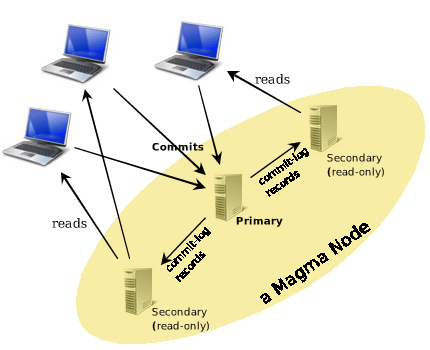
    Chris Muller announced release 42 of Magma to the Squeak-dev mailing list. Magma is a multi-user object database for Squeak and Pharo images and which provides transparent access to a large-scale shared persistent object model. Magma release 42 brings unprecedented scale and availability of persistent domain models to Squeak users.  In particular, a single logical repository can now be served from multiple servers simultaneously, each hosting their own physical copy which are kept constantly up to date automatically.

    There’s lots more information, introductory material and documentation at the Magma homepage.

  • Iliad web framework released

    iliad

    Nicolas Petton recently announced on the squeak-dev mailing list the first public release of Iliad, which is succintly described on the Iliad website as a “a flexible, lightweight but powerful Smalltalk web framework.” Originally developed on GNU Smalltalk, but ported to Squeak/Pharo, Iliad features:

    • standalone stateful widgets
    • nice urls with a simple routing system
    • simple API
    • easy to setup and deploy (no complicated configuration step)
    • javascript layer to update widgets using AJAX. If javascript is not enabled, the behaviour remains the same by making normal requests
    • support for the Magritte meta-description framework, for simple generation of views on data

    Iliad combines elements of the other leading Smalltalk web frameworks Seaside, Aida/Web and HttpView2. You can find out more about the installation and use of Iliad by reading the documentation on the Iliad site, and on the GNU Smalltalk site.

  • SOB lays an egg – what will emerge?

    phoenix

    Those of you who read the squeak-dev mailing list will know that the list is currently going through the annual frenzy of discussion about the nature and direction of Squeak, including much to-and-fro over such topics as: the original vision of the founders of Squeak; the tangled relationship between Etoys and the rest of the Squeak environment and community; the reasons behind the Pharo project and how much its goals really differ from those of Squeak; whether children should be locked in the nursery or allowed to roam freely into every room of the house; and much more. If you have time (and some light body armour), it’s well worth reading through the hundreds of emails that have been written which explore and interpret much of the history and philosophy of Squeak.

    This discussion has motivated the Squeak Oversight Board to look at one topic that caused much debate: how to manage the development of Squeak. Driven by a concern that there are many hurdles that discourage wide-spread participation in the contribution process, the Board have put forward a new community development model that they hope will “enable the community at large to improve Squeak, the core of the system and its supporting libraries”.

    Based on processes that have been shown to work in commercial settings, the Board’s model includes the use of Monticello as the primary source code management system, free access for the developers to the main repositories (trunk, tests, and inbox) and an incremental update process for both developers and users of Squeak.

    Obviously, such a change has sparked off its own debate, and important questions are being hammered out on the squeak dev mailing list. If you care about the health of the Squeak environment, its future direction, and the future support for your own favourite applications, this is a key moment for you to understand and contribute to the discussion which is continuing on the squeak-dev mailing list (see archives), on irc, and on the Board’s blog.

  • Squeak applications now on the App Store

    iPhoneApp

    Following his success in getting Squeak running on the iPhone last year, John M McIntosh has announced on the Squeak-dev mailing list that he has had two applications approved for the Apple iPhone and iPod Touch App Store.

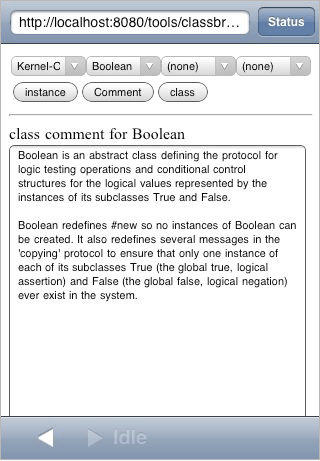
    The two SqueakDocs electronic books, based on Squeak and Seaside, allow users to explore the code and documentation in two Smalltalk images: a 3.10.x Squeak web developer’s image, and a Pharo web developer’s image of late April 2009. They are now available for purchase on the App Store: Squeak version, Pharo version.

    The applications use Seaside to render the content to the built-in Safari browser, so they can also present content to other machines on the local network.

    John is still waiting for approval to come through soon for WikiServer, a “much more complex application,” which will allow users to view and maintain wiki content on their iPhones.

  • The Squeak Oversight Board is now blogging

    As a result of ongoing discussions with the Software Freedom Conservancy, the Squeak Leadership team have now adopted the formal name of the “Squeak Oversight Board”. The members of the new team have made clear and open communications one of their priorities, and to that end, have started up a new blog at board.squeak.org, where they will be publishing agendas and minutes of their monthly meetings.

    In keeping with their mission statement of “Communicating with the Squeak and greater Dynamic Languages Community”, the board will also be using the blog to encourage discussion about the direction and priorities of the Squeak community.

    And yes, the board members are fully aware of the double meaning of “oversight”.

  • Election results

    Göran has announced the election results to the squeak-dev mailing list.

    The new members of the leadership team are (in order of votes received):

    1. Andreas Raab
    2. Bert Freudenberg
    3. Craig Latta
    4. Randal L. Schwartz
    5. Ken Causey
    6. Igor Stasenko
    7. Jecel Assumpcao Jr

    Detailed results can be found at the election site.

    Congratulations to those elected, and commiserations to the other candidates, who were Matthew Fulmer, Edgar J. De Cleene, Brent Pinkney and David Mitchell.

    Thanks are due again to Göran for organising another election so effectively.

  • Don’t forget!

    You’ve only four more days to cast your votes for the Squeak Leadership Team elections—see previous post for details. If you’ve not received any voting details by now, check that you’re still accessing the account you registered with. If you haven’t registered yet, then it’s too late – but as Göran has said, there’s one of these every year!