Category: Tools

  • Conference news: ESUG 2008 – more information

    A set of posts to the squeak mailing lists has given more details about the 16th International Smalltalk Joint Conference organised by the European Smalltalk Users’ Group, to be held 25-29 August 2008 at CWI in Amsterdam.

    Programme Details

    Mathieu van Echtelt writes that the programme features more than 40 presentations on, among others, the following subjects:

    Programming Language Platforms

    • Newspeak (New open source dynamic language focusing on modularity, security and interoperability)
    • Cog (New highly optimized open source Squeak VM)
    • Maglev (Highly scalable Ruby VM)
    • OpenCroquet (Deeply collaborative, multi-user online Smalltalk development environment)

    Web Frameworks

    • Seaside (The continuation & component-based web framework)
    • WebVelocity
    • AidaWeb (Smalltalk Web Application Server)
    • WebTerminal

    Model Driven Engineering:

    • The Meta Environment Language Workbench
    • ObjectStudio ModelingTool
    • Fame; Meta-modeling Framework
    • MBA Smalltalk; to manage your objects

     
    Additionally, the winners of the ABN Amro sponsored Innovation Awards will be presented.

    Booking Accommodation 

    Noury Bouraqadi notes that discount hotel rates for conference attendees are available until 11 July.

    Seaside Sprint

    Lukas Renggli has announced that the core Seaside dev team will be holding the first official Seaside Sprint, starting after the conference closes at 14:00 on 29 August, and finishing when the last participant collapses over their smoking keyboard. He invites anyone interested in working on Seaside or related code to participate. The venue details will be announced once agreed.

    Camp Smalltalk

    As usual, the weekend preceding the conference will be used to host Camp Smalltalk, an opportunity to work with colleagues on a number of exciting projects. See the Camp Smalltalk page for more information.

  • Smalltalk Solutions 2008 – slides now available

    Most of the slides from the presentations at this year’s Smalltalk Solutions conference are now on line.

    The material available includes Gilad Bracha’s talk on Newspeak, James Foster’s guide to building a Seaside application using GemStone/S, Michael Rueger’s introduction to Sophie, Arden Thomas demonstrating WebVelocity in action, and Randal Schwartz’s double-header keynote: Seaside – Your Next Web Framework and an introduction to persistency solutions for use with Seaside.  

    There are also slides from a couple of sessions looking at the reasons for the recent resurgence of interest in Smalltalk: Arden Thomas looks at the features of Smalltalk that other languages lack, and Rob Rothwell explains how Smalltalk helps with the development of healthcare applications.

    There are many more slide-packs available, and still more to be added, so please check out the conference page for more information. James Robertson is adding video and audio as it becomes available.

  • New Yorkers’ chance to see Squeak-based education tools

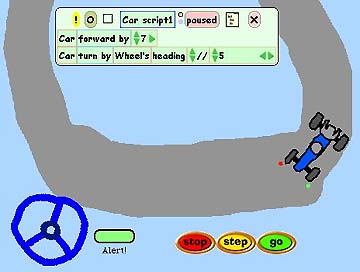
    The Mid-Hudson Valley Linux User Group will get the opportunity on 4th June to hear about a range of educational tools running on Squeak, including: SeasideScratchCroquet and Etoys. Joe Apuzzo will discuss his experience teaching 60 kids from 3th grade to 5th math and science (all within 15 minutes per group).

    Find out more at the website.

  • German Squeak Association Meeting: Demos

    The German Squeak Association (Squeak e. V.) had its annual meeting on May 17. For the second time, the meeting was hosted by the Software Architecture Group at the Hasso-Plattner-Institut in Potsdam. Before the official part, attendees of the meeting were given the opportunity to demonstrate their Squeak projects.

    First, Tobias Pape and Arian Treffer, students of HPI, demonstrated SwaLint, a source code checker for Squeak. SwaLint is intended as a successor to SmallLint and, thanks to its flexible plug-in architecture, supports running SmallLint checks seamlessly. SwaLint can be configured in great detail: thresholds for all kinds of values can be set, and output can be filtered. Users can easily implement their own plug-ins for the tool.

    Next, Michael Haupt (HPI) gave a brief demonstration of SqueakFS, which was implemented by Johan Björk and Eskil Andréen from Stockholm University, Sweden. SqueakFS makes the contents of a running Squeak image available as part of the file system. Currently, it is limited to read-only access, but the image can already be viewed from three perspectives: all classes as a flat collection, assorted by category, and by class hierarchy.

    Robert Krahn presented SqueakSVN, which is an ongoing development effort in the Software Architecture Group at HPI. The purpose of SqueakSVN is to make Subversion version control available to Squeak developers; it is able to import Monticello projects. SqueakSVN will be released in June.

    Martin Beck is currently working on his MSc thesis in the HPI Software Architecture Group. His work is dedicated to implementing NXTalk, a Smalltalk virtual machine for the Lego Mindstorms NXT platform. Development of NXTalk application takes place in a Squeak image, and assembled NXTalk images are transferred to the NXT for execution by the dedicated NXTalk VM. In the current state, simple images can be assembled and run: Martin demonstrated a program that can be used to steer a simple NXT bestowed with two motors.

    The popular introduction to the Seaside web application framework that was produced at HPI was briefly presented by David Tibbe, one of its co-authors.

    Robert Krahn had another appearance presenting the collection of games for the XO laptop developed by HPI students. All of the games are available for download as project or SAR files.

    Finally, Carl Friedrich Bolz (Düsseldorf University), Adrian Kuhn (University of Bern), and Toon Verwaest (University of Bern) presented SPy, their ongoing effort to implement the Squeak VM in Python using the sophisticated PyPy tool chain. SPy is currently lacking GUI  and other I/O support, but is able to load images and run the tinyBenchmarks. Right after the Squeak association meeting, a PyPy development sprint in Berlin will, amongst others, bring new improvements.

    After the official part of the association meeting, special guest Dan Ingalls gave a demonstration of Lively, his current project at Sun Labs. It looks and feels, admittedly, a bit like Squeak in disguise, but in Dan’s opinion, there is nothing bad about building the “same” system several times if it’s cool. That is certainly true for Lively.

  • S3 Highlights: Lively, COLA, Huemul, Squeak on Python and more


    On 15/16 May, the workshop on Self-Sustaining Systems (S3) took place at the Hasso-Plattner-Institut in Potsdam. An exciting event at a beautiful place, it featured invited talks by Ian Piumarta, Dan Ingalls, and Richard P. Gabriel, and five presentations of reviewed papers that approached self-sustainment from different angles.

    (more…)

  • Native look and feel apps with Firefox XULRunner

    Pavel Krivanek has published details of a project he’s been working on: SeasideXUL, which uses the Mozilla Foundation’s XULRunner and Ajax, with Seaside providing the muscle, and allows developers to create applications with a native look and feel.

    Pavel has already used the framework to wrap the OmniBrowser suite of development tools, so allowing Squeak development to take place in the host environment.

    The code is downloadable from SqueakSource, and a pre-built image has also been made available which includes the OmniBrowser integration. Pavel has also published a set of screenshots of the “Periodic Table” sample application demonstrating the capabilities of SeasideXUL.

  • Algernon: your personal assistant for Squeak

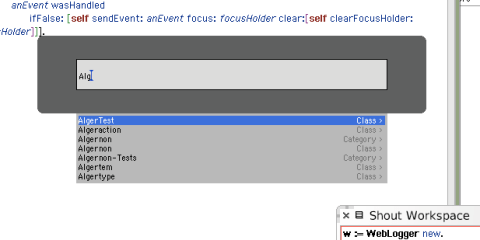
    A team of undergraduates at the University of Illinois at Urbana-Champaign have just released “Algernon”, a new keyboard-based launcher to help you navigate around your Squeak environment.

    Algernon was developed by Erik Hinterbichler and Joey Hagedorn with their CS598 classmates, working with Professor Ralph Johnson of the Software Architecture Group at UIUC. The developers say that Algernon provides lightning quick access to categories, classes, morphs, and global variables in your image, and is inspired by tools such as Quicksilver and LaunchBar for Mac OS X. Like Quicksilver, it learns from your behaviours, and will prioritise options that you use most often. It is triggered by pressing Control-Space Shift-Return, though this can be changed by editing Algernon>>activationString.

    Algernon can be downloaded from SqueakMap using the SqueakMap package loader or from Squeaksource using Monticello, and requires KeyBinder to be installed as a prerequisite.

    [Edited in light of Erik’s comments below.]

  • Seaside: your next web framework

    Randal L. Schwartz had a “standing-room only” audience at BarCampPortland for his presentation on why web developers should consider using the Seaside web application framework. BarCampPortland is described as an “unconference for the Portland [Oregon] tech community”, and aims to offer the attendees interesting topics, cool people and great networking opportunities.

    Randal was offered a 45-minute slot, and took the opportunity to explain what makes Seaside such a powerful framework for professional web developers. His material, which incorporated feedback from colleagues on the Seaside mailing list, was very well received, and will form the basis for future presentations by Randal to raise the awareness of Seaside in the web development community.

  • Squeak and the filesystem

    One of the stumbling blocks for experienced developers looking at Squeak for the first time is the concept of the “image”. Many developers, especially from the UNIX world are used to managing their source code and other resources with a host of file-based utilities, including editors, archivers and change-management tools.

    The Squeak philosophy that everything happens within the image can make the transition to Squeak painful for such developers, but there are tools out there to help with the transition. Two such tools were discussed recently on the #squeak irc channel.

    Johan Björk announced the release of SqueakFS, which allows you to browse and search all objects contained in your squeak image from your local file system. SqueakFS is currently read-only, but the developers are interested in adding editing capabilities. The file system functionality is provided by a socket client built on top of FusePython. This client translates file system paths into squeak objects and queries a server running in the squeak image for details on these objects. In order to do this, SqueakFS uses FusePython for file system support and is dependent on both FUSE and Python and will only work on UNIX systems. SqueakFS has been developed and tested on Linux 2.6 and MacOS Leopard running on Intel systems.

    Brian Rice pointed to another recent project, Stave, which mounts sources on a webDAV share, and so provides an editable WebDAV interface to Squeak’s class system. With the use of a WebDAV filesystem or a webDAV-enabled editor, this enables a file-based view on Squeak. Stave is intended primarily for use with external editors, and hasn’t been tested with search tools.

  • New Dabble DB Demo Debuts

    Avi Bryant writes at the Dabble DB blog that the team has produced a new 8-minute demo of their product in action. This new video replaces their 2006 video which was linked to so frequently that it still shows up as #4 in the google results for “the demo“.

    Dabble DB is a tool to help you create, manage, interpret and present data via your browser. Written in Squeak using the Seaside web application framework, it has received glowing reviews since its launch in 2005.