Category: ESUG

  • All you ever heard about graphics anti-aliasing is wrong!

    Juan Vuletich has been working for some time on Morphic 3, a research and development project aimed at building the next standard in 2D user interfaces. One of his aims is to do mathematically proved alias-free rendering. In order to achieve these objectives, he has been experimenting with several techniques and design features, some which are new and others are not, but have never been consistently applied to a 2D GUI.

    Juan’s contention is that, although the theory behind sampling is about 80 years old, existing graphics software completely ignore the theory and that his quest for higher quality results has resulted in the idea of applying the Sampling Theory which allows for mathematically proved alias free rendering. He informed the squeak-dev mailing list of his latest post which makes the startling claim that “I developed new drawing algorithms that give better results than those in Cairo, AGG, etc.” and he has created some examples showing some of the problems with existing algorithms, and how his approach improves these issues.

    Juan is preparing the algorithms for release, which will involve him publishing it in a  journal or as a Ph.D. thesis, and securing it for free use by either putting the code in the public domain or releasing it under the MIT licence.

    Juan’s work on Morphic 3 is supported by ESUG’s Support Your Project programme.

  • Google Summer of Code – work begins!

    Good news from Mariano Martinez Peck, one of the key organisers of the joint Smalltalk entry into this year’s Google Summer of Code: the students started work on their projects this week!

    Following Google’s decision to focus on fewer organisations last year, ESUG co-ordinated a joint application for projects across all Smalltalk dialects this year, and were so successful in this venture that they got approval for 6 projects. You can find out more about the selected projects at the projects page.

    For the last two weeks or so, students have been talking and discussing with their mentors, reading and investigating about the projects, and perhaps getting an early start on their development work. This was in line with the GSoC deadlines that you can read at the ESUG GSoC site and at the GSoC blog.

    The organisers have told students to ask in case of problems or questions to their mentors but also to the community through the mailing list, so be prepared to help out with questions and issues that the students may have.

    Mariano says “Good luck to all students and enjoy this wonderful opportunity you have. Now we are in the best part of the program!”

  • ESUG 2010 Conference – in Barcelona

    For the past 18 years, the European Smalltalk User Group (ESUG) has organised the International Smalltalk Conference, a lively forum on cutting edge software technologies that attract people from both academia and industry for a whole week. The attendees are both engineers using Smalltalk in business and students and teachers using Smalltalk both for research and didactic purposes.

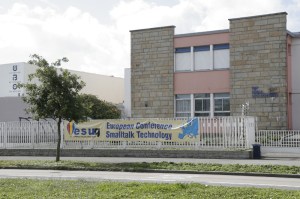
    This year’s conference will be held at Citilab-Cornellà in Cornellà, Barcelona, on 13th—17th September. As in previous years, this year’s edition of the largest European Smalltalk event will include the regular Smalltalk developers conference with renowned invited speakers, and a Smalltalk camp that proves fruitful for interactions and discussions.

    This year will also see:

    • the 6th annual Innovation Technology Awards where prizes will be awarded to authors of best pieces of Smalltalk-related projects
    • an international workshop on Smalltalk and dynamic languages
    • for the first time there will be a business day on Thursday 16th September 2010 with a focus on “Agile Development Processes and Smalltalk”

    ESUG is sponsoring 10 free entrance tickets. To get a free ticket you should send a mail to the esug board (board@esug.org) with a subject of [ESUG 2010 Free entrance] + your name, with an small statement putting your case. Note that students can get free registration and hosting if they enrol into the the Student Volunteers program (see below).

    You can support the ESUG conference in many different ways:

    • Sponsor the conference. New sponsoring packages are described at http://www.esug.org/supportesug/becomeasponsor/
    • Submit a talk, a software or a paper to one of the events. See below.
    • Attend the conference! We’d like to beat the previous record of attendance (156 participants at Brest and 170 people at Amsterdam)!

    Developers Forum: International Smalltalk Developers Conference

    This year we are looking for YOUR experience on using Smalltalk. In addition, we are looking for tutorials. The list of topics includes, but is not limited to the following:

    • XP practices
    • Development tools
    • Experience reports
    • Model driven development
    • Web development
    • Team management
    • Meta-Modeling
    • Security
    • New libraries & frameworks
    • Educational material
    • Embedded systems and robotics
    • SOA and Web services
    • Interaction with other programming languages

    Submissions due on 1 July  2010
    Notification of acceptance on 15 of July 2010
    More information at http://www.esug.org/conferences/2010

    Innovation Technology Award

    We are proud to announce the 6th Innovation Technology Awards. The top 3 teams with the most innovative software will receive, respectively, 500 Euros, 300 Euros and 200 Euros during an awards ceremony at the conference. Developers of any Smalltalk-based software are welcome to compete. This year you are asked to provide 3-5min videos explaining your entry. More information can be found at http://www.esug.org/Conferences/2010/Innovation+Technology+Awards

    Student Volunteer Program

    If you are a student wanting to attend ESUG, have you considered
    being a student volunteer? Student volunteers help keep the
    conference running smoothly; in return, they have free
    accommodations, while still having most of the time to enjoy the conference. More information at http://www.esug.org/Conferences/2010/Student+Volunteers+program


  • ESUG 2009 wrap up – Best Ever?

    DSC_5243-1

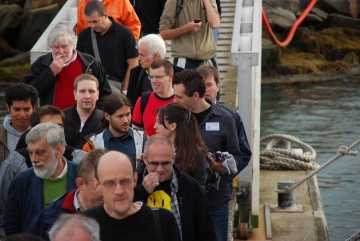
    All the participants should now have safely returned home after a hugely successful ESUG conference. Participants from around the world (including an Argentinian football team) shrugged off the economic climate to spend a week in Brest and share their experiences and aspirations with fellow Smalltalkers.

    Highlights included:

    Check out the photos for a flavour of the conference: Adriaan, Hernan, James, Yuri. and many more.

    Comments on the web have been very positive too:

    • “ESUG was a blast, totally.”
    • “Definitely the best Smalltalk conference I’ve ever been to.”
    • “a great conference”
    • “a pleasure to attend every year”
    • fascinating, inspiring and enjoyable”
    • it’s been intense”

    With reviews like that, next year’s conference in Barcelona is bound to be a sell-out, so remember to book early!

    (Photo from Yuri’s collection)

  • ESUG 2009 kicks off, VAST goes free, Technology Awards break records

    ESUG 2009 UBO

    ESUG 2009 has got off to a successful start, with a packed programme of events lined up for the next few days.

    After an introduction from Stefan Ducasse for ESUG and local organisers Alain Plantec and Loic Lagadec, Georg Heeg looked at Smalltalk’s history and future direction and James Foster ran through news from the Gemstone world, including brief discussions of Metacello and Scaffolding.

    After lunch there were a series of shorter presentations including the “academic strand” of the International Workshop on Smalltalk Technologies.

    In the evening, Instantiations sponsored the reception event in the evening, and took the opportunity to announce free editions of Visual Age Smalltalk for academic and open source usage, which was very well received!

    Attendees also had the opportunity to see the entries for the ESUG 2009 Innovation Technology Awards. A record-breaking 21 applications were entered this year, and the results of the voting will be announced at the conference social event on Thursday.

    (Photo from Adrian van Os’ site)

  • ESUG Innovation Technology Awards – Time is running out!

    esug-logo

    The Innovation Technology Awards session is one of the real highlights of the annual International Smalltalk Conference organised by ESUG each year.

    Noury Bouraqadi has just posted to remind everyone that you only have until 1st July to nominate your work for an award. Put together a brief description of your work, which can be in any Smalltalk dialect, make it available for inspection online, and be prepared to demonstrate it to a constant stream of inquisitive Smalltalkers during the conference, and you could win up to €500 in addition to the recognition and respect of your peers.

    Have a look at Noury’s site for an introduction to the ideas that have proved popular in the past, or our own details of last year’s winners.

    All the administrative details can be found on the ESUG 2009 website – so get those application forms in now!

    And in case you’ve forgotten, this year’s conference is in Brest, France from 31 August—4 September, 2009. It will be preceded by Camp Smalltalk running on the weekend of 29—30 August 2009, and incorporates the International Workshop on Smalltalk Technologies on 31 August.

  • Back to the Future: Programming in Smalltalk

    back-to-the-future

    More exciting conference news for Smalltalk aficionados: James Foster has announced on his blog that this year’s OOPSLA conference will include several tutorials with a Smalltalk theme including his “Back to the Future: Programming in Smalltalk” in which he will look at the “new” ideas from Smalltalk that are still influencing newer programming languages. He will examine some of these ideas and present a number of tutorial exercises that explore some of Smalltalk’s  fundamentally different approach to language design and object orientation, including the following aspects:

    • All values are objects, even integers, booleans, and characters (no boxing/unboxing);
    • Classes and methods are objects (supporting reflection);
    • The language has only five reserved words;
    • All control flow (looping and conditional branching) is done through message sends;
    • Programming is done by sending messages to existing objects; and
    • The base class library can be modified.

    James works on Gemstone’s high performance product family based on Smalltalk, but intends the exercises to be relevant across different versions.

    This year’s OOPSLA will be held in Orlando, Florida from 25 to 29 October, and will also be co-located with the Dynamic Languages Symposium, which will doubtless have lots to interest Smalltalkers.

    On the other hand, if you’re looking for a European break this year, don’t forget that the 2009 International Smalltalk Conference, organised by ESUG, will be held in Brest, France, from 31 August to 4 September, and also has a great set of sessions lined up.

  • ESUG ’08 – Seaside Sprint


    Following the conclusion of ESUG‘s 16th Joint International Smalltalk Conference in Amsterdam, the Seaside developers held a Seaside Sprint. The aim of the sprint was to address a number of outstanding issues in order to move Seaside 2.9 towards release.

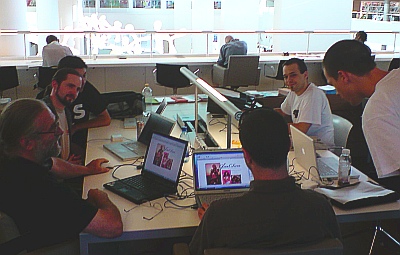
    The sprint was a great success with 14 developers working on a number of issues. Eighteen key bugs were resolved, and progress was made in a number of other areas. The attendees had a range of levels of knowledge and experience, from the core developers, to those seeing Seaside code for the first time

    The Sprint attendees would like to thank Café Kobalt and the Amsterdam Bibliotheek who provided essential facilities including free internet access, and great food and drink.

  • ESUG Innovation Awards 2008

    This year’s winners of the ESUG Innovation Technology Awards were announced at the 16th Joint International Smalltalk Conference in Amsterdam last night. There were a record-breaking 21 entrants, with a great selection of innovative ideas and products. Voting was by all attendees of the conference, and the winners were:

    1st prizeDrGeoII, Hilaire Fernandes’ development in Squeak Smalltalk of an application that allows students at primary or secondary level to create and interactively manipulate geometric figures within definable constraints, as featured on the Weekly Squeak recently (pdf description available here).

    2nd prizeseaBreeze, an application from Georg Heeg eK which allows Seaside developers to work in an interactive environment to develop web content (pdf description available here).

    3rd prize – iSqueak, a project from John M McIntosh, Grit Schuster and Michael Rueger, which allows Squeak to interact with multi-touch input devices such as the iPhone (pdf description available here).

    The competition was sponsored by ABN Amro Bank, and the winners get prizes of €500, €300 and €200.

    Following the ceremony, Georg Heeg announced that seaBreeze will be dual-licensed, with a free versions available under the MIT licence. The code will be made available once some finishing touches have been applied.

  • Squeak projects at Camp Smalltalk

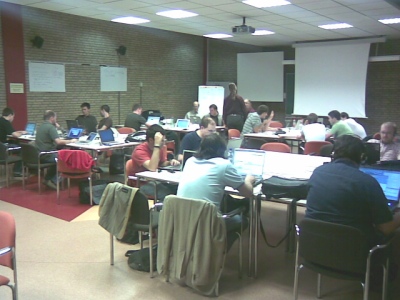
    Over fifty Smalltalk developers have spent the last two days working on a variety of Camp Smalltalk projects before this year’s ESUG Conference. A number of projects were based on Squeak:

    The SqueakNOS team are working to get rid of the need to have an OS underlying the Squeak image. They have now got to the point where any image can run on their VM with minor changes. They can boot from USB memory, and are making progress on accessing SD memory cards.

    The Amelia Project aims to use OpenCroquet to develop a three-dimensional multiuser collaborative virtual environment to help teachers organizing computer-mediated activities where children can collaborate, negotiate and make decisions regarding the spatial configuration of school spaces. Filipe Santos was able to work with other Squeak developers to move his work forward.

    The MOOSE team worked on their collaborative research platform for Software Analysis and Information Visualisation, and were able to make significant progress with migrating their FAMIX2 meta-model to Squeak using Fame.

    Hilaire Fernandes and Michael Reuger began exploring how to integrate DrGeoII, a tool for interacting with geometric figures, into the Sophie multimedia authoring environment.

    Giovanni Corriga worked on the code for the KomHttpServer, and delivered a number of bug-fixes.

    Lukas Renggli and Philippe Marschall were able to fix a number of bugs in Magritte, and add new functionality to Pier, as well as releasing a new maintenance version of Seaside.