Category: Smalltalk

  • ‘Smalltalk is cool again’, says Gartner

    Mark Driver, an analyst at Gartner, has an just published an interesting article noting the resurgence of interest in Smalltalk. He says that developers owe a tremendous debt to Smalltalk but the language itself has been relegated to a small niche of technology elites for several years now. He reasons that this was because it introduced so many new concepts that the developer community is only now coming to appreciate.

    He suggests a number of catalysts for the sudden revival of Smalltalk:

    • Open source Smalltalks encouraging less vendor lock-in.
    • An understanding of the importance of Smalltalk to the designers of Python and Ruby.
    • And of course, the excitement that Seaside has sparked.

    Read the article for more details, and some very interesting comments.

  • BabyIDE – A New Interactive Development Environment

    Trygve Reenskaug wrote to the Squeak dev mailing list to announce the release of BabyIDE, an IDE which which runs on Squeak Smalltalk, and is based on his exploration of a new development paradigm, called DCI. The aim of the DCI (Data-Context-Interaction) paradigm is to minimise any gaps between the programmer’s mental model of the program and the program that is actually stored and executed in the computer, by presenting system operations as networks of communicating objects.

    Trygve, who is based at the Department of Informatics at the University of Oslo, has written a detailed overview (pdf) of the thinking behind his work on BabyIDE and BabyUML.

  • Swazoo 2.2 beta with fast file upload released

    Janko Mivšek has announced that Swazoo 2.2 is ready for beta testing, with much improved upload (input streaming) performance as a main new feature. Swazoo is an open source, vendor agnostic, dialect neutral, highly performant Smalltalk web server with resource and web request resolution framework, born on a first Camp Smalltalk 2000 in San Diego. It is used as standalone web server for static content or for running web frameworks like Seaside and Aida/Web.

    On Squeak it uploads 15 times faster than before, achieving 1.5MB/s throughput locally on a Linux 3.2GHz PC. On VisualWorks it is even more impressive: 30 times better, achieving 15MB/s throughput. This means only 20s for 300MB file upload. In both cases upload performance is about half of the download one due to additional MIME parsing needed.

    Janko believes that in Swazoo we now have a Smalltalk web server with comparable performance to others in terms of upload performance, meaning that Swazoo is ready for demanding upload tasks like video uploading as well as video-serving (eg for screencasts) which has been possible for a while.

    Currently running on Squeak, GNU Smalltalk, Gemstone, Dolphin and VisualWorks, Swazoo appears well on its way to meeting its goal, defined in a manifesto back in 2000: “to join forces and make a really good web server in Smalltalk, open source and for all Smalltalk dialects”.

  • Avi Bryant Interview

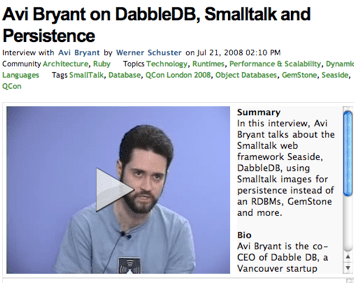
    Werner Schuster from InfoQ.com spent some time talking to Avi Bryant at QCon London 2008, and InfoQ have posted a recording of their conversation. In the interview, Avi talks about the Smalltalk web framework Seaside, DabbleDB, using Smalltalk images for persistence instead of an RDBMs, GemStone and more.

  • Get recording your Squeak videos now!

    The Squeak mailing lists have recently seen a surge of interest in getting videos published to help explain Squeak and Smalltalk to developers coming to the language and environment for the first time.

    In response to this Randal L. Schwartz has set up a new Squeak Smalltalk group on vimeo.com to allow Squeakers to easily upload and share their videos.

    Videos can be a great way to help people quickly pick up a lot of complex information, which makes this an opportunity for Squeakers old and new to help promote Squeak. If there are any topics that you think would suit a short video, why not try recording one and publishing it? If you’re the developer of a powerful Squeak developer tool, and you’re amazed that no-one seems to use all of its functionality, this would be a great way to expose all of those features in a compelling way.

    If you’re a new developer struggling with Squeak, let us know what topics you’d like to see covered in video tutorials. If you’ve got any recommendations for recording and editing software for Windows, Mac or Linux, please leave a comment.

  • Conference news: ESUG 2008 – more information

    A set of posts to the squeak mailing lists has given more details about the 16th International Smalltalk Joint Conference organised by the European Smalltalk Users’ Group, to be held 25-29 August 2008 at CWI in Amsterdam.

    Programme Details

    Mathieu van Echtelt writes that the programme features more than 40 presentations on, among others, the following subjects:

    Programming Language Platforms

    • Newspeak (New open source dynamic language focusing on modularity, security and interoperability)
    • Cog (New highly optimized open source Squeak VM)
    • Maglev (Highly scalable Ruby VM)
    • OpenCroquet (Deeply collaborative, multi-user online Smalltalk development environment)

    Web Frameworks

    • Seaside (The continuation & component-based web framework)
    • WebVelocity
    • AidaWeb (Smalltalk Web Application Server)
    • WebTerminal

    Model Driven Engineering:

    • The Meta Environment Language Workbench
    • ObjectStudio ModelingTool
    • Fame; Meta-modeling Framework
    • MBA Smalltalk; to manage your objects

     
    Additionally, the winners of the ABN Amro sponsored Innovation Awards will be presented.

    Booking Accommodation 

    Noury Bouraqadi notes that discount hotel rates for conference attendees are available until 11 July.

    Seaside Sprint

    Lukas Renggli has announced that the core Seaside dev team will be holding the first official Seaside Sprint, starting after the conference closes at 14:00 on 29 August, and finishing when the last participant collapses over their smoking keyboard. He invites anyone interested in working on Seaside or related code to participate. The venue details will be announced once agreed.

    Camp Smalltalk

    As usual, the weekend preceding the conference will be used to host Camp Smalltalk, an opportunity to work with colleagues on a number of exciting projects. See the Camp Smalltalk page for more information.

  • Smalltalk Solutions 2008 – slides now available

    Most of the slides from the presentations at this year’s Smalltalk Solutions conference are now on line.

    The material available includes Gilad Bracha’s talk on Newspeak, James Foster’s guide to building a Seaside application using GemStone/S, Michael Rueger’s introduction to Sophie, Arden Thomas demonstrating WebVelocity in action, and Randal Schwartz’s double-header keynote: Seaside – Your Next Web Framework and an introduction to persistency solutions for use with Seaside.  

    There are also slides from a couple of sessions looking at the reasons for the recent resurgence of interest in Smalltalk: Arden Thomas looks at the features of Smalltalk that other languages lack, and Rob Rothwell explains how Smalltalk helps with the development of healthcare applications.

    There are many more slide-packs available, and still more to be added, so please check out the conference page for more information. James Robertson is adding video and audio as it becomes available.

  • One stop shop for Smalltalk jobs

    Randal Schwartz is very keen that there should be one community-supported site for collating and finding Smalltalk-related job postings. He says:

    It’s been very helpful to the Perl community to get one place for all serious Perl jobs: jobs.perl.org. Because then all the smart people look there, and all the clueful employers post there, and it’s also free. And the stats at http://jobs.perl.org/about/stats show that Perl is far from dead.

    I’m trying to do the same thing for Smalltalk. Please support me in that. Don’t point at other places.  Get them to post at http://smalltalkjobs.dabbledb.com.  It will be good for all of us overall. Truly.

    The DabbleDB interface has many RSS feeds for particular areas, and can be pulled out and searched in detail.  It’s also all in Smalltalk, which is a good demo.

    Ken Causey has already set up jobs.squeak.org to redirect to http://smalltalkjobs.dabbledb.com, so it look like Randal’s hopes will be fulfilled.

  • Conference News – Libre Software Meeting, 1-5 July, France


    Hilaire Fernandes wrote to tell the Squeak-dev mailing list that the 9th Libre Software Meeting will be held at Mont de Marsan, Landes, in SW France, on 1 – 5 July. LSM is an international free software event taking place in July each year, in a French town; the first event took place in 2000 at Bordeaux. This year, Squeak/Smalltalk will be well represented with conferences and workshops on Squeak, Seaside and Sophie. There will also be a coding sprint for Pharo, a new implementation of Smalltalk based on Squeak.

    For more information, see the post about the conference on Hilaire’s blog.
    http://blog.ofset.org/hilaire/index.php?post/Squeak-Smalltalk-LSM-2008

  • ESUG Awards for innovative software

    Noury Bouraqadi wants to  remind all Smalltalkers that the deadline for entries in the ESUG Innovation Technology Awards is in two weeks time. The Innovation Technology Awards, to be awarded at the 16th International Smalltalk Joint Conference in Amsterdam, are intended to make public part of the innovative software built using Smalltalk. The top 3 teams with the most innovative software will receive, respectively, €500, €300 and €200 during an awards ceremony at the conference.

    The winners will be selected based on criteria of creativity, stability, performance, successful use, and impact for the community. No constraints are put on the software except that it should be Smalltalk-based or Smalltalk-related;  all flavours of Smalltalk are accepted.

     The awards were founded by Nouri in 2004, and details of past winners can be found on his web-site.