Category: Smalltalk

  • S3 Highlights: Lively, COLA, Huemul, Squeak on Python and more


    On 15/16 May, the workshop on Self-Sustaining Systems (S3) took place at the Hasso-Plattner-Institut in Potsdam. An exciting event at a beautiful place, it featured invited talks by Ian Piumarta, Dan Ingalls, and Richard P. Gabriel, and five presentations of reviewed papers that approached self-sustainment from different angles.

    (more…)

  • 16th International Smalltalk Joint Conference – Call for Contributions

    ESUG, the organisers of the 16th International Smalltalk Joint Conference, to be held 25-29 August 2008 in Amsterdam, have issued a call for contributions. Submissions are to be made by 1st June 2008, with notification of acceptance on 15th June 2008.

    About the Conference

    For the past 16 years, the European Smalltalk User Group (ESUG) has organised the International Smalltalk Conference, a lively forum on cutting edge software technologies that attract people from both academia and industry for a whole week. The attendees are both engineers using Smalltalk in business and students and teachers using Smalltalk both for research and didactic purposes.
    As every year, this year’s edition of the largest European Smalltalk event will include the regular Smalltalk developers conference with renowned invited speakers, a Smalltalk camp that proves fruitful for interactions and discussions. This year’s conference will also see the 4th year of the Innovation Technology Awards, where prizes will be awarded to authors of best pieces of Smalltalk-related projects.

    The conference features the following events:

    • Camp Smalltalk – There will be a Smalltalk camp on 23-24 August
    • Developers Forum
    • Technology Forum

    Developers Forum
    This year we are looking for your experience with using Smalltalk. The list of topics includes, but is not limited to, the following:

    • XP practices
    • Development tools
    • Experience reports
    • Model driven development
    • Web development
    • Team management
    • Meta-Modelling
    • Security
    • New libraries & frameworks
    • Educational material
    • Embedded systems and robotics
    • SOA and Web services
    • Interaction with other programming languages

    Technology Forum
    We are proud to announce the 4th Innovation Technology Awards. The top 3 teams with the most innovative software will receive, respectively, €500, €300 and €200 during an awards ceremony at the conference. Developers of any Smalltalk-based software are welcome to compete.

    Student Volunteer Program
    If you are a student wanting to attend ESUG, have you considered being a student volunteer? Student volunteers help keep the conference running smoothly; in return, they have free accommodations, while still having most of the time to enjoy the conference.

    We hope to see you there and have fun together.

  • Using Smalltalk with Java: JavaConnect and JNIPort

    Torsten Bergmann has an interesting post which introduces JavaConnect, a project by Johan Brichau, a postdoctoral researcher at the Université catholique de Louvain. JavaConnect is a library (developed using Visualworks Smalltalk and released under the MIT licence) that allows a seamless interaction between Smalltalk and Java. Johan describes it as allowing a Smalltalk application to “access any Java object and send messages to it, just as if it were a Smalltalk object. Its implementation relies on a connection between the Smalltalk environment and a standard Java VM environment using Visualworks’ DLLCC and Java’s JNI. The Java application thus executes on a regular Java VM and the Smalltalk application executes on the regular Smalltalk VM.”

    Joachim Geidel posted a comment giving a detailed comparison of JavaConnect to JNIPort, a similar tool developed by Chris Uppal for Dolphin Smalltalk, and ported by to VisualWorks by Joachim, a consultant for blueCarat Consulting GmbH. JNIPort (available under a bespoke, liberal licence) invokes a Java VM using the Invocation Interface functions of the Java Native Interface (JNI). It can automatically generate wrapper classes for Java classes.

    Joachim and Johan developed the two projects in parallel, and have discussed whether they could merge in the future, although there are a number of differences in the designs at present. In particular, Joachim believes that JNIPort as currently implemented could be more readily ported to Squeak.


  • Waveplace in the US Virgin Islands

    WavePlace

    WavePlace 2

    Hi everyone,
    We’ve just posted two new videos from the St John Waveplace pilot, which concluded three weeks ago. The first shows mentoring during the pilot. The second shows students presenting their Etoys storybooks.
    1) Scenes from the St John pilot (4 minutes)
    2) The St John Storybook Awards (8 minutes)
    We will be posting the actual storybooks to our website soon so you can see them for yourself.
    In other news, the Haiti pilot will resume next week, since things have calmed down in Port-Au-Prince. The kids and teachers are well.
    As always, if you’d like to hear more from us, please subscribe to our newsletter or donate money on our website to help with our courseware and pilots.
    Take care,
    Tim
    Timothy Falconer
    Waveplace Foundation
    610-797-3100
  • Free Smalltalk books

    Stéphane Ducasse maintains a great list of free Smalltalk books including online pdfs of many out-of-print books.

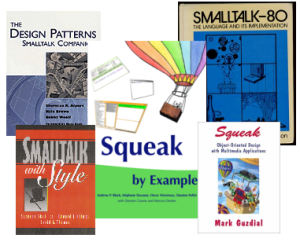
    These books span over twenty years of Smalltalk development, and includes great resources such as Smalltalk-80: The Language and its Implementation (the “Blue Book”), Smalltalk with Style(pdf), and more recent classics such as Squeak by Example (written by Stéphane Ducasse along with Andrew P. Black, Oscar Nierstrasz and Damien Pollet).

    This is a great resource that is of use to beginners and to more experienced programmers wanting to understand more of the philosophy and design decisions behind Smalltalk and Squeak.

    Links and reviews of many other (non-free!) books can be found at the Squeak wiki, John M McIntosh’s site, and Squeakland has a reading list prepared by Alan Kay for those who want to learn more about the ideas and philosophies that influenced the creation of Squeak.

    If you know of other books and online resources that should be listed here, please let us know!

    [Please note the URL has been updated to address David’s comment below. The original URL was an older page with fewer books available.]

  • The Year of Smalltalk

    The Year of Smalltalk

    Randal L. Schwartz just announced that he will be giving a 3 hour tour of Seaside at OSCON 2008. We are very proud to have Randal on the Squeak Foundation Board. We are looking forward to more of his “Year of Smalltalk“.

    [Edit: corrected spelling]

  • What’s the difference?

    Fully Functional Babbage Difference Machine

    The following was posted to the Squeak-Dev Mailing list by Markus Denker. The quote speaks for itself and it does give one pause to consider the implications to our community. It also strikes me as relevant to a lot of other development communities too. Great ideas are still very powerful and inspiring, but the idea alone is still seen as only half the process. We all know that there is a lot of very interesting problems that arise while we transform our ideas into working code. We also know that it is much easier to build onto a working system, or take what we learned from the process of building a working system to the next generation. While the idea itself can be seen as a great accomplishment, the realization of the idea by itself confers even greater benefits to the community. What projects have you left undone? What’s the difference?

    “One of the sad memories of my life is a visit to the celebrated mathematician and inventor, Mr Babbage. He was far advanced in age, but his mind was still as vigorous as ever. He took me through his work-rooms. In the first room I saw parts of the original Calculating Machine, which had been shown in an incomplete state many years before and had even been put to some use. I asked him about its present form.
    ‘I have not finished it because in working at it I came on the idea of my Analytical Machine, which would do all that it was capable of doing and much more. Indeed, the idea was so much simpler that it would have taken more work to complete the Calculating Machine than to design and construct the other in its entirety, so I turned my attention to the Analytical Machine.’”

    “After a few minutes’ talk, we went into the next work-room, where he showed and explained to me the working of the elements of the Analytical Machine. I asked if I could see it. ‘I have never completed it,’ he said, ‘because I hit upon an idea of doing the same thing by a different and far more effective method, and this rendered it useless to proceed on the old lines.’ Then we went into the third room. There lay scattered bits of mechanism, but I saw no trace of any working machine. Very cautiously I approached the subject, and received the dreaded answer, ‘It is not constructed yet, but I am working on it, and it will take less time to construct it altogether than it would have token to complete the Analytical Machine from the stage in which I left it.’ I took leave of the old man with a heavy heart.”

    — Lord Moulton

    Marcus Denker http://www.iam.unibe.ch/~denker

  • The Squeak Foundation Board 2008

    Gaylord Opryland

    Hi all Squeakers!

    Ok, the Squeak Foundation Board Election 2008 ended 19 minutes ago –
    promptly at 18.00 UTC, 8 March.

    For this year we had 437 authorized voters of which 178 voted, that is
    slightly more than 40% voting – a bit disappointing IMHO since we had
    157 voting of 347 last year which gives above 45%.
    On the other hand 178 is more than 157, so we had more voters and thus a
    growing community, which of course is the most important aspect!

    And without further ado I bring you the board for the following year
    starting from NOW. The order reflects the ranking from the election:

    1. Dan Ingalls
    2. Craig Latta
    3. Bert Freudenberg
    4. Yoshiki Ohshima
    5. Tim Rowledge
    6. Randal L. Schwartz
    7. Igor Stasenko

    (more…)

  • Hashing in Smalltalk

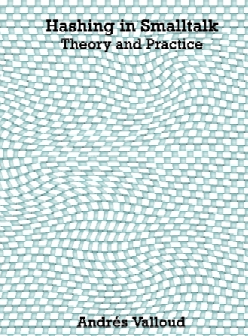
    Hashing in SmalltalkAndrés Valloud has just published “Hashing in Smalltalk: Theory and Practice” on Lulu. He describes the book as providing “a strong foundation for hashing, hash functions, and their application in the context of software development. The first part develops hashing and hash functions from first principles. The behavior characteristics required of hash functions are examined in detail. A thorough description of how hash functions are constructed follows, complete with a rich survey of existing hash functions. But often times existing hash functions are inappropriate for the task at hand. To address this problem, the second part shows how to build novel hash functions that are both efficient and of very high quality for many of the types of data that occur in practice.”

    The book compares algorithms and implementations of hashing across the main Smalltalks (Squeak, Dolphin, Visual Works and VisualAge), as well as other languages including C, C++, C#, Java, OCaml and ML. It’s available for $40/€32.20/£22.04 .

    Andrés has also posted a great illustration of the dangers of the use of inappropriate hashing functions.