Category: Smalltalk

  • Immersive Education Summit Ad-Hoc Meeting

    Immersive Education Summit

    Well I couldn’t resist. Aaron E. Walsh sent out an invitation to the SqueakCroquet communities for an ad-hoc Immersive Education Meeting. The Boston Digital Summit held in January covered the Education Grid, this meeting was a chance to review this information for those that were not able to make it to the summit.

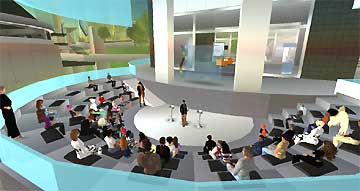
    Second Life was quite an experience. I had to sign up and go through some training, figure out how to get to Sun’s virtual auditorium and sit down. It was quite amusing to see some people show up on stage and not know how to sit down either, so I didn’t feel so bad. Maybe I should have spent more time in the training.

    Aaron, reviewed the details of the Education Grid. The Grid is an education content virtual repository focused on interoperability, standards, and quality educational content. The goal is to provide standards that allow content to be developed to operate in different virtual worlds. These standards must be open source to ensure that content can be made freely available.

    Content is just a piece of the puzzle in education. Educators also need tools to be able to evaluate the progress of students. There are a number of general tools that should be developed and made available in a consistent way for each offering. Aaron mentioned, “While it is possible to record everything that happens in a virtual world there is no way an educator could watch everything a student did in an activity that might take 2 hours.” Tools that allow educators to evaluate raw data, to assess progress and to track grades, and to create content are essential.

    Quality content will be assured by having a Peer Review of offerings before the become part of the grid. The peers will be selected from the community and people with special expertise will be sought to make sure that the education goals are met, the content is accurate, standards are followed, and licensing is compatible to be a part of the grid.

    Licensing and interoperability were the major concerns once Aaron opened the floor to questions. Ownership of the content was also discussed. Aaron mentioned that a not-for-profit organization would own the grid, but that the grid would be virtual and would be hosted by multiple organizations. I’m not sure there was a full answer about the ownership of the content. I would have suggested that copyright stay with the author or developing organization, and that the grid would receive unlimited rights to distribute the content, much in the same way were are trying to organize the Squeak community.

    Well I ran out of time but Aaron did a very nice job of wrapping it up just a few minutes over. Thank you! The concept is really a terrific idea. I hope that our communities will join together and support developing freely available virtual world educational materials. Aaron mentioned that other meetings will be held in Croquet, I look forward to that. I hope to see you there. Hopefully that meeting will be just as well attended as the SL meeting.

  • Learn Smalltalk And See the World!

    Smalltalk See The World 2

    Smalltalk positions around the world! Interested in a Smalltalk Job? Ready to see the world? Check out Noury Bouraqadi’s Smalltalk Jobs and Internship page.

    Dr. Bouraqadi just posted 3 new Jobs in Paris France, for French Speakers.

  • Dynamic Languages Symposium (DLS) 2008 – Call For Papers

    Cern

    Call For Papers

    *** Dynamic Languages Symposium (DLS) 2008 ***

    July 8, 2008 (Tuesday)

    Co-located with ECOOP 2008, Paphos, Cyprus

    Sponsored by ACM SIGPLAN

    http://www.swa.hpi.uni-potsdam.de/dls/dls08/

    ——————————-
    IMPORTANT DATES
    ——————————-
    Submission deadline: April 25, 2008 (hard deadline) Author notification: May 23, 2008 Camera-ready copy due: June 6, 2008 DLS 2008: July 8, 2008

    ——————————-
    ABOUT DLS
    ——————————-
    The Dynamic Languages Symposium (DLS) at ECOOP 2008 in Paphos, Cyprus, is a forum for discussion of dynamic languages, their implementation and application. While mature dynamic languages including Smalltalk, Lisp, Scheme, Self, Prolog, and APL continue to grow and inspire new converts, a new generation of dynamic scripting languages such as Python, Ruby, PHP, Tcl, and JavaScript are successful in a wide range of applications.

    DLS provides a place for researchers and practitioners to come together and share their knowledge, experience, and ideas for future research and development.

    DLS 2008 invites high quality papers reporting original research, innovative contributions or experience related to dynamic languages, their implementation and application. Accepted Papers will be published in the ACM Digital Library.

    ——————————-
    TOPICS OF INTEREST
    ——————————-
    Areas of interest include but are not limited to:

    – Innovative language features and implementation techniques
    – Development and platform support, tools
    – Interesting applications
    – Domain-oriented programming
    – Very late binding, dynamic composition, and runtime adaptation
    – Reflection and meta-programming
    – Software evolution
    – Language symbiosis and multi-paradigm languages
    – Dynamic optimization
    – Hardware support
    – Experience reports and case studies
    – Educational approaches and perspectives
    – Object-oriented, aspect-oriented, and context-oriented programming

    ——————————-
    SUBMISSION GUIDELINES
    ——————————-
    We invite original contributions that neither have been published previously nor are under review by other refereed events or publications. Research papers should describe work that advances the current state of the art. Experience papers should be of broad interest and should describe insights gained from substantive practical applications. The program committee will evaluate each contributed paper based on its relevance, significance, clarity, and originality.

    Papers are to be submitted electronically at http://www.swa.hpi.uni-potsdam.de/dls/dls08/ in PDF format. Submissions must not exceed 12 pages and need to use the ACM format, templates for which can be found at http://www.acm.org/sigs/pubs/proceed/template.html.

    ——————————-
    PROCEEDINGS
    ——————————-
    Accepted Papers will be published in the ACM Digital Library.

    ——————————-
    PROGRAM COMMITTEE
    ——————————-

    Chair: Johan Brichau (Université catholique de Louvain, Belgium)

    Joe Armstrong (Ericsson AB, Sweden) Pierre Cointe (École des Mines de Nantes, France)William R. Cook (University of Texas at Austin, USA) Pascal Costanza (Vrije Universiteit Brussel, Belgium) Wolfgang De Meuter (Vrije Universiteit Brussel, Belgium) Maja D’Hondt (IMEC, Belgium) Robert Hirschfeld (Hasso-Plattner Institüt, Germany) Roberto Ierusalimschy (PUC-Rio, Brazil) Andy Kellens (Vrije Universiteit Brussel, Belgium) Michele Lanza (University of Lugano, Switzerland) Michael Leuschel (University of Düsseldorf, Germany) Oscar Nierstrasz (University of Berne, Switzerland) Kent Pitman (PTC, USA) Lynne Shaw (CheckFree Investment Services, USA) David Ungar (Sun Microsystems, USA) Peter Van Roy (Université catholique de Louvain, Belgium) Martin von Löwis (Hasso-Plattner Institüt, Germany) Daniel Weinreb (ITA Software, USA)

  • Brought to you by ESUG!

    ESUGWelcome

    The European Smalltalk Users Group – ESUG has generously agreed to support international smalltalk presentations.

    From Prof. Stéphane DUCASSE :

    Hi all

    as announced at Lugano ESUG is putting in place new action to promote the use of smalltalk http://www.esug.org/promotionactions/publicationpromotion/

    PublicationPromotion
    ESUG offers 150 Euros for each international conference paper whose concepts involves an implementation in Smalltalk

    Rules
    • After notification of acceptance, one of the authors sends to the ESUG board the article, a CV, and a brief explanation of how Smalltalk was used
    • In case the ESUG board decides to support the promotion, the author has to send to ESUG after the camera-ready deadline a PDF of the article, where ESUG is referenced in the acknowledgment section, including a link to esug.org
    • During the presentation at the conference, the author must mention ESUG support
    • After the presentation at the conference the author sends to ESUG a PDF version of the slides, where there is a visible reference to ESUG (e.g. theESUG Logo). ESUG will put the slides on the ESUG website
    • The author can then trigger the payment by sending an e-Mail to the ESUG board
    • A maximum of 3 supported articles per year per institution is allowed

    Prof. Stéphane DUCASSE [ | ]
    http://stephane.ducasse.free.fr

    Open Source Smalltalks: http://www.squeak.org, http://www.gnu.org/software/smalltalk/smalltalk.html
    Free books for Universities at http://www.esug.org/sponsoring/promotionProgram.html
    Online Free Books at http://stephane.ducasse.free.fr/FreeBooks.html

  • Lively Kernel, a Self Supporting System on a Web Page

    Babe Ruth

    Don’t Miss Dan Ingalls’ Talk about the Lively Kernel! It’s Squeak on steroids! Ok not steroids (considering everything that going on with baseball), but it is Squeak on JavaScript!

    Details below:

    (more…)

  • Old Smalltalk Pics From PARC

    PARC Browser smallPARC Hardware smallPARC Hilberts smallPARC kids smallPARC Mazewar smallPARC Patterns smallPARC Welcome small

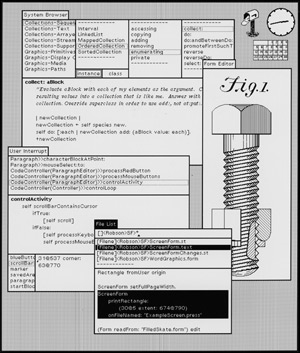
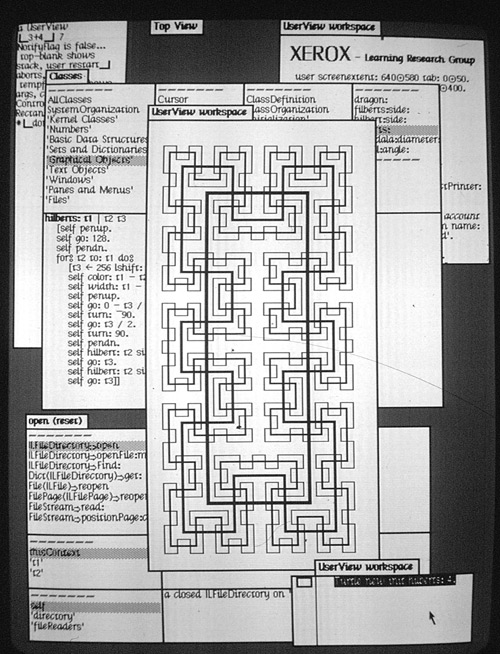
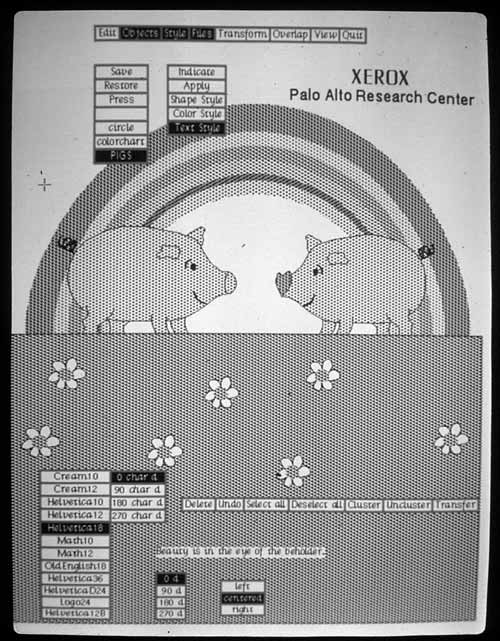
    Special Thanks to Craig Latta who recently brought back these pictures of 1979 Smalltalk\Alto from PARC. What fun it is to see these pictures. The originals in terrific high resolution can be downloaded from here.

  • Here it is. OLPC!!

    Ron-Zoe from olpc

    Now I know this computer is supposed to be for children, and I’ve really enjoyed seeing all the wonderful pictures of the children receiving their computers, but as an adult I really did not expect it to be this much fun.

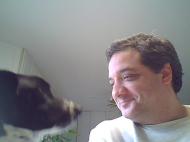
    I’m writing you from my olpc computer. I just received it from the Give 1 Get 1 program. I took this snapshot from the computer. Zoe was quite interested too and couldn’t resist getting in the picture.

    I had no trouble getting on-line and figuring out the interface. I was quickly zooming around making music, guessing random numbers, finding matching tiles, and reading programs.  There are a lot of fun, interesting and educational activities to do.  I got to turtle art and had a blast creating my own turtle spirograph. I made the little turtle walk using the programming tiles in a repeating path, then turned it by 80 degrees and set up a repeat.  I was able to draw some very cool shapes.

    What fun !! It is not too late, but time is running out fast. Give an Olpc XO computer to a needy child and get one that you can play with too! Now I guess maybe I’ll show it too wife and daughter. If I have too.

  • The First Smalltalk Conference In Argentina

    Argentina Smalltalk 2007

    From Hernan Wilkinson:

    Hi,

    I just wanted to let you know that the Smalltalks 2007 presentations are available at https://www.dc.uba.ar/events/smalltalks/2007/presentaciones
    Most of them are in English although not all.
    You can look some pictures at http://picasaweb.google.com/smalltalks2007 and http://picasaweb.google.com/WeybridgeWay/1erCongresoArgentinoDeSmalltalk

    I wanted to give a public “Thanks” to ESUG for their support (DVD, book, ideas, etc), Viewpoints, Dan Ingalls, James Robertson, John Sarkela and Bruce Badger for the videos. Stef and Noury sent me something to read but finally I did not have the time to do it (sorry). Also, to all the sponsors that helped us with the conference.

    Below are some comments we got in the Argentine Smalltalk lists (first in Spanish and then in English, translated by Andres Valloud).
    It is very hard for me to find the right words to express how happy we are with the outcome of the conference, not only for the amount of people that came but also for their kindness and technical level of the presentations. Thanks to all.

    Hernan
    (more…)

  • Demand OLPC

    Non-Universal Learning

    As they roll off the production line demand for the little education laptop is growing. The OLPC project, created by Nicholas Negroponte, to help teach the worlds children is starting to gain real traction. It sure didn’t take long to run through the first production run! The Give 1 Get 1 program appears to have been a big success. The program was extended through the end of 2007. Don’t wait get yours now!

    Over the weekend Peru pushed the demand over the first run ordering 260,000 laptops. We are very happy that the huge potential is being recognized. The stories and pictures of the children around the world receiving their laptops are terrific.

    We like to speculate about the benefits that these computers will bring to a world with such limited resources. How will these tools help to enhance the ability of teachers, provide access to materials and resources that help children learn, and eventually eliminate poverty in our world?

    It is easy to get the wrong idea about what this computer is, just as it is easy to get the wrong idea of the benefit of the internet. There is so much of the internet that is not good for children. The explosion of new social media has many people asking if letting children on the internet at all is even a good idea. It is true that delivering access to basic software and the internet is of little value and could even be considered harmful. If the OLPC project was about delivering laptops there would really be no good reason to support it.

    OLPC is not laptops, it’s software. It’s Squeak and EToys. It’s communications and collaboration. It’s coordination of lesson plans between teachers and with students. This is no regular computer, it’s an education platform geared to enhance the abilities of teachers to teach. To extend the reach of real educators, to provide a common platform so that the worlds brightest minds can reach across the great north-south divide and help teach children that have so little resources. It is a way to share the greatest discoveries of the past with the children of the future. There is no better way to fight violence and poverty than with education.

    Children around the world will benefit from the extraordinary efforts of all the volunteers and participants in this very worthwhile project. Children that may even be in your own back yard. Like maybe Birmingham Alabama in the U.S.A. where the city just ordered 15,000 laptops for every child in grade 1 through 8.

    It appears the questions about success are beginning to fade. The real question is can production keep up with demand. Demand OLPC today. There is no substitute for the little education laptop.

  • Qwaq Secures $7 Million in Funding From Alloy Ventures and Storm Ventures

    Qwaq_Intel_Screeshot

    Full speed ahead. With the rise of virtual technology and a huge lead in the virtual workspace market, Qwaq pulls even further ahead with a successful first round funding raising $7 Million from Alloy Ventures and Storm Ventures.

    Qwaq Forums the company’s first commercial product is built on Croquet and open source virtual world development platform written in Squeak, an open source version of Smalltalk. The work that Qwaq has put into forums is exceptional. The platform takes the concept of a virtual world with all the benefits of immediate communications and immersive visual feed back and integrates it with important business technologies that allow users to truly collaborate in real time. They have taken Croquet and made it work for business.

    The news is really terrific, not only for Qwaq and their customers, but for our open source communities as well. Qwaq continues to share code and support both Croquet and Squeak, not to mention hiring some of the best and brightest Smalltalkers, something I’m sure Qwaq will continue to do with this new funding.

    Congratulations Qwaq!!