Category: Squeak

  • 16th International Smalltalk Joint Conference – Call for Contributions

    ESUG, the organisers of the 16th International Smalltalk Joint Conference, to be held 25-29 August 2008 in Amsterdam, have issued a call for contributions. Submissions are to be made by 1st June 2008, with notification of acceptance on 15th June 2008.

    About the Conference

    For the past 16 years, the European Smalltalk User Group (ESUG) has organised the International Smalltalk Conference, a lively forum on cutting edge software technologies that attract people from both academia and industry for a whole week. The attendees are both engineers using Smalltalk in business and students and teachers using Smalltalk both for research and didactic purposes.
    As every year, this year’s edition of the largest European Smalltalk event will include the regular Smalltalk developers conference with renowned invited speakers, a Smalltalk camp that proves fruitful for interactions and discussions. This year’s conference will also see the 4th year of the Innovation Technology Awards, where prizes will be awarded to authors of best pieces of Smalltalk-related projects.

    The conference features the following events:

    • Camp Smalltalk – There will be a Smalltalk camp on 23-24 August
    • Developers Forum
    • Technology Forum

    Developers Forum
    This year we are looking for your experience with using Smalltalk. The list of topics includes, but is not limited to, the following:

    • XP practices
    • Development tools
    • Experience reports
    • Model driven development
    • Web development
    • Team management
    • Meta-Modelling
    • Security
    • New libraries & frameworks
    • Educational material
    • Embedded systems and robotics
    • SOA and Web services
    • Interaction with other programming languages

    Technology Forum
    We are proud to announce the 4th Innovation Technology Awards. The top 3 teams with the most innovative software will receive, respectively, €500, €300 and €200 during an awards ceremony at the conference. Developers of any Smalltalk-based software are welcome to compete.

    Student Volunteer Program
    If you are a student wanting to attend ESUG, have you considered being a student volunteer? Student volunteers help keep the conference running smoothly; in return, they have free accommodations, while still having most of the time to enjoy the conference.

    We hope to see you there and have fun together.

  • Native look and feel apps with Firefox XULRunner

    Pavel Krivanek has published details of a project he’s been working on: SeasideXUL, which uses the Mozilla Foundation’s XULRunner and Ajax, with Seaside providing the muscle, and allows developers to create applications with a native look and feel.

    Pavel has already used the framework to wrap the OmniBrowser suite of development tools, so allowing Squeak development to take place in the host environment.

    The code is downloadable from SqueakSource, and a pre-built image has also been made available which includes the OmniBrowser integration. Pavel has also published a set of screenshots of the “Periodic Table” sample application demonstrating the capabilities of SeasideXUL.

  • Squeak by Example now available in French

    Squeak by Example has been a hugely successful introduction to Squeak since its publication last year, and it has now been made available to a wider audience, following the publication of a French edition Squeak par l’exemple. As with the English edition, the book has been made available in print from print-on-demand specialists lulu.com for around €17/$20/£11, or can be downloaded from the site as a pdf.

    Squeak par l’exemple was produced thanks to the hard work of the team of translators: Martial Boniou, Mathieu Chappuis, Luc Fabresse, René Mages, Nicolas Petton, Alain Plantec, Benoît Tuduri and Serge Stinckwich.

  • Squeak Etoys – Students Build Their Own Games In Four Days

    The Software Architecture Group at the Hasso-Plattner-Institut (who have produced a great online Seaside tutorial and associated book) have recently been involved in using Etoys in the classroom. They kindly sent us this report about the experience of two of their members when introducing Squeak and Etoys to high school students.

    (more…)

  • Algernon: your personal assistant for Squeak

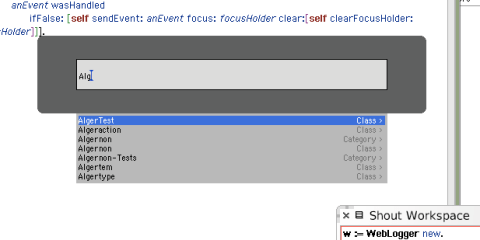
    A team of undergraduates at the University of Illinois at Urbana-Champaign have just released “Algernon”, a new keyboard-based launcher to help you navigate around your Squeak environment.

    Algernon was developed by Erik Hinterbichler and Joey Hagedorn with their CS598 classmates, working with Professor Ralph Johnson of the Software Architecture Group at UIUC. The developers say that Algernon provides lightning quick access to categories, classes, morphs, and global variables in your image, and is inspired by tools such as Quicksilver and LaunchBar for Mac OS X. Like Quicksilver, it learns from your behaviours, and will prioritise options that you use most often. It is triggered by pressing Control-Space Shift-Return, though this can be changed by editing Algernon>>activationString.

    Algernon can be downloaded from SqueakMap using the SqueakMap package loader or from Squeaksource using Monticello, and requires KeyBinder to be installed as a prerequisite.

    [Edited in light of Erik’s comments below.]

  • Squeak and the filesystem

    One of the stumbling blocks for experienced developers looking at Squeak for the first time is the concept of the “image”. Many developers, especially from the UNIX world are used to managing their source code and other resources with a host of file-based utilities, including editors, archivers and change-management tools.

    The Squeak philosophy that everything happens within the image can make the transition to Squeak painful for such developers, but there are tools out there to help with the transition. Two such tools were discussed recently on the #squeak irc channel.

    Johan Björk announced the release of SqueakFS, which allows you to browse and search all objects contained in your squeak image from your local file system. SqueakFS is currently read-only, but the developers are interested in adding editing capabilities. The file system functionality is provided by a socket client built on top of FusePython. This client translates file system paths into squeak objects and queries a server running in the squeak image for details on these objects. In order to do this, SqueakFS uses FusePython for file system support and is dependent on both FUSE and Python and will only work on UNIX systems. SqueakFS has been developed and tested on Linux 2.6 and MacOS Leopard running on Intel systems.

    Brian Rice pointed to another recent project, Stave, which mounts sources on a webDAV share, and so provides an editable WebDAV interface to Squeak’s class system. With the use of a WebDAV filesystem or a webDAV-enabled editor, this enables a file-based view on Squeak. Stave is intended primarily for use with external editors, and hasn’t been tested with search tools.

  • New Dabble DB Demo Debuts

    Avi Bryant writes at the Dabble DB blog that the team has produced a new 8-minute demo of their product in action. This new video replaces their 2006 video which was linked to so frequently that it still shows up as #4 in the google results for “the demo“.

    Dabble DB is a tool to help you create, manage, interpret and present data via your browser. Written in Squeak using the Seaside web application framework, it has received glowing reviews since its launch in 2005.

  • Using Squeak in Education

    Hilaire Fernandes is writing a series of blog posts intended to introduce Squeak to teachers and to developers of educational software. The articles—available in both English and French—are intended to be a gentle introduction to Squeak’s features, and to highlight the ways in which it can be used in education. In each post Hilaire introduces a new topic, and explains its relevance to educational users.

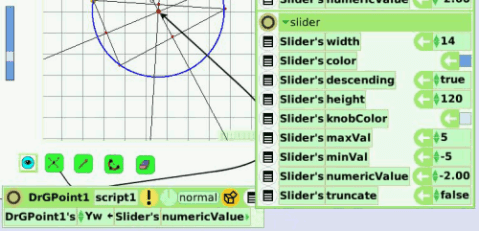
    In writing this series of posts, Hilaire is able to draw on many years involvement in developing Free software in education (including Dr Geo II for the OLPC XO), and working with education professionals to incorporate such software into the school curriculum.

    The first post gives Squeak’s background and introduces Morphic – English, Français.

    The second post is an overview of how images work – English, Français.

  • Squeak Project in Google Summer of Code 2008

    The Google Summer of Code team have announced that the Squeak Project is one of 175 Free and Open Source projects that have been accepted into their programme for 2008.

    This year’s submission was explicitly under the “Squeak Project” title, to allow for projects from the wider community developing based on the Squeak environment.

    The current list of projects with assigned students consists of:

    Congratulations to Giovanni Corriga and colleagues on the SoC mailing list who put the Squeak Project submission together, and best wishes to the students and mentors for a productive and enjoyable experience. We’re all looking forward to seeing your work!

  • Waveplace in the US Virgin Islands

    WavePlace

    WavePlace 2

    Hi everyone,
    We’ve just posted two new videos from the St John Waveplace pilot, which concluded three weeks ago. The first shows mentoring during the pilot. The second shows students presenting their Etoys storybooks.
    1) Scenes from the St John pilot (4 minutes)
    2) The St John Storybook Awards (8 minutes)
    We will be posting the actual storybooks to our website soon so you can see them for yourself.
    In other news, the Haiti pilot will resume next week, since things have calmed down in Port-Au-Prince. The kids and teachers are well.
    As always, if you’d like to hear more from us, please subscribe to our newsletter or donate money on our website to help with our courseware and pilots.
    Take care,
    Tim
    Timothy Falconer
    Waveplace Foundation
    610-797-3100