Category: Squeak

  • Building user interfaces in Squeak

    maui

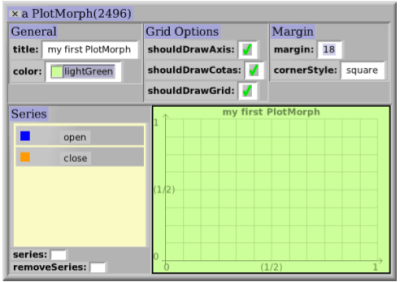
    Chris Muller has released a thoroughly updated and documented version of his user interface framework Maui. Chris has described Maui as a “naked objects” Morphic-based UI builder that allows rapid UI creation based on object-message composition.

    Maui includes a number of light satellite frameworks that supply various application services like documents, object-search, background process management with progress monitoring. It also provides a number of tools which allow applications to be synthesized quickly, without the need to write any user-interface code.

    Chris has written a fifty page document describing Maui and giving examples of how to use it to build user interfaces for complex applications. In this document he also discusses future work for Maui, including the tantalising possibility of extending it to support the development of web applications.

  • Aliens coming to Squeak

    Aliens approaching Squeak

    John McIntosh has ported Newspeak‘s Aliens FFI implementation to Squeak. John notes that the port is in its early days, and more work and support will be needed to implement Aliens support across the full range of Squeak platforms.

    As a result of this interest in Aliens, Gilad Bracha has written a post giving an overview of Aliens, the thinking that went into it, and how it works. FFI allows a programming language to make use of services written in another language, and Gilad suggests that the lack of a standard, fully-featured FFI has been an ongoing problem for Smalltalk developers. In particular, John writes that “Squeak VM’S existing FFI has been found to be buggy bloated and slow” (though see Andreas’ comments on this below).

    John’s code, under the Apache licence, is available at http://www.squeaksource.com/Alien.html, and more information on his implementation can be found at the Alien swiki page.

  • Exploring history using Squeak multimedia

    albaplata

    Germán Arduino writes with news of a very interesting multimedia application his company has been developing for the Spanish state of Extremadura. The application consists of a number of units, each developed in Squeak using the multimedia-application framework FMA, originally developed by Diego Gómez Deck. The application will be available in Spanish, English and Portuguese, and is intended to be used by visitors to the region. It includes a variety of games, puzzles and quizzes to help the user test their understanding.

    Germán notes that, as usual with all the Extremadura projects, the software is open sourced and is available to download from Squeaksource, under the name Albaplata project.

    Germán’s post on the project has more information and screenshots.

  • Monticello 2 podcast

    Monticello 2

    As we mentioned recently, Colin Putney has been working on Monticello 2, a ground-up rewrite of the distributed optimistic concurrent versioning system for Squeak code written by Avi Bryant and Colin Putney with contributions from many members of the Squeak community. This version offers a new, more flexible and more performant versioning engine, as well as many improved features.

    James Robertson of Cincom recently spoke to Colin on his Industry Misinterpretations podcast, where they discussed the changes in the new version, and how these would help developers to maintain and share code. The podcast is available here.

  • Smalltalk on Eclipse

    Having seemingly started to lose interest in Smalltalk when it sold off its VisualAge for Smalltalk business to Instantiations, it looks like IBM is now keen to develop its own Smalltalk IDE. The IBM Smalltalk Tools Development Team is working to support Smalltalk in Eclipse. They’re working with a strong understanding of Eclipse and ENVY Smalltalk, and with support from the Instantiations team, and seem to be making great progress: the screenshot above shows a class browser perspective in Eclipse.

    Although the product is still only available internally, the team are sharing their experiences in developing what they’re calling “WRATH”, having presented updates at EclipseCon and Smalltalk Solutions, and talking to James Robertson on the Industry Misinterpretations podcast.

  • “Squeak: Learn Programming with Robots” now free!

    Stéphane Ducasse writes that his book “Squeak: Learn Programming with Robots” is now free.

    The book was the result of a collaboration by Stéph with his wife who was a maths and physics teacher in a French school for students aged 11–15, meaning that the book addresses many of the issues that are raised by children when first introduced to programming concepts. It uses a simple environment written in Squeak Smalltalk to allow children to create and manipulate bots.

    The book (also known as the Bots Inc book) was published by Apress in June 2005, and received some very nice testimonials and reviews, with Huw Collingbourne saying that for “a beginning programmer or someone who wants an easy-to-understand entry to the world of ‘real’ object orientation, it would be a real treat.”

    Thanks to financial support from ESUG, Stéph has now been able to buy back the rights to the book in order to release it for free. He is now working to make the book available on his website, and translations are already under way.

    The original book is still available for purchase both as hard copy and for download onto Amazon’s Kindle.

  • Squeak and Seaside BOFs at OOPSLA ’08

    Nicolas Chen has posted a very interesting report on the Squeak and Seaside ‘Birds of a Feather’ sessions at this year’s OOPSLA Conference in Nashville, Tennessee. Speakers included Michael Lucas-Smith of Cincom talking  about their WebVelocity development tool for Seaside; Göran Krampe on Blackfoot, his lightweight SCGI-based KomHttpServer replacement for Seaside deployment; Dave Ungar (ex-Sun Labs, now at IBM Research) on his work on multi-core Squeak; and Jecel Assumpcao Jr. on Smalltalk Hardware Design, and his Siliconsqueak project.

    As promised, Göran has published videos of the sessions; see his blog for details.

  • New Dependency Browser for Squeak

    Hernán Morales Durand recently announced a new tool he has developed, which allows developers to review the dependencies between the classes within their applications. His Dependency Browser includes an OmniBrowser interface (as shown above) allowing you to review and edit those dependencies.

    Hernán is continuing to work on the tool, and is looking at extending the functionality, and the possibility of displaying the graph of the dependencies using tools such as GraphViz.

    Anyone interested in this approach should also be aware of the MudPie and Moose projects.

  • Squeak BOF at OOPSLA 2008

    OOPSLA, the “original conference devoted to object-oriented programming”, is running this year on 19th-23rd October in Nashville. Göran Krampe wrote to the mailing list to let attendees know that he is organising a Squeak “Birds of a Feather” evening session on Tuesday at 18:00.

    Göran has had experience of organising these events in the past, so you can be sure that the logistics have been thought through carefully – he’s even bringing his own projector with him from Sweden, rather than rely on the equipment available at the venue! All the videos of all the presentations will be made available after the session.

    If you’re interested in attending this session, please let Göran know by adding your name to the OOPSLA 2008 page on the Squeak wiki (if you’re having trouble editing that page, the words squeak and viewpoints may be of some use to you). The wiki page also has information on some other items that may be of interest to Squeakers.

  • Subversion integration for Squeak

    Michael Perscheid and his colleagues in the Software Architecture Group of the Hasso-Plattner-Institut have just announced the release of SqueakSVN, a tool to give Squeak access to the version control capabilities offered by Subversion, the open-source revision control system. This will allow Squeak developers take advantage of the benefits of Subversion’s growing popularity and support, while remaining within the Squeak browser environment.

    SqueakSVN supports repositories using the http, file and svn protocols, but there is currently no support for https. There are more details at the SqueakSVN project home page, including a video of SqueakSVN in use.

    The new package was developed in co-operation with CollabNet, the primary corporate sponsor of Subversion.