Casey mentioned:
Speaking of Pythagoras, Alan Kay demos a visual proof for the theorem that’s super easy for just about anyone to understand right away using Etoys in his TED talk, which is worth a look:
Casey mentioned:
Speaking of Pythagoras, Alan Kay demos a visual proof for the theorem that’s super easy for just about anyone to understand right away using Etoys in his TED talk, which is worth a look:
Bert posted a youtube video as a response to a newbie question:
For her third language she chose Squeak, since she knew that Scratch was written in it. I would like to have her write the “Hello Pythagoras” program using Morphic objects, in a visually appealing way. So far I have had some trouble finding a tutorial that covers relevant information. I am sure I can figure this out by poking around long enough but if anyone has a pointer to documentation that might help, or a similar example, that would be great and much appreciated
Here is Bert’s terrific answer!
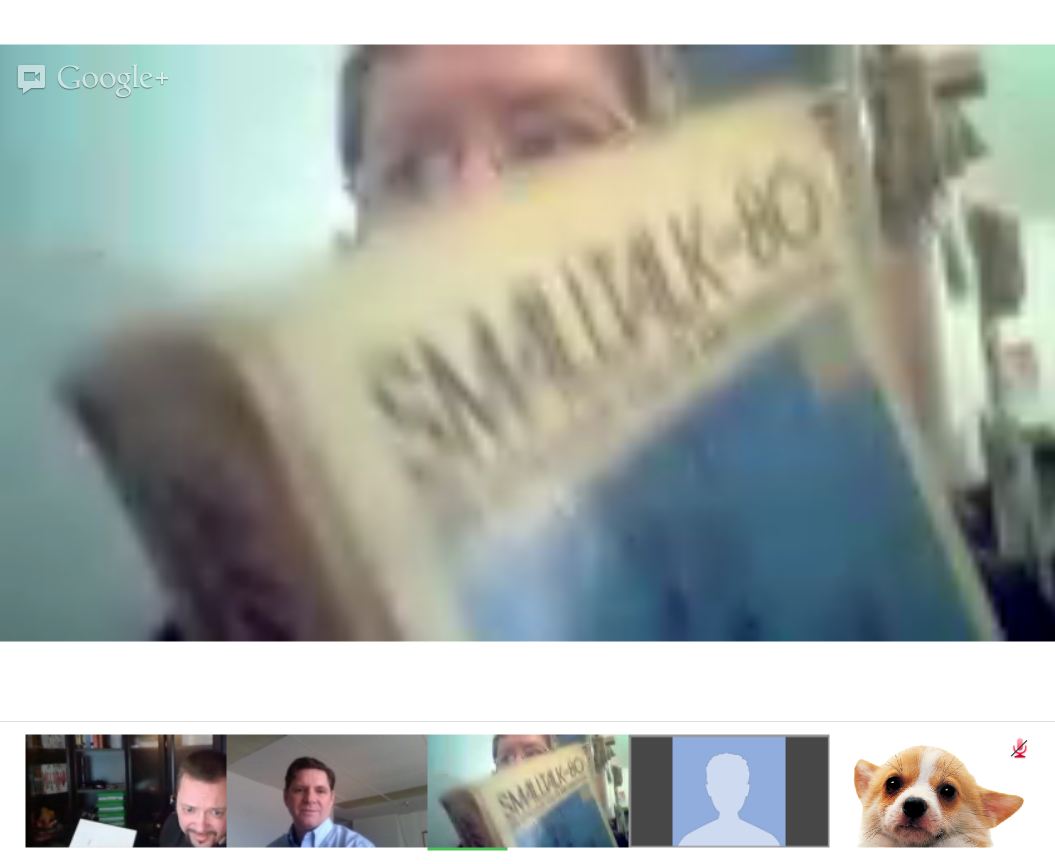
https://plus.google.com/u/0/events/csf1f4prqs0s40o64avo9b9808g

OK, RISC OS Pi squeak is now available as a tentative demo pre-alpha possibly useful maybe release at http://www.rowledge.org/tim/squeak/Squeak3-9-RISCOS.zip
If you try it and like it, remember to mentally thank Chris Cunnington for providing the dev-tools and the Pi Foundation for providing the tasty Pi. And offer up wishes for somebody realising that they need to *pay me* to develop stuff.
Apparently Scratch runs on it, though I haven’t tried and wouldn’t really have any current experience to judge it by.
tim
http://lists.squeakfoundation.org/pipermail/squeak-dev/2013-January/167703.html
Hi All,

This is a reminder that it's that time again!  Please announce yourself as a
candidate before Monday 28th of January 3PM (20.00 UTC) if you plan to run
for the Squeak Oversight Board.  It is a good idea to do that soon so that
you will be able to answer questions from the community.

Please consider running yourself or reach out to community members you think
would be good to have on the board.

You can follow the election progress here:
http://wiki.squeak.org/squeak/6191

If you are a part of the community and have not voted in the past please let
me know.

If you were invited to vote last year you are already on the list, no
worries! If you are a new Squeaker and wish vote do ONE of the following:

* Get a "known" Squeaker to vouch for you. If a known Squeaker sends an
email to me (voters at squeak.org) giving me name and email for you - then I
will add you.

* Send an email to me (voters at squeak.org) presenting yourself with
information/arguments showing me that you are indeed serious about voting
and that you are indeed a Squeaker. And no, I don't have any hints on what
you should write! :) Unless you totally screw that up, you will probably be
added. And no, don't send me a 10 page essay ;)

When the voting period starts all voters will receive an email with
instructions and a link to the voting website.

Also don't forget once the election starts PLEASE VOTE!

All the best,

Ron Teitelbaum
Hi,
Our community have very few dedicated official resources: running
www.squeak.org and so on either takes cash or donations.

The new CI work is rather heavy CPU wise, and limited to (CentOS)
Linux builds only. However, Jenkins supports the use of headless build
slaves that connect TO a Jenkins master, permitting these slaves to
run while still behind NATs.

I've been experimenting these past few days investigating using build
slaves. I've set up jobs for building FreeBSD VMs (both broken,
because FreeBSD support does lag behind the other platforms) and for
running Trunk tests on OS X. You can see that we have some (known)
network issues on OS X here:
http://squeakci.org/job/SqueakTrunk-OSX/9/testReport/?

It's pretty easy to run a build slave. If you wish to donate some
computing time, ask here and we can create a node for you, with a
(unique) name of your choice. Once that's done, you need to
* have (a recent version of) Java installed
* download the slave.jar from  http://squeakci.org/jnlpJars/slave.jar
* run the jar somehow. On a Unix machine that'll be $ java -jar
slave.jar -jnlpUrl
http://squeakci.org/computer/${SLAVENAME}/slave-agent.jnlp. On a
Windows machine, running java from a command prompt should be
perfectly sufficient, if you don't feel like figuring out how to turn
the agent into a service.

What are the downsides? Jenkins masters can send arbitrary Java
classes to a slave for running. That means that if squeakci.org's
Jenkins was compromised, your build slave could potentially be
compromised. You will want to, at the minimum, run the slave under a
dedicated user with low privileges.

You can find more reading material here:
https://wiki.jenkins-ci.org/display/JENKINS/Distributed+builds

Thanks,

frank
http://lists.squeakfoundation.org/pipermail/squeak-dev/2013-January/167679.html
http://www.lshift.net/blog/2012/12/31/squeak-4-4-released
Squeak 4.4 is released and is now available. The release manager, Frank Shearar, announced the latest Squeak to be ready on New Year’s Eve.
The first link provides the image. The second link is a blog post discussing the process Frank followed in the making. He is the first release manager to use a Jenkins continuous integration server for the production of a release, which has set the template for how Squeak images will be released in future.
http://lists.squeakfoundation.org/pipermail/squeak-dev/2012-December/166934.html
Squeak is in the process of releasing its latest version – Squeak4.4. Frank Shearar, the release manager, has just released the latest release candidate for public vetting by the community. Download it. Take a look. Post feedback on the Squeak-dev mailing list.
Hi Folks,
Cuis 4.1 is available at http://www.jvuletich.org/Cuis/Index.html.
Biggest news is in the Morph hierarchy. Ivars ‘bounds’ and
‘fullBounds’ are gone! All coordinates are now Float and relative to
the owner morph. This is part of the transition to Morphic 3. The
drawing engine is still BitBlt and the UI is not scalable yet, but
Morphic 3 is now much closer.
Cheers,
Juan Vuletich