Author: Michael Davies

  • Final preparation for 4.1 now under way

    Following the successful release of Squeak 4.0, which was the first version of Squeak to be cleaned of all non-open-source code, there was enthusiasm to quickly get the next release out of the door. This was driven by concerns that the long and difficult process of re-licensing and re-writing meant that many areas of the 4.0 release were a long way behind the current state of Squeak.

    As a result, there has been a concerted effort to move quickly to release version 4.1, incorporating many bugfixes, thorough test suites, much faster and cleaner code in many areas, the removal of obsolete code, and a much more consistent and clean user interface. It will also offer a much simpler and more robust installation process for new users.

    The work on preparing for the 4.1 release is now drawing to a close, but more help is still welcome! You can support the work by downloading the latest release candidate from http://ftp.squeak.org/trunk/ (and possibly the 4.0 sources file) and:

    • ensuring all tests are green,
    • contributing fixes for issues marked as critical for 4.1 on bugs.squeak.org (or any other fixes you’ve been hiding up your sleeves),
    • checking that your packages on SqueakSource and SqueakMap install correctly in the new version,
    • checking that the new Windows installation process works on your configuration,
    • and of course, keeping an eye on the squeak-dev mailing list to ensure that you’re not duplicating work.

    We expect a lot of interest in this new release, and want to ensure that we give new users a great first impression of Squeak. If you want to contribute to this work, now’s the time!

  • Call for students for Google Summer of Code

    Janko and Mariano who are co-ordinating the joint ESUG application to this year’s Google Summer of Code are now looking for students to apply for the thirty-five proposed projects. The process couldn’t be simpler: review the list of projects, and you can register your interest in projects with just one click once you’re registered. You can also contact the project mentors for more information.

    Note that this approach allows many students to register for each project, so if you want to improve your chances, make sure the project mentors can see why you would be the best choice for their project by editing your biography, and making sure that your contact information is up to date!

    You must register by 9th April, so get cracking!

    Any questions, visit the ESUG GSoC website, or contact the admins at esug.gsoc.adm2010@gmail.com.

  • ESUG accepted for Google Summer of Code

    Mariano Martinez Peck has announced that “We are incredibly proud to announce that ESUG was selected for the GSoC 2010.”

    Mariano and his colleagues put a lot of time and effort into preparing a joint entry via ESUG for all Smalltalk-related projects, and pulled together a long list of wonderful projects, mentors and a cool website.

    Although Google are still to confirm the exact number of projects that will be funded, Mariano would like to thank all the people who help them publishing project ideas, giving feedback on the submit text or the English. They will contact all the mentors again very soon to let you know the following steps.Maybe you are not aware of what our selection to this year GSoC really means for the Smalltalk community. And I wasn’t aware completely until few hours. Just to give you an example, even such big organizations like Ruby or PHP where not selected. From this viewpoint  you can see what we have achieved.

    Mariano makes a very clear case for the importance of this successful application:

    “Some people said and still says that Smalltalk is old and that it is dead. Ok, we have been selected by the major Informatics and Software company all over the world.

    “The point is that ESUG and the Smalltalk community was selected because of the seriousness mixed with passion of all the application, project and ideas. We have an incredible high quality list of ideas and mentors.

    “We have a unique opportunity to show the rest of the world why we love Smalltalk, why it is much better than other alternatives, etc. So, we invite all of you to make this happens.”

  • Google Summer of Code – candidates needed at once!

    The Squeak community are working with ESUG to submit a joint entry to this year’s Google Summer of Code but need your help at once!

    Squeak participated in GSoC  in 2007 and 2008 but in 2009 Google started to focus on bigger communities, so Squeak developers are working with ESUG this year to put together a joint submission with other groups including open-source projects from all Smalltalk dialects, including Pharo, Smalltalk/X, GNU Smalltalk and Cuis as well as commercial distributions such as VisualWorks, VisualAge, Dolphin and Gemstone. Entries from cross-platform projects like Seaside, AidaWeb, Magma, etc. will also be welcome.

    Mariano Martinez Peck will administrate the joint application supported by Janko Mivšek. They need to supply Google with information about ESUG as a mentoring organisation and a list of ideas/projects,  each with a description and a nominated mentor. If their submission get selected by Google they will be told how many projects Google will sponsor — the mentor receives $500 and the student who volunteers to work on the projects will receive $4500.

    Due to a late start, they are very near to the first deadline! They have until 12th March 2010 to submit all the information of the mentor organisation and give the list of projects with mentors. So as a matter of urgency they need your projects. They’ve put together a webpage to hold details, so if you have project suggestions, send them a short title and a paragraph (for the moment) explaining the idea. You can also reply to Mariano’s email on most of the key developer mailing lists including the squeak-dev mailing list.

    Good mentors are often as hard to come by as good ideas, but often being helpful, being aware of the dates, answering emails, etc. can be more important than the Smalltalk knowledge, so if you’re able to act as a mentor or a back-up, let them know at once!

    For some inspiration, you can see the ideas proposed in previous years:
    2007: http://wiki.squeak.org/squeak/5936
    2008: http://wiki.squeak.org/squeak/6031
    2009: http://wiki.squeak.org/squeak/6120

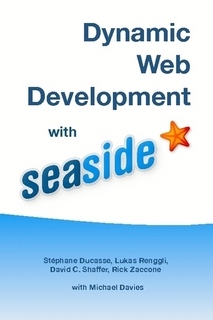
  • Dynamic Web Development with Seaside

    Dynamic Web Development with Seaside

    A print-on-demand, softcover copy of the book “Dynamic Web Development with Seaside” is now available from Lulu.

    Seaside is an source framework for developing highly dynamic and interactive web applications, and makes building web applications as simple as building desktop applications. The book gives you all the instruction and support necessary to get up and running in all the popular distributions of Smalltalk, with separate chapters on Pharo and Squeak, Cincom Smalltalk, Gemstone/S, GNU Smalltalk and VASmalltalk.

    The printed book is based on the free online version and the purchasable PDF version of the book, and will be updated regularly. The book costs around €28/£24/$40 and will be delivered within 3-5 working days, so order your copy now!

    The authors wish to thank the European Smalltalk User Group (ESUG), inceptive.be, Cincom Smalltalk, Gemstone Smalltalk,  and Instantiations for generously sponsoring this book.

  • Squeak Board candidates wanted

    An Election Entertainment - Hogarth

    Göran Krampe has begun the process for this year’s elections for the Squeak Oversight Board.
    The Squeak Oversight Board (SOB) consists of seven members from our community, all of whom are elected by popular vote. The members are responsible for

    • building a legal presence – currently by working with the Software Freedom Law Center as part of their Conservancy;
    • providing the network services that support the various mailing lists and repositories that in turn make a community possible;
    • helping coordinate the various interest groups and projects being pursued by Squeakers;
    • making decisions where there is no clear community consensus.

    The current board members are:

    • Jecel Assumpcao Jr
    • Ken Causey
    • Bert Freudenberg
    • Craig Latta
    • Andreas Raab
    • Randal Schwartz
    • Igor Stasenko

    (From http://www.squeak.org/Foundation/Board)

    The schedule and process of the Election is as follows:

    Nominations

    Candidates should nominate themselves by 3rd March and start their campaign on the squeak-dev mailing list. Or if you nominate someone else, make sure that person really wants to run. Göran will not put anyone on the candidate list until that person makes it known on squeak-dev that he/she does run.

    Final candidate list

    The list will be closed on 3rd March. The candidates should ideally present themselves on squeak-dev, unless they have already done so, and the community can ask questions.

    Online election starts

    The voting period starts on 10th March 6PM (18.00 UTC) and is one week long. Ballots are sent out via email.

    Online election ends

    The voting process will end on 17th March 6PM (18.00 UTC). Results will be announced immediately when the election ends.

    Registering

    If you were invited to vote last year you are already on the voter list, no worries! If you are a new Squeaker and wish vote do ONE of the following:

    • Get a “known” Squeaker to vouch for you. If a known Squeaker sends an email to voters@squeak.org giving your name and email address then Göran will add you.
    • Send an email to voters@squeak.org yourself (and CC to squeak-dev if you like) with information/arguments showing that you are indeed serious about voting and that you are indeed a Squeaker.

    When the voting period starts all voters will receive an email with instructions and a link to the voting website.

    More information

    Everything about the election, including schedule above and more, can be tracked here:

    http://wiki.squeak.org/squeak/6150

  • Squeak on Android

    Andreas Raab has announced a new home for some work he’s been doing recently to port Squeak to the Android platform:

    http://code.google.com/p/squeak-android-vm/

    He’s aware that lots of things are still missing that would be required to support a full port (including text input and network support). But he’s still interested to hear if (and how well) it works for other Android-based cell phones. So if you have a Motorola Droid or or a T-Mobile G1 give it a shot and post some benchmark results.

    Andreas reports that “performance on the Nexus One is about what one would expect: With roughly 1M sends/sec and 30M bytecodes/sec it’s not exactly rocking but it’s quite usable for most tasks on a mobile device. (Input is *terrible* though; Squeak’s UI is not made for fat-fingered clicks like mine :-)”

    If you’d like to be added as developer, please send Andreas your Google Account email address so that he can add you to the project. But, he warns that “unless you know how to deal with both the Android SDK and NDK, Java, JNI, and the Squeak VM it will be a very steep learning curve”.

    (Of course, for those of us still using iPhones, there also John McIntosh’s iPhone port of Squeak.)

  • Cincom Smalltalk World Tour under way

    Cincom are starting 2010 with their Smalltalk Technology Conference 2010 World Tour. This is a chance to learn more about how Smalltalk helps companies around the world reduce costs, improve efficiency, and get to market faster.

    The Cincom team of Suzanne Fortman, James Robertson, Arden Thomas and Andreas Hiltner will be joined at the venues by Georg Heeg, giving a customer perspective on how Smalltalk can help your organisation, and Gartner analyst Tom Murphy, talking about the value of dynamic languages in general, and of Smalltalk in particular.

    The schedule of events is:
    • Seattle, 21 January
    • Toronto, 26 January
    • D.C. Metro Area, 28 January
    • London, 2 March
    • Paris, 4 March
    Find out more about each session on the events page of Cincom’s glossy new website, and keep an eye on James Robertson’s blog for updates as they happen.
  • Smalltalks 2009 videos and photos available

    Hernan Wilkinson wrote to the squeak -dev mailing list that the Smalltalks 2009 presentations are available now at the Smalltalks Conference site under the “Talks” tab. Given that the speakers included such well-known figures as Dan Ingalls, Stephane Ducasse, Alex Warth, Tim Mackinnon, James Foster and Travis Griggs, there should be some fascinating viewing to be had.

    Hernan added: “You can watch also the video used during the presentation that summarizes the previous two years of the conference, it is a very nice video. It is at http://www.youtube.com/watch?v=ekRhvg7W6AQ“.

    There are also links to other videos and pictures from the conference home page.

  • Scratch featured in “Communications of the ACM”

    Scratch is the cover story of the November 2009 issue of CACM, the monthly magazine of the Association for Computing Machinery.

    Scratch is a visual programming language, developed in Squeak, that makes it easy to create interactive stories, animations, games, music, and art — and share these creations on the web. Aimed at children between the ages of 8 and 16, Scratch has developed a thriving community, with over 1000 new projects being uploaded to the site every day.

    In inviting the Scratch team to submit an article, the editor of CACM explained his motivation: “A couple of days ago, a colleague of mine (CS faculty) told me how she tried to get her 10-year-old daughter interested in programming, and the only thing that appealed to her daughter (hugely) was Scratch.”

    The submitted article is also available for viewing online.