Category: Media

  • Preview of new Seaside Visual Interface Builder

    Seaside Builder preview

    Hernán Morales and his colleagues have been working for a while on an interface builder tool to generate Seaside components (pages) dynamically, and they have just released a video showing their work so far. The ideas are based on a visual programming tool for Windows called WindowBuilder Pro.

    The tool, called Seaside Builder, has support for most common web controls (TextField, Panel, RadioButton, TextArea, Label, Button, Anchor, CheckBoxGroup, RadioButtonGroup, ListBox, FieldSet).

    See the video (19 MB) at:

    http://smartware.com.ar/builder.avi
    http://cs.hernanmorales.com.ar/SeasideBuilder.avi

    (Image from Torsten Bergmann’s blog)

  • Pretty Cool NYTimes OLPC Review

    OLPC Interface

    David Pogue at NYTimes reviews the One Laptop Per Child computer.  Don’t miss the video clip, it’s very cool.

  • Qwaq, Intel Collaborate on Enhanced Virtual Workspace Product

    Qwaq - Intel

    For those of you who want to see Croquet in action, check out the keynote by Justin Rattner from Intel’s developer forum in San Francisco this morning:

    http://www.intel.com/pressroom/kits/events/idffall_2007/webcasts.htm

    The topic is “The rise of the 3D Internet” and Croquet is featured both in the talk in general (as an example of P2P collaboration environment) and live via a Qwaq Forums demonstration (about 15mins into the talk).

    Also, a link to the press release of the Qwaq/Intel collaboration:

    http://www.intel.com/pressroom/archive/releases/20070920corp_a.htm
    http://www.qwaq.com/press/release_2007-09-20.html

  • Squeak By Example now published!

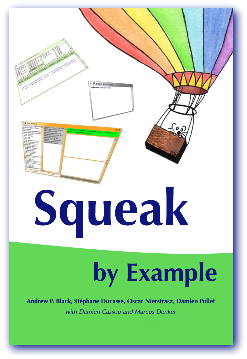
    Squeak By ExampleFollowing Stéphane Ducasse’s announcement last week, the finishing touches were applied at a blistering pace, and Squeak By Example has now been published! You can order the book in hardcopy from print-on-demand specialists lulu.com. There is also an accompanying website http://SqueakByExample.org, where you can download the book as a PDF.

    The book is intended as an introduction and tutorial for both students and developers, and will guide readers gently through the language and tools by means of a series of examples and exercises. The book helps you get started with A Quick Tour of Squeak and guides you through A First Application.

    The Smalltalk language is introduced in three chapters on Syntax in a Nutshell, Understanding Message Syntax and The Smalltalk Object Model. Development with Squeak is covered in The Squeak Programming Environment and SUnit. Several of the key classes are presented in chapters on Basic Classes, Collections, Streams and Morphic.

    The book concludes with chapters on Classes and Metaclasses and Frequently Asked Questions.

    Congratulations to co-authors Oscar Nierstrasz, Stéphane Ducasse, Damien Pollet, Andrew P. Black, Damien Cassou and Marcus Denker for producing such a great resource for new Squeakers!

  • Coming Soon – Open Source Squeak Book!

    Last week at ESUG, co-author Stéphane Ducasse announced a new book will be available in mid-September entitled “Squeak By Example“. First released as a beta version, and totally free and open-source, you can find out more at the book’s website.

  • OLPC on TV

    OLPC Size

    From: Michael Haupt,

    The German/Swiss/Austrian TV station 3sat has a weekly 30-minute show called “neues” (roughly translated “new things”) which deals with IT-related information. Yesterday’s show was focusing on bringing IT to isolated regions and emerging nations as well as developing countries. The show featured an article on mesh networks in Ecuador and the Linux4Africa project.

    Linux4Africa is a German project collecting old but functional hardware. The components are cleaned, repaired (if necessary), bestowed with an Edubuntu Linux installation, and sent to Tanzania and Moçambique.

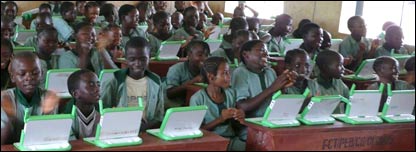
    12 of the show’s 30 minutes were dedicated to an extensive coverage of the OLPC project. Etoys and Squeak were mentioned several times during the feature. The project itself was introduced, and Bert Freudenberg was interviewed about the technical features of the XO laptop, which was presented in detail.

    There were also two interviews in the studio. Two members of GTZ (Deutsche Gesellschaft für Technische Zusammenarbeit; German Society for Technical Cooperation) responsible for XO distribution in Ethiopia talked about the project in general and about the impressive progress children made when working with the XO.

    The other interview – which filled the first slot in the OLPC coverage – featured two students from Hasso Plattner Institute, Potsdam, who have developed strategic and skill-improving games for the XO in the Software Architecture Group‘s course on software architectures.

    All in all, the editorial staff at 3sat did a tremendous job in preparing this show. To the writer’s knowledge, this was the first time the OLPC project was presented at such a level of detail in German television. Germany being a country where the the project has no actual lobby, it is important to have such media coverage – it would be nice to see much, much more of it.

    The entire show can be watched online (in German).

  • OLPC – The $100 Laptop – Goes into Production

    https://i0.wp.com/newsimg.bbc.co.uk/media/images/44015000/jpg/_44015059_galadima_416.jpg

    Five years after the concept was first proposed, the so-called $100 laptop is poised to go into mass production. Check out the BBC Article.

  • A Squeak 3.9 development tutorial

    Steve Wessels has recently published a complete development example for Squeak 3.9. In this tutorial, he guides the reader towards the creation of a simple solitaire-style game.

    From the Introduction:

    An activity I enjoy is writing simple games in Squeak. I also enjoy sharing this powerful development environment with interested developers. This is one of the reasons I write these tutorials.

    For this development example I’d like to try something different and take the student through the process of writing a game in Squeak. Proceed linearly through the example. The development process described here will be very specific to the way I work. Consequently, you will see how I encourage organization of files and other processes as part of Squeak development. In a very real way, Smalltalk development is a personal expression.

    While not geared towards complete begginers, Steve’s tutorial is good learning material for beginning/intermediate Squeak users.

  • SqueakFest ’07 – Register Now!

    SqueakFest 07 Official

    Register for SqueakFest ’07.

    From Kim Rose, Viewpoints Research Institute:

    Greetings —

    Online registration is now available for SqueakFest ’07!
    http://imamp.colum.edu/eceim/squeakfest07/index.php

    We’re putting together a great three day program including hands-on workshops, panels, presentations, casual sharing time and fun social events.

    Alan Kay will give a talk about the One Laptop Per Child Initiative, the “xo” machine and Squeak Etoys on this platform.

    Registration for the entire program is $125.00. Please register
    early as this will be helpful for our planning. We also encourage
    you to BOOK YOUR HOTEL ROOM(s) EARLY! Chicago will host numerous summer events and hotels are already near capacity for August 1-3.

    Some suggested accomodations appear on the SqueakFest website:
    http://imamp.colum.edu/eceim/squeakfest07/accommodations.php

    Please forward this email to anyone you know that may be interested in attending.
    Come join us in Chicago! We look forward to seeing you there.
    cheers,
    Kim