Category: Squeak

  • Iliad web framework released

    iliad

    Nicolas Petton recently announced on the squeak-dev mailing list the first public release of Iliad, which is succintly described on the Iliad website as a “a flexible, lightweight but powerful Smalltalk web framework.” Originally developed on GNU Smalltalk, but ported to Squeak/Pharo, Iliad features:

    • standalone stateful widgets
    • nice urls with a simple routing system
    • simple API
    • easy to setup and deploy (no complicated configuration step)
    • javascript layer to update widgets using AJAX. If javascript is not enabled, the behaviour remains the same by making normal requests
    • support for the Magritte meta-description framework, for simple generation of views on data

    Iliad combines elements of the other leading Smalltalk web frameworks Seaside, Aida/Web and HttpView2. You can find out more about the installation and use of Iliad by reading the documentation on the Iliad site, and on the GNU Smalltalk site.

  • SOB lays an egg – what will emerge?

    phoenix

    Those of you who read the squeak-dev mailing list will know that the list is currently going through the annual frenzy of discussion about the nature and direction of Squeak, including much to-and-fro over such topics as: the original vision of the founders of Squeak; the tangled relationship between Etoys and the rest of the Squeak environment and community; the reasons behind the Pharo project and how much its goals really differ from those of Squeak; whether children should be locked in the nursery or allowed to roam freely into every room of the house; and much more. If you have time (and some light body armour), it’s well worth reading through the hundreds of emails that have been written which explore and interpret much of the history and philosophy of Squeak.

    This discussion has motivated the Squeak Oversight Board to look at one topic that caused much debate: how to manage the development of Squeak. Driven by a concern that there are many hurdles that discourage wide-spread participation in the contribution process, the Board have put forward a new community development model that they hope will “enable the community at large to improve Squeak, the core of the system and its supporting libraries”.

    Based on processes that have been shown to work in commercial settings, the Board’s model includes the use of Monticello as the primary source code management system, free access for the developers to the main repositories (trunk, tests, and inbox) and an incremental update process for both developers and users of Squeak.

    Obviously, such a change has sparked off its own debate, and important questions are being hammered out on the squeak dev mailing list. If you care about the health of the Squeak environment, its future direction, and the future support for your own favourite applications, this is a key moment for you to understand and contribute to the discussion which is continuing on the squeak-dev mailing list (see archives), on irc, and on the Board’s blog.

  • Squeak applications now on the App Store

    iPhoneApp

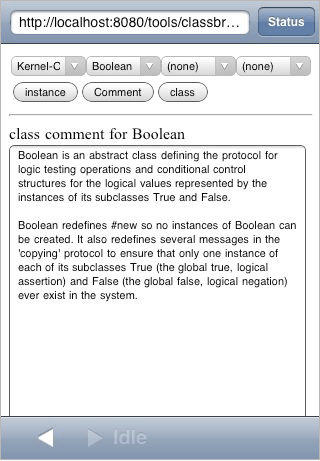
    Following his success in getting Squeak running on the iPhone last year, John M McIntosh has announced on the Squeak-dev mailing list that he has had two applications approved for the Apple iPhone and iPod Touch App Store.

    The two SqueakDocs electronic books, based on Squeak and Seaside, allow users to explore the code and documentation in two Smalltalk images: a 3.10.x Squeak web developer’s image, and a Pharo web developer’s image of late April 2009. They are now available for purchase on the App Store: Squeak version, Pharo version.

    The applications use Seaside to render the content to the built-in Safari browser, so they can also present content to other machines on the local network.

    John is still waiting for approval to come through soon for WikiServer, a “much more complex application,” which will allow users to view and maintain wiki content on their iPhones.

  • The Squeak Oversight Board is now blogging

    As a result of ongoing discussions with the Software Freedom Conservancy, the Squeak Leadership team have now adopted the formal name of the “Squeak Oversight Board”. The members of the new team have made clear and open communications one of their priorities, and to that end, have started up a new blog at board.squeak.org, where they will be publishing agendas and minutes of their monthly meetings.

    In keeping with their mission statement of “Communicating with the Squeak and greater Dynamic Languages Community”, the board will also be using the blog to encourage discussion about the direction and priorities of the Squeak community.

    And yes, the board members are fully aware of the double meaning of “oversight”.

  • Election results

    Göran has announced the election results to the squeak-dev mailing list.

    The new members of the leadership team are (in order of votes received):

    1. Andreas Raab
    2. Bert Freudenberg
    3. Craig Latta
    4. Randal L. Schwartz
    5. Ken Causey
    6. Igor Stasenko
    7. Jecel Assumpcao Jr

    Detailed results can be found at the election site.

    Congratulations to those elected, and commiserations to the other candidates, who were Matthew Fulmer, Edgar J. De Cleene, Brent Pinkney and David Mitchell.

    Thanks are due again to Göran for organising another election so effectively.

  • Don’t forget!

    You’ve only four more days to cast your votes for the Squeak Leadership Team elections—see previous post for details. If you’ve not received any voting details by now, check that you’re still accessing the account you registered with. If you haven’t registered yet, then it’s too late – but as Göran has said, there’s one of these every year!

  • Squeak Foundation Election 2009

    Vote badge

    As Göran posted recently, it is time to consider the membership of the Squeak Leadership Team (the “board”) for the coming year.

    Nominations are currently open for candidates interested in working with colleagues to maintain and co-ordinate the various interest groups and activities that support the Squeak community.

    If you think that you can make a difference to Squeak, put your name forward on the squeak-dev mailing list by 22nd February. All candidates are asked to make themselves available on the list for questions and discussion with the community until the end of February.

    Voting begins on 1st March for one week. If you’ve voted in previous elections, your name should already be registered. If not, then contact Göran explaining why you’re interested in voting (see the election page for more details).

    The list of candidates, and more details of the process to be followed can be found on the Election 2009 page.

  • Squeak 4.0 is coming…

    On Squeak Mailing list Matthew Fulmer just wrote  (we stressed some lines):

    […]
    Squeak 4.0 is within sight. With this release, the four-year
    relicensing project of the Leadership team will be complete. We
    will be able to incorporate under SFLC, and Pharo will be one
    step closer to a 1.0 release.

    Squeak 4.0 will be the first official squeak release with no
    code under SqueakL; everything in the .image, .changes, and
    .sources files will be under either the MIT license or the
    Apache license.
    […] 

    Are you ready for the Open  Squeak4?

  • Soup for Squeak

    squeaksoup

    Zulq Alam has been working on Soup, a Squeak port of Beautiful Soup, the tolerant HTML/XML parser written in Python, which is extremely useful when you need to scrape data from a web page. He has recently announced a working release and gave some example of its usage.

    Zulq notes that there’s still plenty of work to do on this port:

    • No attempt is made to deal with different character sets and encodings.
    • The parser will not convert entity or char references.
    • The parser will not accept options such as whether to convert entities, which entities to convert, what to parse, etc.
    • The parser will only do HTML; there are no configurations for other XML flavours yet.

    He adds that the project repository is globally writable, and he looks forward to your feedback and contributions.

  • Squeak goes to Mars

    mars

    Esteban Lorenzano gave Squeakers on Mac OS X a nice little Christmas present to see out 2008, with the release of Mars, an MVC framework for Squeak built using Cocoa. Mars is a plugin, and will run in any fork of Squeak, and as you can see above, is integrated with OmniBrowser.

    Esteban notes that one of his main objectives in developing Mars is to keep it small and simple, in order to allow it to be executed in small environments such as the iPhone, (using John McIntosh’s new VM and Edgar de Cleene’s SqueakLightII minimal images).

    Mars is MIT licensed, and can be downloaded from the Mars homepage, which also has posts following the progress of Esteban’s work. Esteban adds that Mars is still in the pre-alpha stage, and he looks forward to bug reports, feature requests, comments, and of course, code.