
Squeakfest 2012 in Uruguay and Argentina is coming up soon: 17 to 23 May in Montevideo and Buenos Aires. Attendees will have the opportunity to participate in introductory workshops, develop content for various curricular areas, learn about project development, educational robotics and other topics related to Squeak Etoys and the One Laptop Per Child project.
Category: Uncategorized
-
Zero Percent Failure
How many calls have you missed since 2009? For Childline, a child-crisis-hotline service in South Africa, that number has been zero. Squeak Oversight Board member Chris Muller developed a GIS module to provide real-time regional call routing for 4Dst’s “Awareness Engine” product. Explore the presentation he made at this year’s Smalltalk Industry Council convention. Squeak Smalltalk — good in a crisis.
-
Physical Etoys 2.0 released
Physical Etoys 2.0 has been released with lots of new features:
1. First of all, it’s based on Etoys 5.0 so it incorporates all the
bug-fixes and new features from the Etoys release.
2. It focuses on the two main hardware platforms: Arduino and
Lego Mindstorms Nxt.
3. An Argentinian version of Arduino is now supported called DuinoBot.More information available at http://tecnodacta.com.ar/gira/projects/physical-etoys/.
-
New Squeak Oversight Board elected
The leadership team for 20 April 2012 to – 20 April 2013 (approximately) has been announced after the regular voting period. The order reflects the ranking from the election using default Condorcet completion rules (Beatpath/Schulze/CSSD). As usual, the rules actually give the same top 7 choices in the same order. The is year’s Squeak Oversight Board is composed of:
1. Bert Freudenberg
2. Craig Latta
3. Colin Putney
4. Chris Muller
5. Randal Schwartz
6. Levente Uzonyi
7. Chris Cunnington -
Cuis 4.0 Released
Cuis 4.0 has been released. This is a big release for Cuis, as it has been ten months since the last version. Lots of new features are available including a StyledTextEditor by Bernhard Pieber. All the details are available at the Cuis website at http://www.jvuletich.org/Cuis/CuisReleaseNotes.html.
-
Call for papers for IWST in Edinburgh
Alain Plaintec has published the call for papers for the International Workshop on Smalltalk Technologies which will be held on 23rd August during the ESUG 2011 conference in Edinburgh. The goal of the workshop is to “create a forum around advances or experience in Smalltalk and to trigger discussions and exchanges of ideas”.
Participants are invited to submit short and not-so short research articles, of two kinds
- Short position papers describing emerging ideas.
- Long research papers with deeper description of experiments and of research results.
Contributions can be on a wide range of topics, including meta-programming and meta-modeling, new dialects or languages implemented in Smalltalk and experience reports.
Key dates:
- Submission: 17th June
- Feedback: 15th July
- Workshop: 23rd August
-
Squeak 4.1 in production use
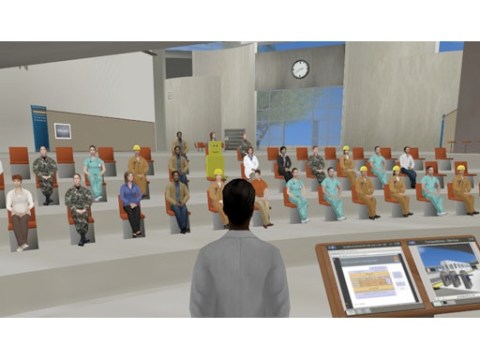
Andreas Raab noted on the Squeak-dev mailing list and on his blog that Teleplace have decided that Squeak 4.1 is sufficiently stable to use as the basis for their commercial software. They made the massive leap from 3.8 all the way to Squeak 4.1 in this release of their Teleplace Enterprise Server 3.5, which is used to host online collaboration environments.
It appears to have been a painless and successful activity, and is a massive vote of confidence in the ongoing changes to Squeak. If you want to see the new product in action, there’s a free trial version available at http://www.teleplace.com/trial/signup.php.
-
Workshop on Self-Sustaining Systems 2010
The Workshop on Self-sustaining Systems (S3) is a forum for discussion of topics relating to computer systems and languages that are able to bootstrap, implement, modify, and maintain themselves. One property of these systems is that their implementation is based on small but powerful abstractions; examples include (amongst others) Squeak/Smalltalk, COLA, Klein/Self, PyPy/Python, Rubinius/Ruby, and Lisp. Such systems are the engines of their own replacement, giving researchers and developers great power to experiment with, and explore future directions from within, their own small language kernels.
S3 will take place September 27-28, 2010 at The University of Tokyo, Japan. It is an exciting opportunity for researchers and practitioners interested in self-sustaining systems to meet and share their knowledge, experience, and ideas for future research and development.
See the conference website for details and deadlines.
-
ESUG 2010 Conference – in Barcelona

For the past 18 years, the European Smalltalk User Group (ESUG) has organised the International Smalltalk Conference, a lively forum on cutting edge software technologies that attract people from both academia and industry for a whole week. The attendees are both engineers using Smalltalk in business and students and teachers using Smalltalk both for research and didactic purposes.
This year’s conference will be held at Citilab-Cornellà in Cornellà, Barcelona, on 13th—17th September. As in previous years, this year’s edition of the largest European Smalltalk event will include the regular Smalltalk developers conference with renowned invited speakers, and a Smalltalk camp that proves fruitful for interactions and discussions.
This year will also see:
- the 6th annual Innovation Technology Awards where prizes will be awarded to authors of best pieces of Smalltalk-related projects
- an international workshop on Smalltalk and dynamic languages
- for the first time there will be a business day on Thursday 16th September 2010 with a focus on “Agile Development Processes and Smalltalk”
ESUG is sponsoring 10 free entrance tickets. To get a free ticket you should send a mail to the esug board (board@esug.org) with a subject of [ESUG 2010 Free entrance] + your name, with an small statement putting your case. Note that students can get free registration and hosting if they enrol into the the Student Volunteers program (see below).
You can support the ESUG conference in many different ways:
- Sponsor the conference. New sponsoring packages are described at http://www.esug.org/supportesug/becomeasponsor/
- Submit a talk, a software or a paper to one of the events. See below.
- Attend the conference! We’d like to beat the previous record of attendance (156 participants at Brest and 170 people at Amsterdam)!
Developers Forum: International Smalltalk Developers Conference
This year we are looking for YOUR experience on using Smalltalk. In addition, we are looking for tutorials. The list of topics includes, but is not limited to the following:
- XP practices
- Development tools
- Experience reports
- Model driven development
- Web development
- Team management
- Meta-Modeling
- Security
- New libraries & frameworks
- Educational material
- Embedded systems and robotics
- SOA and Web services
- Interaction with other programming languages
Submissions due on 1 July 2010
Notification of acceptance on 15 of July 2010
More information at http://www.esug.org/conferences/2010Innovation Technology Award
We are proud to announce the 6th Innovation Technology Awards. The top 3 teams with the most innovative software will receive, respectively, 500 Euros, 300 Euros and 200 Euros during an awards ceremony at the conference. Developers of any Smalltalk-based software are welcome to compete. This year you are asked to provide 3-5min videos explaining your entry. More information can be found at http://www.esug.org/Conferences/2010/Innovation+Technology+Awards
Student Volunteer Program
If you are a student wanting to attend ESUG, have you considered
being a student volunteer? Student volunteers help keep the
conference running smoothly; in return, they have free
accommodations, while still having most of the time to enjoy the conference. More information at http://www.esug.org/Conferences/2010/Student+Volunteers+program -
ESUG accepted for Google Summer of Code
Mariano Martinez Peck has announced that “We are incredibly proud to announce that ESUG was selected for the GSoC 2010.”
Mariano and his colleagues put a lot of time and effort into preparing a joint entry via ESUG for all Smalltalk-related projects, and pulled together a long list of wonderful projects, mentors and a cool website.
Although Google are still to confirm the exact number of projects that will be funded, Mariano would like to thank all the people who help them publishing project ideas, giving feedback on the submit text or the English. They will contact all the mentors again very soon to let you know the following steps.Maybe you are not aware of what our selection to this year GSoC really means for the Smalltalk community. And I wasn’t aware completely until few hours. Just to give you an example, even such big organizations like Ruby or PHP where not selected. From this viewpoint you can see what we have achieved.
Mariano makes a very clear case for the importance of this successful application:
“Some people said and still says that Smalltalk is old and that it is dead. Ok, we have been selected by the major Informatics and Software company all over the world.
“The point is that ESUG and the Smalltalk community was selected because of the seriousness mixed with passion of all the application, project and ideas. We have an incredible high quality list of ideas and mentors.
“We have a unique opportunity to show the rest of the world why we love Smalltalk, why it is much better than other alternatives, etc. So, we invite all of you to make this happens.”
 The Weekly Squeak