Category: Squeak

  • Squeak Video Tutorials, 74 and counting!

    Chris Cunnington reminded the Squeak-dev mailing list that for a while now he’s been creating video tutorials explaining aspects of Squeak. In fact he’s been working at this for so long that he now has over 70 videos available!

    The videos give snappy introductions to topics as varied as: using SqueakSource to download Squeak applications; the mysteries of the red, blue, and yellow mouse buttons; how to use morphs; and using Croquet to interact in 3D environments (as seen above).

    If you want to learn about Squeak, or to find out more about Squeak applications you’ve never used before, these are a great resource, so head over to Chris’ Smalltalk Medicine Show channel on YouTube. If you know of other great videos for newcomers to Squeak and Smalltalk, please let us know in the comments.

  • Squeak 4.1 released

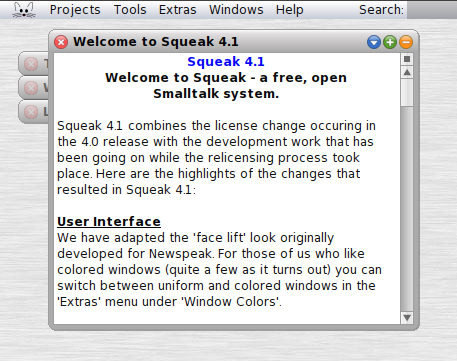
    Squeak 4.1 has now been released! This version combines the licence change occurring in the 4.0 release with the development work that has been going on while the re-licensing process took place.

    Much of the work in this release has been focused on fundamental improvements. Major achievements are the integration of Cog’s closure implementation, the improved UI look and feel, the new anti-aliased fonts, the core library improvements, and the modularity advances.

    One key focus for this release was to address the issues that have been known to frustrate developers using Squeak for the first time. A much improved set of UI widgets, the new menu bar including the fast search control, integrated help, improved test coverage, more class and method comments, and integrated syntax highlighting all make the system more accessible. The new full closures, the new traits implementation, multiple improvements to the collections and streams classes, the new NumberParser hierarchy all help make development easier and produce cleaner, faster code. Deploying your completed applications will be made easier by the work done on making many modules unloadable, and by support for other cleanup activities.

    To download the Squeak 4.1 release please visit http://ftp.squeak.org/4.1 or go to the squeak.org homepage and use the Download links on the right hand side.

  • Final preparation for 4.1 now under way

    Following the successful release of Squeak 4.0, which was the first version of Squeak to be cleaned of all non-open-source code, there was enthusiasm to quickly get the next release out of the door. This was driven by concerns that the long and difficult process of re-licensing and re-writing meant that many areas of the 4.0 release were a long way behind the current state of Squeak.

    As a result, there has been a concerted effort to move quickly to release version 4.1, incorporating many bugfixes, thorough test suites, much faster and cleaner code in many areas, the removal of obsolete code, and a much more consistent and clean user interface. It will also offer a much simpler and more robust installation process for new users.

    The work on preparing for the 4.1 release is now drawing to a close, but more help is still welcome! You can support the work by downloading the latest release candidate from http://ftp.squeak.org/trunk/ (and possibly the 4.0 sources file) and:

    • ensuring all tests are green,
    • contributing fixes for issues marked as critical for 4.1 on bugs.squeak.org (or any other fixes you’ve been hiding up your sleeves),
    • checking that your packages on SqueakSource and SqueakMap install correctly in the new version,
    • checking that the new Windows installation process works on your configuration,
    • and of course, keeping an eye on the squeak-dev mailing list to ensure that you’re not duplicating work.

    We expect a lot of interest in this new release, and want to ensure that we give new users a great first impression of Squeak. If you want to contribute to this work, now’s the time!

  • Call for students for Google Summer of Code

    Janko and Mariano who are co-ordinating the joint ESUG application to this year’s Google Summer of Code are now looking for students to apply for the thirty-five proposed projects. The process couldn’t be simpler: review the list of projects, and you can register your interest in projects with just one click once you’re registered. You can also contact the project mentors for more information.

    Note that this approach allows many students to register for each project, so if you want to improve your chances, make sure the project mentors can see why you would be the best choice for their project by editing your biography, and making sure that your contact information is up to date!

    You must register by 9th April, so get cracking!

    Any questions, visit the ESUG GSoC website, or contact the admins at esug.gsoc.adm2010@gmail.com.

  • Google Summer of Code – candidates needed at once!

    The Squeak community are working with ESUG to submit a joint entry to this year’s Google Summer of Code but need your help at once!

    Squeak participated in GSoC  in 2007 and 2008 but in 2009 Google started to focus on bigger communities, so Squeak developers are working with ESUG this year to put together a joint submission with other groups including open-source projects from all Smalltalk dialects, including Pharo, Smalltalk/X, GNU Smalltalk and Cuis as well as commercial distributions such as VisualWorks, VisualAge, Dolphin and Gemstone. Entries from cross-platform projects like Seaside, AidaWeb, Magma, etc. will also be welcome.

    Mariano Martinez Peck will administrate the joint application supported by Janko Mivšek. They need to supply Google with information about ESUG as a mentoring organisation and a list of ideas/projects,  each with a description and a nominated mentor. If their submission get selected by Google they will be told how many projects Google will sponsor — the mentor receives $500 and the student who volunteers to work on the projects will receive $4500.

    Due to a late start, they are very near to the first deadline! They have until 12th March 2010 to submit all the information of the mentor organisation and give the list of projects with mentors. So as a matter of urgency they need your projects. They’ve put together a webpage to hold details, so if you have project suggestions, send them a short title and a paragraph (for the moment) explaining the idea. You can also reply to Mariano’s email on most of the key developer mailing lists including the squeak-dev mailing list.

    Good mentors are often as hard to come by as good ideas, but often being helpful, being aware of the dates, answering emails, etc. can be more important than the Smalltalk knowledge, so if you’re able to act as a mentor or a back-up, let them know at once!

    For some inspiration, you can see the ideas proposed in previous years:
    2007: http://wiki.squeak.org/squeak/5936
    2008: http://wiki.squeak.org/squeak/6031
    2009: http://wiki.squeak.org/squeak/6120

  • Dynamic Web Development with Seaside

    Dynamic Web Development with Seaside

    A print-on-demand, softcover copy of the book “Dynamic Web Development with Seaside” is now available from Lulu.

    Seaside is an source framework for developing highly dynamic and interactive web applications, and makes building web applications as simple as building desktop applications. The book gives you all the instruction and support necessary to get up and running in all the popular distributions of Smalltalk, with separate chapters on Pharo and Squeak, Cincom Smalltalk, Gemstone/S, GNU Smalltalk and VASmalltalk.

    The printed book is based on the free online version and the purchasable PDF version of the book, and will be updated regularly. The book costs around €28/£24/$40 and will be delivered within 3-5 working days, so order your copy now!

    The authors wish to thank the European Smalltalk User Group (ESUG), inceptive.be, Cincom Smalltalk, Gemstone Smalltalk,  and Instantiations for generously sponsoring this book.

  • Squeak Board candidates wanted

    An Election Entertainment - Hogarth

    Göran Krampe has begun the process for this year’s elections for the Squeak Oversight Board.
    The Squeak Oversight Board (SOB) consists of seven members from our community, all of whom are elected by popular vote. The members are responsible for

    • building a legal presence – currently by working with the Software Freedom Law Center as part of their Conservancy;
    • providing the network services that support the various mailing lists and repositories that in turn make a community possible;
    • helping coordinate the various interest groups and projects being pursued by Squeakers;
    • making decisions where there is no clear community consensus.

    The current board members are:

    • Jecel Assumpcao Jr
    • Ken Causey
    • Bert Freudenberg
    • Craig Latta
    • Andreas Raab
    • Randal Schwartz
    • Igor Stasenko

    (From http://www.squeak.org/Foundation/Board)

    The schedule and process of the Election is as follows:

    Nominations

    Candidates should nominate themselves by 3rd March and start their campaign on the squeak-dev mailing list. Or if you nominate someone else, make sure that person really wants to run. Göran will not put anyone on the candidate list until that person makes it known on squeak-dev that he/she does run.

    Final candidate list

    The list will be closed on 3rd March. The candidates should ideally present themselves on squeak-dev, unless they have already done so, and the community can ask questions.

    Online election starts

    The voting period starts on 10th March 6PM (18.00 UTC) and is one week long. Ballots are sent out via email.

    Online election ends

    The voting process will end on 17th March 6PM (18.00 UTC). Results will be announced immediately when the election ends.

    Registering

    If you were invited to vote last year you are already on the voter list, no worries! If you are a new Squeaker and wish vote do ONE of the following:

    • Get a “known” Squeaker to vouch for you. If a known Squeaker sends an email to voters@squeak.org giving your name and email address then Göran will add you.
    • Send an email to voters@squeak.org yourself (and CC to squeak-dev if you like) with information/arguments showing that you are indeed serious about voting and that you are indeed a Squeaker.

    When the voting period starts all voters will receive an email with instructions and a link to the voting website.

    More information

    Everything about the election, including schedule above and more, can be tracked here:

    http://wiki.squeak.org/squeak/6150

  • Squeak on Android

    Andreas Raab has announced a new home for some work he’s been doing recently to port Squeak to the Android platform:

    http://code.google.com/p/squeak-android-vm/

    He’s aware that lots of things are still missing that would be required to support a full port (including text input and network support). But he’s still interested to hear if (and how well) it works for other Android-based cell phones. So if you have a Motorola Droid or or a T-Mobile G1 give it a shot and post some benchmark results.

    Andreas reports that “performance on the Nexus One is about what one would expect: With roughly 1M sends/sec and 30M bytecodes/sec it’s not exactly rocking but it’s quite usable for most tasks on a mobile device. (Input is *terrible* though; Squeak’s UI is not made for fat-fingered clicks like mine :-)”

    If you’d like to be added as developer, please send Andreas your Google Account email address so that he can add you to the project. But, he warns that “unless you know how to deal with both the Android SDK and NDK, Java, JNI, and the Squeak VM it will be a very steep learning curve”.

    (Of course, for those of us still using iPhones, there also John McIntosh’s iPhone port of Squeak.)

  • New Development Model, two months on.

    It has been two months since the Squeak Oversight Board first put forward their “New Community Development Model”. At the time the proposal caused a lot of heated debate on the squeak-dev mailing list, with concerns being expressed that similar efforts in the past had had little lasting impact, and had caused great frustration for those pushing those earlier efforts.

    The motives of the Board were to “get rid of as many hurdles as possible in the contribution process [and]  to enable the community at large to improve Squeak, the core of the system and its supporting libraries”.

    So, two months down the line, how’s it doing?

    If sheer volume is any criterion, it looks like a great success with over 500 packages uploaded as patches to 3.10.2 and over 40,000 downloads from the trunk (see bottom of the linked page for up to date statistics).

    The results of all this activity are available to use and test in the daily updated image published at http://ftp.squeak.org/trunk/ (needs a recent VM). If you want to contribute, you can add new patches at http://source.squeak.org/inbox/, or ask one of the current developers for access to the developers repository at http://source.squeak.org/trunk.

    If you just want to get an idea of what’s going on, check out the commit logs that are getting posted to the squeak-dev mailing list, and to the #squeak irc channel on freenode.

  • Magma goes HA!

    MagmaNode

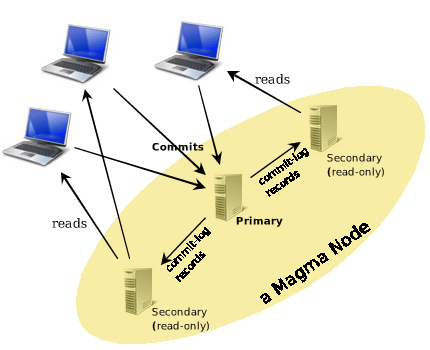
    Chris Muller announced release 42 of Magma to the Squeak-dev mailing list. Magma is a multi-user object database for Squeak and Pharo images and which provides transparent access to a large-scale shared persistent object model. Magma release 42 brings unprecedented scale and availability of persistent domain models to Squeak users.  In particular, a single logical repository can now be served from multiple servers simultaneously, each hosting their own physical copy which are kept constantly up to date automatically.

    There’s lots more information, introductory material and documentation at the Magma homepage.